Disclosure: As an Amazon Associate, I earn from qualifying purchases. This post contains affiliate links.
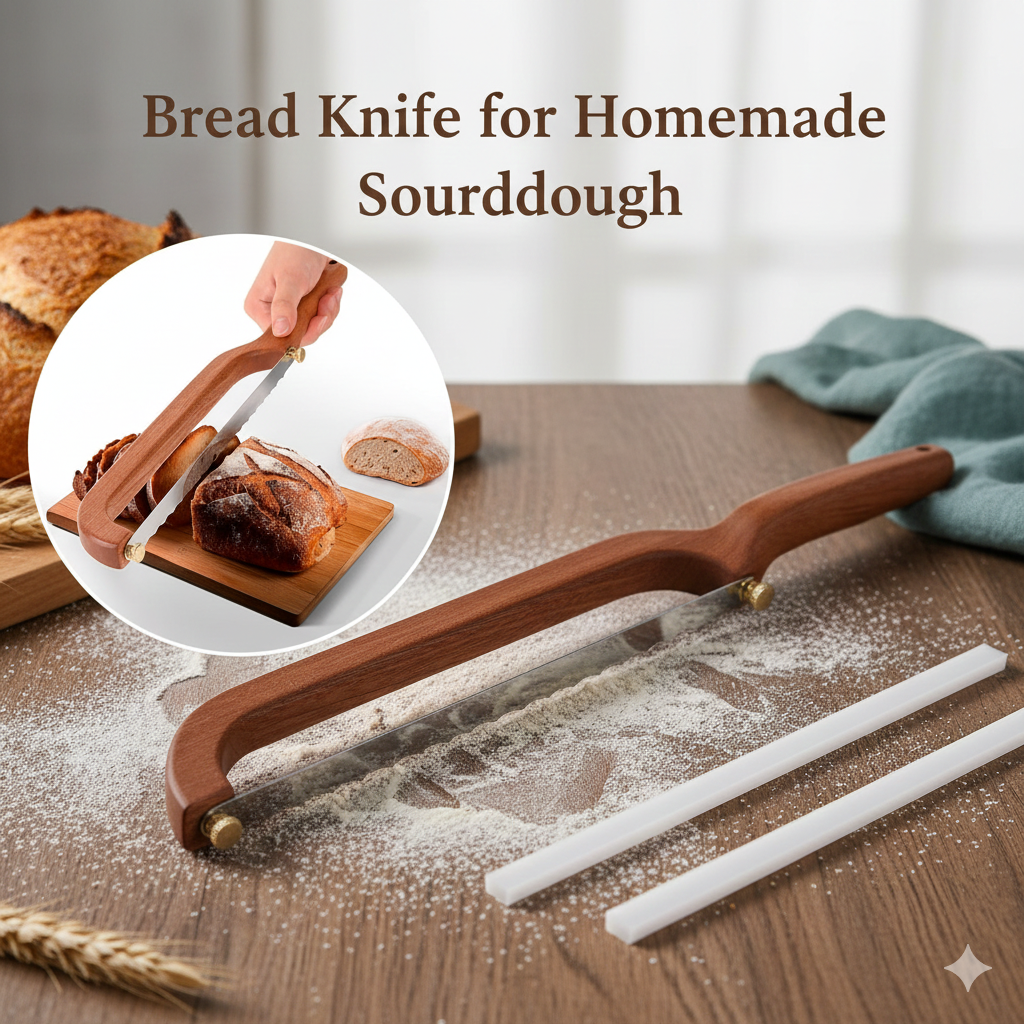
If you follow sourdough bakers on Instagram, you’ve seen it. That strange, beautiful wooden bow that looks like a violin but cuts bread like a laser.
It’s called a Bread Bow Knife (or “Bread Fiddle”), and it’s become a viral sensation.
But is it just an aesthetic gimmick, or does it actually solve a problem?
The answer: It solves the biggest problem beginners have—squishing the bread.
Quick Verdict: Pros & Cons
| Pros | Cons |
| No Squishing: The tensioned blade slices without downward pressure. | Height Limit: The wooden bar limits you from cutting massive 2kg+ loaves. |
| Straight Cuts: The wooden “bow” acts as a natural guide for even slices. | Sharpening: You cannot sharpen the blade (but you can replace it cheaply). |
| Aesthetic: Looks stunning on your counter (great for gifts). | Board Space: It is longer than a standard knife, requiring more drawer space. |
| Ergonomic: Easier to hold for people with weak grip strength. |
What IS a Bread Bow Knife?
Unlike a standard kitchen knife where the blade is thick and stiff, a Bread Bow Knife works on tension.
- It uses a very thin, flexible serrated blade (similar to a hacksaw).
- The wooden bow pulls this blade incredibly tight.
The Physics: Because the blade is so thin and tight, it creates almost zero friction. This means you don’t need to press down (which squishes your airy crumb); you just slide back and forth.
The “Squish Test”: Bow vs. Regular Knife
I tested this against my expensive $100 German chef’s knife on a fresh, crusty sourdough loaf.
| Feature | Regular Bread Knife | Bread Bow Knife | Winner |
| Motion | Push/Crush | Sawing/Gliding | Bow Knife |
| Crust Break | Often slips on hard crusts | Bites instantly due to thin teeth | Bow Knife |
| Evenness | Hard to keep straight | The wood guides your hand | Bow Knife |
| Versatility | Cuts melons, pumpkins, etc. | Only cuts bread/bagels | Regular Knife |
The Result: The regular knife required me to “saw” aggressively, which showered crumbs everywhere. The Bread Bow Knife felt like cutting through butter. The slices looked photo-perfect.
Important: Are You Left-Handed?
This is the number one thing people forget. Because the wooden bow acts as a guide, these knives are “handed.”
- The Good News: Most high-quality bow knives are reversible. You simply unscrew the blade, flip it over, and re-attach it.
- The Check: Before you buy, make sure the listing says “reversible blade” or “ambidextrous.”
Who is This For?
1. The “Aesthetic” Baker
Let’s be honest: It looks cool. If you gift loaves to friends or post photos online, having this knife next to your bread board is a major flex.
2. Beginners Who Can’t Cut Straight
We’ve all done it—started a slice thin at the top and ended up 2 inches thick at the bottom. The “Bow” shape naturally aligns your hand parallel to the cutting board, making it much easier to cut perfectly vertical slices.
3. People with Grip Issues
Because the handle is thick and you don’t need downward pressure, this is often recommended for bakers with arthritis or weaker grip strength.
The Only Downside: Vertical Clearance
I want to be 100% honest. There is one limitation. The “Bow” has a wooden bar above the blade.
If you bake massive, high-hydration “monuments” that are taller than 6 inches, the wooden bar might hit the top of the loaf before you finish the cut.
- Solution: It works perfectly for standard batards, boules, and sandwich loaves. Just don’t try to cut a giant 2kg miche with it.
Final Verdict
Is it a gimmick? No.
Is it absolutely necessary? No.
Is it the best way to slice sourdough without ruining the crumb? Yes.
If you are tired of spending 24 hours making a fluffy loaf only to smash it flat with a dull knife, this is the best $20 you will spend.