Quick Answer
Does toasting sourdough lower the calorie count?
Technically No, Metabolically Yes.
- The Physics: Toasting only removes water, so the total calories in the slice remain the same (~260 kcal/100g).
- The Biology: Toasting—specifically after freezing—converts digestible starch into Resistant Starch, which your body cannot absorb as sugar.
- The Result: You absorb roughly 30% fewer calories from a slice of frozen-then-toasted sourdough compared to fresh bread.
Does toasting bread reduce its calorie count? Technically, no. Metabolically, yes.
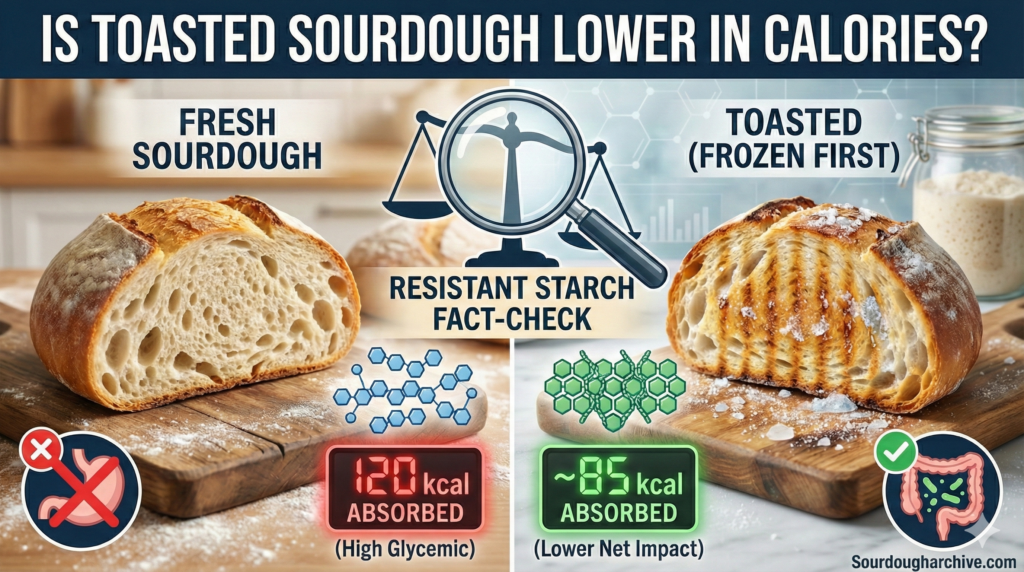
If you place bread in a bomb calorimeter (a device used to measure total energy), a toasted slice contains roughly the same number of calories as a fresh slice. The heat merely evaporates water, which has zero calories.
However, the human body is not a calorimeter. Toasting physically alters the molecular structure of the starch, converting a portion of it into Resistant Starch Type 3. This specific type of starch resists digestion in the small intestine and is not absorbed as glucose. Instead, it passes to the colon where it acts as a prebiotic fiber.
“Resistant starch is just one of several reasons sourdough supports fat loss — for the complete picture including GI, insulin response, and the second meal effect, see is sourdough good for weight loss.”
The Bottom Line: While the total energy in the bread remains constant (~260 kcal/100g), the absorbable energy decreases. By freezing and then toasting sourdough, you can reduce the glycemic impact by approximately 30-40%, effectively lowering the “net” calories your body stores.
The Short Answer: No (Technically), But Yes (Metabolically)
To understand why toasting helps weight loss, we must distinguish between Physics and Biology.
The Physics: Water Loss vs. Energy Loss
When you toast a slice of sourdough, the weight of the slice decreases significantly. This is due exclusively to water evaporation.
- Fresh Slice (50g): Contains ~120 calories.
- Toasted Slice (40g): Still contains ~120 calories.
- The Myth: Many people mistake the lighter weight for fewer calories. You are simply eating a more calorie-dense (drier) product.
The Biology: Bioavailability
In nutrition, “Bioavailability” refers to how much of a nutrient your body can actually extract. Raw starch is easily broken down by the enzyme amylase into glucose, which enters the bloodstream as energy.
- The Change: The heating and cooling process involved in toasting (especially if the bread was frozen first) causes the starch molecules to recrystallize.
- The Result: Your digestive enzymes cannot latch onto these crystallized structures. Therefore, a portion of the carbohydrates passes through you undigested. You ate the calories, but you did not absorb them.
The Science: How Heat Changes the “Calorie Math”
Most weight loss advice relies on the standard Atwater system, which assigns 4 calories to every gram of carbohydrate. This is an oversimplification that ignores the chemical state of the starch.
The “4 vs. 2.5” Rule
To calculate the true metabolic impact of toasted sourdough, you must adjust the caloric value based on digestibility:
- Digestible Starch: 4 kcal/gram. This is rapidly absorbed as glucose and spikes insulin.
- Resistant Starch: ~2.5 kcal/gram. This behaves like soluble fiber. It travels to the large intestine where gut bacteria ferment it into short-chain fatty acids (like butyrate).
The Calculation: If toasting converts just 10% of the digestible starch into resistant starch, you are effectively swapping “high-insulin” calories for “gut-health” calories.
The Sourdough Advantage (Acidity)
This process works better with sourdough than with white bread. The lactic acid produced during fermentation creates a low-pH environment. This acidity slows down starch gelatinization during baking, resulting in a more organized starch structure that undergoes retrogradation more efficiently. In short: Sourdough is biologically primed to become resistant starch.
Absorbability Chart
Here is how the “Net Impact” changes based on preparation method:
| Preparation Method | Bioavailability (Absorbability) | Insulin Spike |
| Fresh Sourdough | 100% | High |
| Toasted Sourdough | 75% | Moderate |
| Frozen + Toasted | ~65% | Low / High Satiety |
The “Double-Retrograde” Protocol: How to Maximize the Effect
Sourdough stales slower than white bread due to its acidity. This means a quick 20-minute freeze isn’t enough to trigger the crystal formation. You need a dedicated protocol.
Step 1: The “Counter Cure” (24 Hours)
Let the fresh loaf sit on the counter for a full day. This initial cooling period allows the starch network to settle.
Step 2: The Deep Freeze (48 Hours)
Slice the bread and freeze it for at least 48 hours. The extreme cold forces the amylose molecules to eject water and bind tightly together. This is the peak of retrogradation.
Step 3: The Toast
Toast the bread directly from its frozen state. Do not thaw it first. The rapid heat removes moisture, “locking in” the resistant starch structure before it can revert.
Evidence: The “Frozen Bread” Study
This isn’t just bio-hacker theory; it is backed by clinical data.
The Burton & Lightowler Findings (2008)
In a landmark study titled The impact of freezing and toasting on the glycemic response of white bread, researchers measured the blood sugar response of healthy adults eating bread prepared in four different ways.
- Fresh Bread: Baseline glucose spike.
- Toasted Bread: Lowered spike by ~25%.
- Frozen then Toasted: Lowered spike by 39%.
Real-World Data (CGM Experiments)
Bio-hackers using Continuous Glucose Monitors (CGMs) have replicated these results at home.
- Observation: Eating fresh sourdough typically causes a sharp “mountain” peak on a glucose graph.
- Observation: Eating the same amount of “Frozen-Toasted” sourdough creates a “rolling hill”—a lower peak that lasts longer, providing sustained energy without the crash.
Common Myths & Mistakes
Myth: “Reheating melts the crystals back into sugar.”
Fact: False. The retrograded starch in bread is Type 3 (Retrograded Amylose), which is thermally stable up to approximately 120-160°C (248-320°F). Normal toasting warms the bread but does not destroy the resistant structure. You would have to burn the bread to ash to break these bonds.
Myth: “Charring the bread reduces calories.”
Fact: Technically true (combustion consumes carbon), but dangerous. Burning bread creates Acrylamides, which are potential carcinogens. Aim for a “Golden Brown” toast. The risk of eating burnt food far outweighs the 5-calorie savings.
People Also Ask
Does this work with supermarket sourdough?
Less effectively. Supermarket “fake” sourdough is often airy and low-density. The crystal formation relies on the dense starch network found in traditional, slow-fermented bread. Authentic sourdough yields higher resistant starch levels.
How many calories does toasting actually save?
You should estimate a savings of 10-15 “effective” calories per slice. However, the bigger benefit is hormonal: by blunting the insulin spike, you keep your body in “fat burning” mode rather than “fat storage” mode.
Is stale bread lower in calories than fresh?
Yes. Staling is retrogradation. Stale bread has high levels of resistant starch. It is healthier, just less tasty. Toasting it (Step 3) fixes the taste/texture issue while preserving the health benefit.
Eat Your Toast (But Freeze It First)
Don’t fear the toaster. It is a tool that turns a high-carb food into a prebiotic fiber source. By treating your bread with temperature (Freezing + Toasting), you fundamentally change how your body metabolizes it.
You’ve mastered the “Freeze-Thaw” hack, but that is just one part of the equation. To get the maximum fat-burning effect, you must also time when you eat it. Read our guide on The Best Time to Eat Sourdough for Weight Loss to align your toast with your circadian rhythm.
Medical Disclaimer: The information provided in this article is for educational and informational purposes only and is not intended as medical advice or as a substitute for professional healthcare. Weight loss and metabolic health are highly individualized; therefore, you should consult with a physician or a registered dietitian before making significant changes to your diet, especially if you have pre-existing conditions like insulin resistance, diabetes, or digestive disorders. Never disregard professional medical advice or delay seeking it because of something you have read on this website.