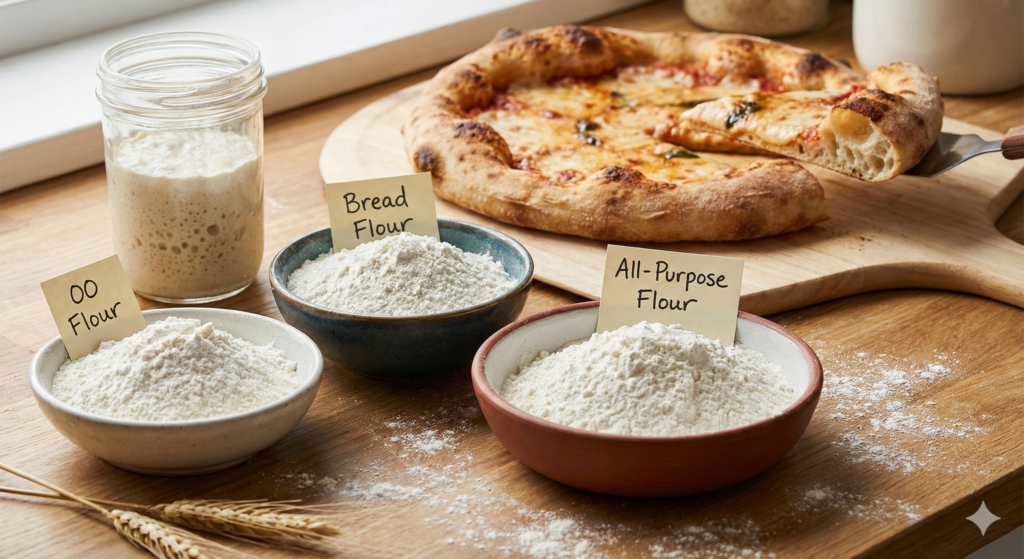
You have nurtured your starter, planned your bake schedule, and dreamed of that perfect, leopard-spotted crust. But here is the hard truth: you can have the most active starter in the world, but if you pick the wrong flour, your pizza foundation will crumble. While the starter is the heart of your dough, the flour is the skeleton.
Many home bakers assume they need “Tipo 00” flour because that is what the pros in Naples use. However, using that specific flour in a standard home oven is often a recipe for a pale, soft crust. The secret to achieving a chewy sourdough discard pizza dough lies in matching your flour’s protein content to your oven’s top temperature.
no matter which flour you choose, this pizza dough without yeast method works perfectly.
In this guide, we are going to move past the marketing labels on the bags. We will decode the science of protein percentages and gluten structure so you can confidently choose the “Big Three”—00, Bread, or All-Purpose—for your specific baking environment.
The Science of Sourdough Structure
To choose the right flour, you have to stop looking at the brand name and start looking at the nutrition label. Specifically, you are looking for one number: Protein Content.
In the world of baking, protein equals potential structure. When flour meets water, two proteins (gliadin and glutenin) combine to form the gluten network. Think of gluten as a microscopic net. The stronger and tighter this net is, the more gas bubbles it can trap during fermentation.
The “Sourdough Effect”
This structure is doubly important when working with discard. Sourdough is naturally acidic. Over long fermentation periods, specifically during cold retarding in the fridge, that acidity increases enzymatic activity (proteolysis). This activity literally cuts the gluten strands over time.
This is why standard “All-Purpose” flour can be risky for sourdough pizza. With a lower protein count (usually 10–11%), it starts with a weaker net. If you add the acid from the discard to a weak flour, by the time you bake, that net may be too degraded to hold gas. This results in a dense, flat puck rather than an airy crust. Using a higher protein flour acts as an “insurance policy,” providing a robust structure that can withstand the acidity.
Elasticity vs. Extensibility
Different flours balance two critical texture characteristics:
- Elasticity: This is the dough’s ability to “snap back” to its original shape. High-protein flours (12–14%) create a strong elastic network. This gives the pizza that satisfying “chew” and allows the dough to hold the weight of heavy toppings.
- Extensibility: This is the dough’s ability to stretch out easily without fighting you. If a dough is too elastic, it will shrink back like a rubber band every time you try to shape it. The goal is to find the perfect middle ground.
The Flour Face-Off: 00 vs. Bread vs. All-Purpose
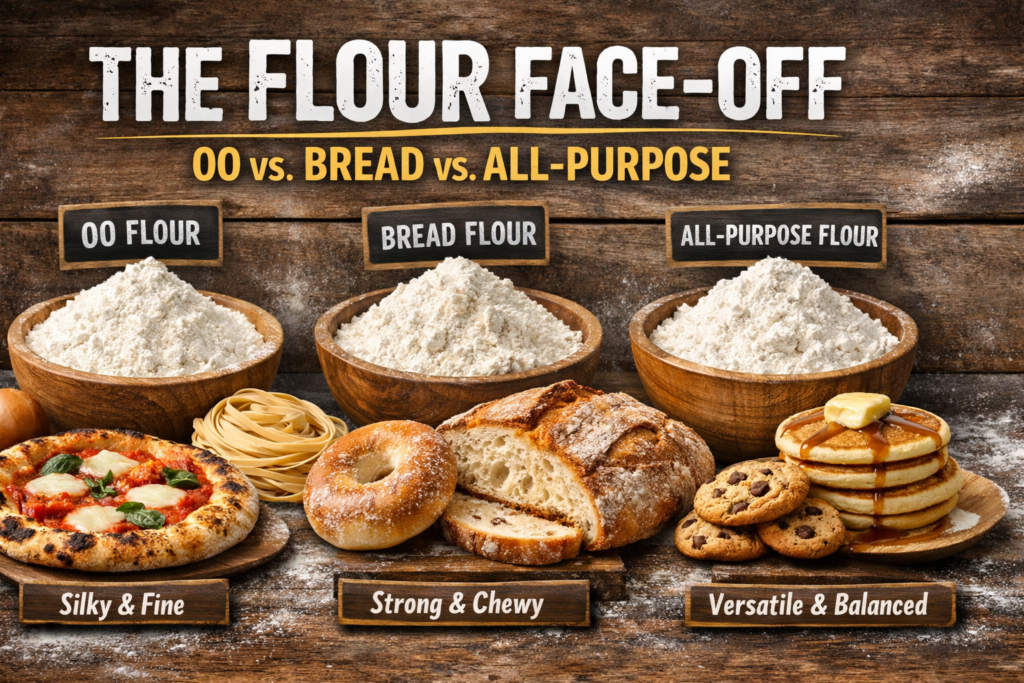
Now that you understand the science, let’s see how the three most common flours perform in the “arena” of your kitchen.
Tipo 00 Flour (The Specialist)
“00” refers to how finely the flour is milled (baby powder soft), not its protein content. It creates a beautifully extensible dough that is easy to shape. However, most 00 flours are unmalted, meaning they resist browning at lower temperatures.
- Protein Content: Varies (Usually 11-12.5%)
- Best For:
- Outdoor pizza ovens (Ooni, Gozney, Roccbox)
- Temperatures reaching 700°F – 900°F
- Neapolitan-style purists
- The Verdict: In a home oven (max 550°F), 00 flour often fails to trigger the Maillard reaction (browning). You will likely end up with a pale, dry, and soft crust. Unless you have a specific high-heat pizza oven, skip this.
Bread Flour (The Home Oven Hero)
If you are baking indoors, this is your champion. Bread flour is milled from hard red spring wheat and is designed to build massive structure. Crucially, most American bread flours contain malted barley flour, an enzyme that helps sugars caramelize at lower temperatures.
- Protein Content: High (12% – 14%)
- Best For:
- Standard home ovens (450°F – 550°F)
- New York Style pizza
- Long cold fermentations (24-72 hours)
- The Verdict: Bread flour delivers the “chew” essential for artisan pizza and ensures a golden-brown color even at 500°F. Its high protein content makes it strong enough to hold up heavy toppings without flopping.
All-Purpose Flour (The Risky Backup)
All-Purpose (AP) flour is designed to be “good enough” for cookies, cakes, and quick breads. It lacks the muscle required for a thin, structural crust.
- Protein Content: Moderate (10% – 11%)
- Best For:
- Pan pizzas (Cast Iron)
- Grandma-style pies
- Soft, fluffy focaccia
- The Verdict: For a thin-crust sourdough pizza, AP flour is risky. The lower protein combined with the acidity of sourdough discard can lead to a dough that tears easily when you stretch it. It yields a texture that is “biscuit-like” or soft, rather than crisp and chewy.
Expert Pro-Tips for the Perfect “Baker’s Blend”
If you want to bake like a pro, you don’t have to stick to just one bag. Here is how to manipulate your flour for artisan results.
- The “50/50” Magic Mix: If you find 100% Bread Flour too rubbery or tough to stretch, try mixing 50% Bread Flour and 50% 00 Flour. This gives you the strength and browning of the bread flour with the easy handleability of the Italian style.
- Watch Your Hydration: Not all flours drink water the same way. Bread flour has a higher hydration absorption capacity than AP flour. If you switch from AP to Bread Flour, your dough might feel dry. Don’t be afraid to add an extra 10–20g of water to get the right consistency.
- The Whole Wheat Warning: Want to add whole wheat for flavor? Keep it to under 20% of your total flour weight. The sharp bran flakes in whole wheat act like tiny razors, cutting your gluten strands and reducing the airy puff of your crust.
Frequently Asked Questions
Can I use bleached flour for sourdough pizza? Avoid it if possible. Bleached flour has been treated with chemicals (like benzoyl peroxide) to whiten it. These chemicals can inhibit the natural wild yeast and bacteria in your sourdough culture. Always choose unbleached flour for the healthiest fermentation.
Why is my dough tearing when I stretch it? This is usually a sign of low gluten development or degraded structure. It could be because you used a low-protein flour (like AP) that couldn’t handle the sourdough acidity, or you didn’t perform enough “stretch and folds” during the bulk rise.
Does the brand of flour matter? Yes. Generic store brands vary wildly in protein content batch-to-batch. Brands like King Arthur Baking Company or Bob’s Red Mill have strict specifications, ensuring that their “Bread Flour” is consistently 12.7% protein every time you buy it. Consistency is key for sourdough.
Can I add Vital Wheat Gluten to All-Purpose flour? Absolutely. If you only have AP flour in the pantry, you can “hack” it by adding 1 tablespoon of Vital Wheat Gluten per cup of flour. This artificially boosts the protein content, mimicking the strength of bread flour.
Final Thoughts
Choosing the best flour for sourdough pizza isn’t about buying the most expensive imported bag; it’s about matching the flour to your oven. If you are baking in a standard kitchen range, Bread Flour is your undisputed king, delivering the perfect balance of chew, structure, and browning.
Now that you know the science, grab a bag of high-protein flour and put it to the test. You will feel the difference in your hands the moment you start stretching the dough. Happy baking!