Disclosure: As an Amazon Associate, I earn from qualifying purchases. This post contains affiliate links.
Most people buy the Brod & Taylor Folding Proofer for sourdough. Then they realize it’s one of the most versatile low-temperature appliances in the kitchen — and the bread almost becomes the bonus. Here are 15 things you can make in it besides a loaf.
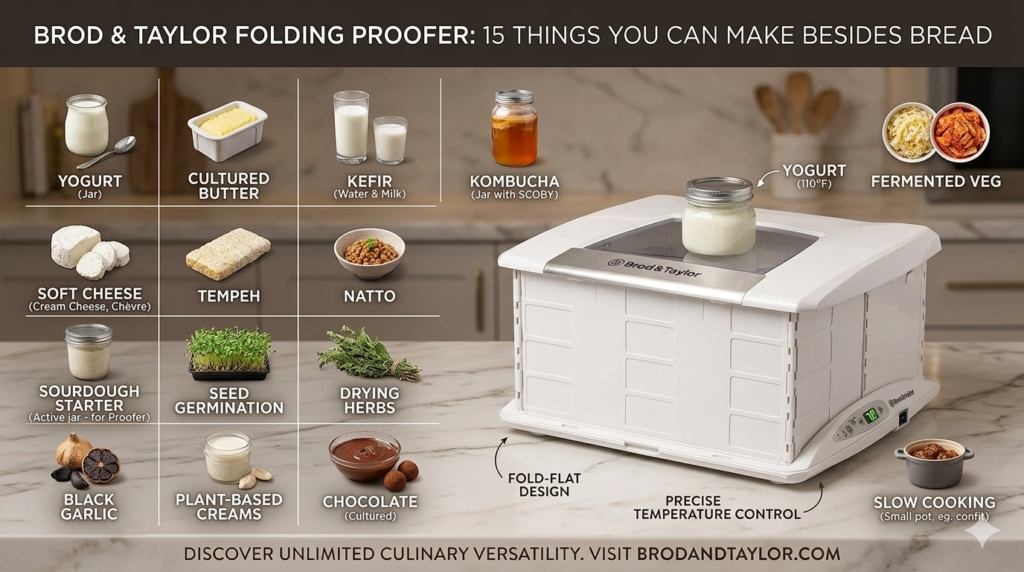
If you’ve been on the fence about the $200 price tag, this post might be what tips you over. The Folding Proofer has three operating modes — proofing mode, dry mode, and slow cook mode — and each one unlocks a completely different category of food. We cover all three below, with the exact temperature to set for each use case.
For the full breakdown of how the proofer works and whether it’s worth buying, see our complete Brod & Taylor Folding Proofer review. This post focuses entirely on the non-bread uses — the ones that turn a single-purpose baking tool into an everyday kitchen appliance.
Understanding the Three Modes
Before jumping into the list, it helps to know which mode each use requires. The setup is different for each one.
- Proofing Mode (with humidity tray): Rack in place, water tray filled. Best for anything that benefits from warm, humid air — dough, starters, cultured dairy.
- Dry Mode (no water tray): Rack in place, water tray removed. Best for culturing and fermenting foods in sealed containers — yogurt, kombucha, tempeh, kefir, natto.
- Slow Cook Mode (pot on base): Both rack and water tray removed. Your pot sits directly on the heating plate. Best for black garlic, bone broth, sous vide, and traditional slow cooking up to 195°F.
The 15 Things You Can Make
1. Homemade Yogurt
Mode: Dry Mode | Temperature: 110°F (43°C) | Time: 6–8 hours
This is the most common non-bread use by a wide margin, and for good reason. Yogurt needs to be held at a very precise 110°F for several hours without any temperature fluctuation — exactly what the proofer does effortlessly. The unit can hold up to 9 liters of yogurt per batch, which means you can fill multiple quart jars or a full stockpot in one go.
The math is compelling: a quart of store-bought Greek yogurt costs $5–8. A quart of homemade yogurt costs under $1 in milk. Most owners who start making yogurt in the proofer never go back to buying it. See our full guide to making Greek yogurt in bulk for the step-by-step method.
2. Black Garlic
Mode: Slow Cook Mode | Temperature: 140°F (60°C) | Time: 3–4 weeks
Black garlic is white garlic that has been held at low heat for weeks until the Maillard reaction transforms it into something entirely different — soft, jammy, deeply savory, and mildly sweet with no harsh bite. A tiny jar at a specialty store costs $15–20. Making it yourself from raw bulbs costs under $2 per head of garlic.
The reason this is nearly impossible without the proofer: your oven cannot hold 140°F reliably for weeks. The proofer can — and because it uses so little electricity (under $4 in energy for a full batch), it’s one of the most cost-effective things you can make in it. See our full guide on how to make black garlic at home without the smell.
3. Kombucha
Mode: Dry Mode | Temperature: 75–85°F (24–29°C) | Time: 7–14 days (first fermentation)
Kombucha ferments best between 75–85°F. In most kitchens, especially in winter, the ambient temperature is too low for consistent fermentation — the SCOBY gets sluggish, fermentation stalls, and the result is flat and overly sweet. The proofer holds the exact temperature your SCOBY needs without any monitoring or babysitting.
Simply place your kombucha vessel (covered with a cloth, not sealed) on the rack inside the proofer with the water tray removed, set to your target temperature, and let time do the work. The result is consistently tangy, properly carbonated kombucha on a reliable schedule.
4. Kefir
Mode: Dry Mode | Temperature: 70–77°F (21–25°C) | Time: 24–48 hours
Milk kefir grains culture at a slightly lower temperature than yogurt, making them tricky in cold kitchens — they either over-ferment into a separated mess or under-ferment into something too mild. The proofer gives you a stable warm environment so your kefir finishes in a predictable window with consistent tartness and texture every time.
5. Tempeh
Mode: Dry Mode | Temperature: 85–88°F (29–31°C) | Time: 24–48 hours
Tempeh is one of the most temperature-sensitive fermented foods you can make at home — the Rhizopus mold that binds the soybeans together is very particular about its range. Too cold and it won’t grow. Too hot and it overheats itself (the fermentation generates its own heat). The proofer’s steady temperature control makes home tempeh genuinely achievable, whereas most kitchens simply can’t maintain the precision required.
6. Natto
Mode: Dry Mode | Temperature: 100–105°F (38–40°C) | Time: 22–24 hours
Natto — fermented soybeans with a sticky texture and intensely savory flavor — is a staple of Japanese cuisine and one of the richest dietary sources of vitamin K2. It requires a very consistent high-warm temperature for about 24 hours that is essentially impossible to maintain without a dedicated appliance. The proofer handles this perfectly, and the cost savings versus imported natto are significant.
7. Sour Cream
Mode: Dry Mode | Temperature: 72–77°F (22–25°C) | Time: 12–24 hours
Culturing heavy cream with a mesophilic starter produces sour cream that is richer, fresher, and cleaner-tasting than anything from a grocery store carton. The process is simple — mix cream with a small amount of starter culture or existing sour cream, place in the proofer at a low-warm temperature, and wait. The proofer keeps it in the exact range where the bacteria culture without any risk of overheating.
8. Crème Fraîche
Mode: Dry Mode | Temperature: 70–75°F (21–24°C) | Time: 12–16 hours
Crème fraîche is the French cousin of sour cream — slightly less tangy, silkier, and with a higher fat content that means it doesn’t break when cooked. A small tub costs $5–8 at specialty grocery stores. Made at home in the proofer, it costs pennies. Spoon it over soups, stir it into sauces, or serve it alongside fresh bread from your last bake.
9. Soft Cheese (Fromage Blanc / Quark)
Mode: Dry Mode | Temperature: 72–77°F (22–25°C) | Time: 12–18 hours
Fresh soft cheeses like fromage blanc and quark are essentially thickened, cultured milk — and the proofer is ideal for the culturing stage. Warm the inoculated milk to your target temperature, place it in the proofer, and the culture does its work without any heat fluctuation disturbing the protein structure. Strain through cheesecloth and you have fresh cheese that pairs beautifully with the sourdough you’re already baking.
10. Fermented Hot Sauce
Mode: Dry Mode | Temperature: 75–80°F (24–27°C) | Time: 5–14 days
Lacto-fermented hot sauce — made by packing peppers in a salt brine and letting wild bacteria do the work — develops a depth of flavor that vinegar-based sauces can’t touch. The fermentation needs consistent warmth to proceed reliably without going too fast or stalling. The proofer holds that sweet spot while you ignore it for a week. The result is a complex, funky, living hot sauce that is alive in the same way your sourdough starter is.
11. Tempering Chocolate
Mode: Dry Mode | Temperature: 88–90°F (31–32°C) for dark chocolate; 84–86°F (29–30°C) for milk or white
Properly tempered chocolate — the kind that snaps cleanly and has a glossy finish — requires holding melted chocolate at a very specific temperature while stirring. The proofer keeps your bowl of melted chocolate at the exact working temperature indefinitely, giving you as much time as you need to dip, mold, or decorate without the chocolate seizing or cooling too fast. This is the use case that surprises most bakers, but chocolatiers who discover it swear by it.
12. Clarified Butter / Ghee
Mode: Slow Cook Mode | Temperature: 180–190°F (82–88°C) | Time: 2–3 hours
Making ghee requires gently simmering butter until the milk solids separate and can be skimmed off — a process that burns easily on the stovetop if the heat is too high. The slow cook mode of the proofer holds a steady, gentle temperature that makes the clarification process almost hands-free. Place a pot of butter on the heating plate, set the temperature, and check back in a few hours. The result is perfectly golden, nutty ghee without any scorching.
13. Bone Broth
Mode: Slow Cook Mode | Temperature: 185–195°F (85–90°C) | Time: 12–24 hours
Low and slow is the key to a deeply collagen-rich bone broth. The proofer’s slow cook mode holds a pot at just below simmering for as long as you need — no stovetop babysitting, no boiling (which clouds the broth and breaks down the gelatin structure). Place your pot directly on the heating plate, set the temperature to the upper range, and let it run overnight. The result gels solid when refrigerated, which is the mark of a properly made broth.
14. Sous Vide Cooking
Mode: Slow Cook Mode | Temperature: Varies by protein | Time: Varies
The proofer can function as a low-tech sous vide setup for small batches. Place vacuum-sealed or zip-lock bagged proteins into a water-filled pot sitting on the heating plate, set to your target temperature, and cook low and slow. It won’t replace a dedicated immersion circulator for precision, but for eggs, salmon, chicken breast, or pork tenderloin at moderate temperatures, it works well — and it’s one more reason the proofer earns its counter space.
15. Slow Cooker Meals
Mode: Slow Cook Mode | Temperature: 185–195°F (85–90°C) | Time: 4–8 hours
The proofer doubles as a full slow cooker for stews, braises, and one-pot meals. Place your Dutch oven or any covered metal pot directly on the heating plate, set to the upper temperature range, and cook as you would in a Crock-Pot. The advantage over a traditional slow cooker is degree-by-degree temperature control — you can dial in a lower setting for a more delicate braise, or push to maximum for a faster cook. And when dinner is done, the whole unit folds flat and slides into a drawer.
Quick Reference: Temperature Cheat Sheet
| What You’re Making | Mode | Temperature | Time |
|---|---|---|---|
| Yogurt | Dry | 110°F (43°C) | 6–8 hrs |
| Black Garlic | Slow Cook | 140°F (60°C) | 3–4 weeks |
| Kombucha | Dry | 75–85°F (24–29°C) | 7–14 days |
| Kefir | Dry | 70–77°F (21–25°C) | 24–48 hrs |
| Tempeh | Dry | 85–88°F (29–31°C) | 24–48 hrs |
| Natto | Dry | 100–105°F (38–40°C) | 22–24 hrs |
| Sour Cream | Dry | 72–77°F (22–25°C) | 12–24 hrs |
| Crème Fraîche | Dry | 70–75°F (21–24°C) | 12–16 hrs |
| Fromage Blanc / Quark | Dry | 72–77°F (22–25°C) | 12–18 hrs |
| Fermented Hot Sauce | Dry | 75–80°F (24–27°C) | 5–14 days |
| Tempering Chocolate (dark) | Dry | 88–90°F (31–32°C) | As needed |
| Clarified Butter / Ghee | Slow Cook | 180–190°F (82–88°C) | 2–3 hrs |
| Bone Broth | Slow Cook | 185–195°F (85–90°C) | 12–24 hrs |
| Sous Vide | Slow Cook | Varies by protein | Varies |
| Slow Cooker Meals | Slow Cook | 185–195°F (85–90°C) | 4–8 hrs |
The Real Cost Justification
If you use the proofer only for sourdough, it costs roughly $1.92 per bake in its first year (at 2 bakes per week). That’s already defensible when you consider the time and flour saved from failed loaves.
But layer in weekly yogurt making, a monthly kombucha batch, and even one black garlic project per season, and the math changes completely. The yogurt alone saves most households $20–30 per month versus buying it at the store. The proofer pays for itself in yogurt inside six months — before you count a single loaf of bread.
That’s the reason so many owners describe it as an “everyday appliance” rather than a bread tool. Once you see what it can do, it rarely gets folded away.
Frequently Asked Questions
Do I need to do anything different to switch between modes?
Yes — the setup changes depending on what you’re making. For proofing mode, the rack is in and the water tray is filled. For dry mode (culturing), the rack stays in but the water tray is removed. For slow cook mode, both the rack and the water tray come out and your pot sits directly on the heating plate. The controller itself works the same way across all three modes — you just set your temperature.
Can I make dairy-free yogurt in the proofer?
Yes. Soy milk yogurt works well at the same temperature as dairy yogurt (110°F). Coconut milk and oat milk yogurts also culture in the proofer, though they typically need a thickening agent like tapioca starch since plant milks don’t gel the same way dairy does.
Is the slow cook mode the same as a Crock-Pot?
Functionally yes, but with more precision. A traditional slow cooker’s “low” and “high” settings are fixed and often imprecise. The proofer lets you dial in the exact temperature you want in 1-degree increments, giving you much finer control over the cooking process — particularly useful for anything delicate like bone broth or sous vide.
Does making black garlic smell up the house?
It can, especially in the first week. The transformation process releases sulfur compounds that have a noticeable odor. Many bakers move the proofer to a garage, basement, or outdoor space for the first 7–10 days when the smell is strongest. After that, it mellows significantly. See our guide to making black garlic without the smell for specific tips on managing this.
Want to see everything the proofer can do for your actual bread? Start with our full Brod & Taylor Folding Proofer review — it covers the complete temperature settings guide, first-time setup, and the honest verdict on whether it’s worth the investment.
Related reading: How to make Greek yogurt in bulk · How to make black garlic at home · Best proofing boxes for sourdough