Disclosure: As an Amazon Associate, I earn from qualifying purchases. This post contains affiliate links.
Spending $200 on a kitchen appliance raises a fair question: how long is it actually going to last? This post compiles real owner experiences from 3, 5, even 10+ years of use — plus what the warranty covers, what breaks (rarely), and what to do if something goes wrong.
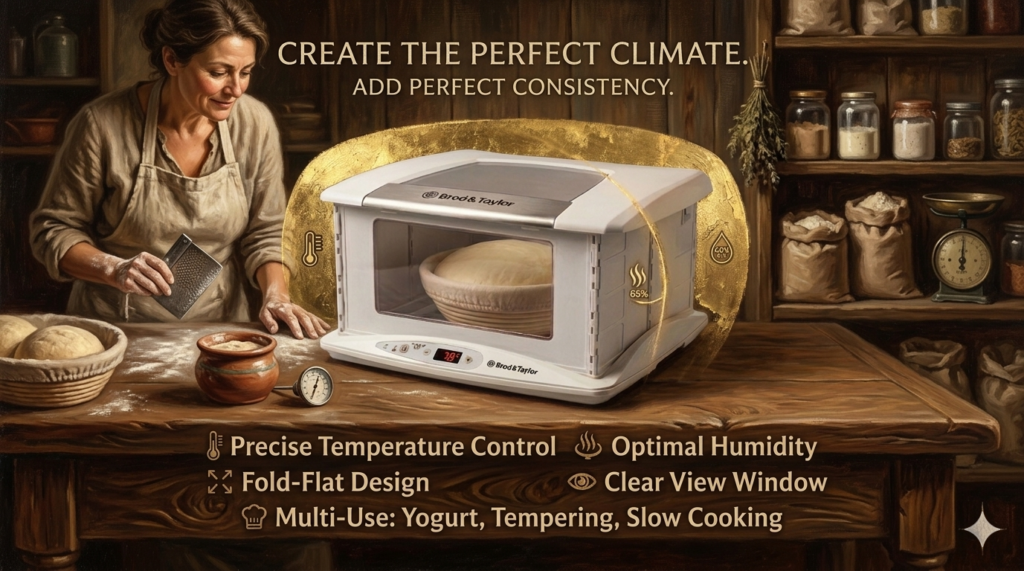
The Brod & Taylor Folding Proofer has been on the market since 2011 — long enough for a genuine multi-year ownership picture to emerge from the baking community. What that picture shows is unusually consistent: this is a product that tends to last, and when it does fail, the brand typically makes it right.
This post is for the baker on the fence about whether a $200 appliance is a smart long-term purchase — or whether it’ll end up in a drawer after two years. For the complete review of what the proofer does and whether it’s worth buying, see our full Brod & Taylor Folding Proofer review.
The Short Answer on Longevity
Most Brod & Taylor proofers run for 5–10+ years of regular use without failure. The product has been on the market since 2011 and owners from the original launch still report using their units regularly today.
This is not the typical answer for a consumer kitchen appliance. Most gadgets in this price range have a 2–4 year practical lifespan before a failure, a replacement part unavailability, or simple obsolescence ends their usefulness. The Brod & Taylor tells a different story — partly because of its simple design, and partly because of how the brand handles the rare failures that do occur.
Why It Lasts: The Design Argument
Before getting into community experiences, it helps to understand why this product tends to outlast comparable appliances. The answer is in what it doesn’t have.
The Brod & Taylor Folding Proofer has no fan, no pump, no compressor, no moving parts, no display screen, and no complex circuit board. It is fundamentally an aluminum heating plate with a thermostat and a simple digital controller — built into a collapsible plastic box. The fewer components a device has, the fewer things can break. A long-term owner on The Fresh Loaf community put it plainly: “Four years and it’s never broke. What’s to break? It’s a simple device.”
The heating element runs at very low temperatures — rarely above 90°F for proofing, occasionally up to 195°F for slow cooking — which means thermal stress on the components is minimal. Compare this to an oven or a stovetop that cycles to hundreds of degrees repeatedly. The proofer’s operating range is gentle by any electrical appliance standard.
The polypropylene walls are durable plastic that doesn’t corrode, rust, or degrade at the temperatures involved. The fold mechanism has been reported to remain smooth and functional after years of weekly assembly and storage.
Before you take our word for it, see the data for yourself. Sourdough expert FoodGeek ran a rigorous independent temperature test on the Brod & Taylor — measuring whether it actually holds the temperature it claims across a real fermentation session. This is the most useful pre-purchase video we’ve found because it answers the one question that matters most: does the dial actually match the dough? Watch the results below, then read on for our full breakdown.
Real Owner Experiences: What the Community Reports
We compiled feedback from The Fresh Loaf, Reddit’s sourdough communities, Facebook baking groups, and published long-term reviews. Here is an honest summary of what regular owners report after 3+ years of use.
3–4 Year Owners
Owners in the 3–4 year range are almost uniformly positive. The most common report is that the unit still performs identically to how it did on day one — holds temperature accurately, assembles quickly, and stores flat without the fold mechanism loosening or becoming difficult.
Several owners in this range report running the unit continuously for months at a time — particularly for sourdough starter maintenance — without any sign of wear or performance degradation. One reviewer who has owned their unit for over three years noted using it constantly, including for slow cooking overnight oats and dehydrating coconut, and reported that the temperature consistency remained reliable throughout.
The most common complaint at this stage remains what it was at purchase: the short power cord. This is a design decision Brod & Taylor has maintained across iterations, and most owners have resolved it with a short extension cord purchased separately.
5–7 Year Owners
Multi-year community threads going back to the product’s early years show owners still actively using their units at the 5–7 year mark. The Fresh Loaf forums, which have documented Brod & Taylor use since the product launched, contain multiple threads where longtime members report uninterrupted performance over this range.
At this stage, the most commonly mentioned wear item is cosmetic — light scratching on the base plate from years of pot contact in slow cook mode, and minor discoloration of the plastic walls from humidity over time. Neither affects performance. No structural failures of the fold mechanism have been widely reported in this ownership range.
10+ Year Owners
The Brod & Taylor proofer launched in 2011, which means original owners are now 14+ years into their ownership. Community evidence suggests a meaningful number of those original units are still in service. Northwest Sourdough’s Teresa Greenway — one of the original beta testers for the product — documented her use of the proofer from launch and has continued baking with Brod & Taylor equipment for well over a decade. This kind of long-term endorsement from serious bakers who’ve used the product continuously is the most credible data point on longevity.
At 10+ years, some owners have reported heating element failures — the most common mechanical issue cited when the proofer does eventually fail. These failures are not common, but they do happen in older units. The question at that point is whether Brod & Taylor will support an out-of-warranty unit — and the answer, based on community reports, is often yes.
When Things Do Go Wrong: The Warranty and Beyond
The 3-Year Warranty
The Brod & Taylor Folding Proofer comes with a 3-year warranty when registered at purchase. This covers manufacturing defects and component failures during normal use. Registration is done directly through Brod & Taylor’s website and takes a few minutes.
For context, most kitchen appliances in the $150–250 range carry 1-year warranties. The 3-year coverage is a meaningful differentiator and reflects the brand’s confidence in the product’s construction.
What Happens After the Warranty
This is where Brod & Taylor’s reputation genuinely stands out. Multiple community reports — across The Fresh Loaf, Reddit, and Facebook groups — describe the brand replacing or repairing units that failed after the warranty period expired, often without requiring the owner to argue for it. This is not a documented policy, but the pattern is consistent enough across years of community discussion to be meaningful.
The practical implication: if your proofer fails at year 4 or 5, it is worth contacting Brod & Taylor directly before assuming you need to purchase a replacement. The customer service experience has been described by community members as responsive and genuinely helpful — not the automated deflection common from larger appliance brands.
What Actually Breaks (And How Rarely)
Based on community reports across 14 years of ownership data, here is an honest breakdown of what fails and how often:
| Component | Failure Frequency | Notes |
|---|---|---|
| Heating element | Rare — primarily in units 8–10+ years old | Most commonly reported failure; Brod & Taylor often replaces even out-of-warranty |
| Temperature controller / display | Very rare | Occasional reports of display malfunction; usually resolved by warranty replacement |
| Fold mechanism / side panels | Extremely rare | No widespread structural failures reported; plastic holds up well |
| Water tray | Occasional cracking after years of use | Inexpensive replacement part available directly from Brod & Taylor |
| Power cord | Very rare | Short cord is a complaint but not a failure point; cord itself rarely breaks |
The pattern from 14 years of community data: most failures are heating element issues in older units. Everything else — the fold mechanism, the walls, the controller — tends to outlast the heating element by a wide margin.
How to Maximize Your Proofer’s Lifespan
The proofer is not a high-maintenance appliance, but a few habits will extend its useful life significantly:
Keep the Base Plate Clean
The aluminum base plate is the most important component. Spills — especially from yogurt, bone broth, or anything acidic — should be cleaned promptly with a damp cloth. Do not immerse the base unit in water. Brod & Taylor recommends placing a sheet of aluminum foil on the base plate before use in slow cook mode to catch any drips from the pot, making cleanup simple and protecting the plate from direct contact with food residue.
Don’t Insulate the Outside
Some bakers try to wrap the proofer in towels in winter to “help” it hold temperature. This backfires — the thermostat is calibrated for the unit’s standard thin-walled environment, and adding external insulation causes the internal temperature to overshoot significantly, putting unnecessary stress on the heating element cycling. Use the proofer as designed in a standard indoor environment.
Store It Properly
The fold mechanism is designed for regular use, not storage stress. When folded flat, don’t stack heavy items on top of it. The walls are durable but not rated for weight-bearing storage. Most owners slide it into a kitchen drawer or cabinet standing on its side — the 2.75″ profile makes this easy.
Register Your Warranty Immediately
This sounds obvious but it’s easy to forget. Register directly at Brod & Taylor’s website within a few days of purchase. The 3-year warranty is tied to registration, not purchase date in isolation, and you’ll want the documentation if you ever need to make a claim.
Use It in a Stable Indoor Environment
The proofer performs best and lasts longest in a standard heated indoor space. Using it in a cold garage or basement — where ambient temperatures drop below 50°F — causes the heating element to work harder and cycle more frequently, which accelerates wear over time. For indoor kitchen use, this is a non-issue.
The Long-Term Cost Math
At $200 and a realistic useful lifespan of 8–10 years for a baker who uses it weekly, the proofer works out to roughly $20–25 per year of ownership. Over 10 years at 2 bakes per week, that’s about $0.19 per bake — before counting yogurt, black garlic, and any other non-bread uses.
Compare this to the budget knockoff scenario: a $60 unit that lasts 2–3 years before failing, purchased twice over the same period, comes to $120 with two rounds of setup, learning, and potential mid-fermentation failures. The Brod & Taylor’s longevity advantage compounds over time.
It also compares favorably to other major baking investments. A good Dutch oven costs $100–350 and lasts decades. A stand mixer costs $400–600 and lasts years with maintenance. The Brod & Taylor sits in the same category of purpose-built tools that pay for themselves through consistent, reliable performance over a long horizon.
Frequently Asked Questions
How long does the Brod & Taylor proofer last?
Based on community data spanning the product’s full 14-year market history, most units last 5–10 years of regular weekly use without failure. Some original 2011 units are still in service. Heating element failure is the most common end-of-life issue and tends to appear in units that are 8–10+ years old. Brod & Taylor frequently replaces units that fail near or after the warranty period, so even when failure occurs the outcome is often a free or discounted replacement.
What does the 3-year warranty cover?
The warranty covers manufacturing defects and component failures under normal use conditions. It requires product registration through Brod & Taylor’s website at the time of purchase. Damage from misuse, liquid submersion of the base unit, or external modifications is not covered. Contact Brod & Taylor directly at contact@brodandtaylor.com for warranty claims — community reports suggest the response is typically prompt and helpful.
Is it safe to leave on 24/7 for extended periods?
Yes — Brod & Taylor explicitly states the proofer is designed and tested for unattended continuous operation. Many owners run it non-stop for months at a time during winter for starter maintenance. The low operating temperatures (typically 75–82°F for proofing) mean the heating element cycles on and off gently rather than running at sustained high heat, which contributes to its long-term reliability.
Can I get replacement parts if something breaks?
Yes — Brod & Taylor sells replacement parts including the water tray and wire rack directly through their website. For heating element or controller issues, the brand typically replaces the full unit rather than offering component-level repair, which is standard practice for appliances in this price range. Contact their support team for part availability on specific components.
What’s the most common thing that fails?
Heating element failure is the most commonly cited issue in long-term ownership reports, and it primarily appears in units that are many years old. The water tray occasionally cracks after extended use and is available as a replacement part. The fold mechanism, side panels, and controller are rarely reported as failure points. In the short to medium term (1–5 years), failure reports are uncommon enough that longevity should not be a significant concern for most buyers.
What do I do if my proofer stops working?
First, check the basics: confirm it’s in Proofer mode rather than Slow Cook mode (which has a minimum of 85°F), verify the display is not showing an error code, and check that the power connection is secure. If the unit is not heating at all, contact Brod & Taylor at contact@brodandtaylor.com. If you’re within warranty, they will handle the replacement. If you’re outside warranty, community experience suggests it is still worth reaching out — multiple owners have received replacements or assistance after their warranty period ended.
Ready to take the next step? Read our full Brod & Taylor Folding Proofer review for the complete verdict, or check our breakdown of whether the Brod & Taylor Proofer is worth the investment.
Related reading: Brod & Taylor vs. cheap knockoff proofers · Temperature settings cheat sheet · 15 things you can make besides bread