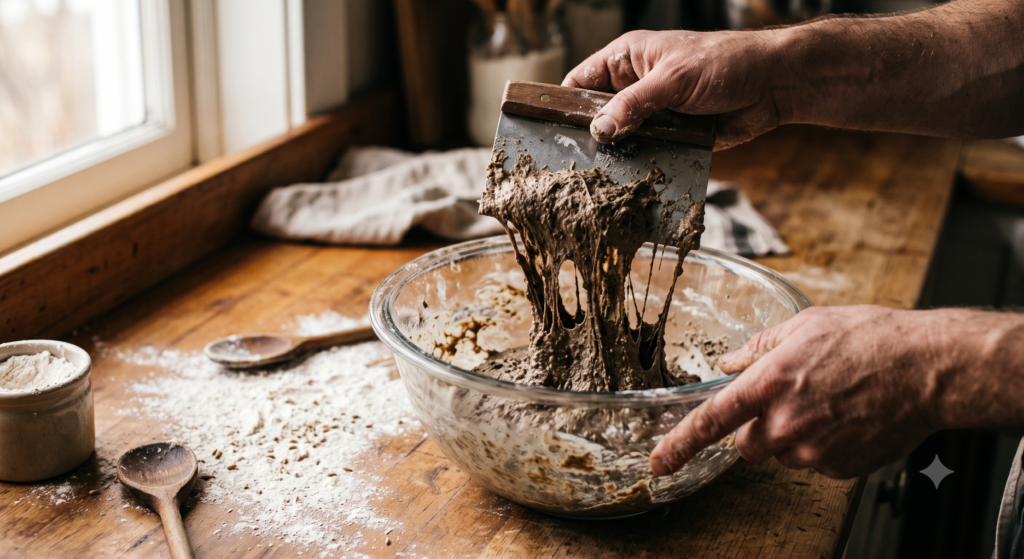
If you’ve searched this question and landed on general sourdough troubleshooting advice — longer autolyse, more stretch and folds, check your gluten development — that advice is built for wheat dough, and most of it doesn’t apply to rye at all. Rye has little to no gluten-forming capacity, so techniques designed to “develop” gluten can’t fix rye stickiness, because there’s no gluten network to develop in the first place. This guide separates normal rye stickiness (which is structural, not a mistake) from the handful of real problems that actually need fixing.
This is one spoke in our full rye sourdough bread recipe guide, which covers the rye percentage and hydration framework referenced throughout this post.
It’s worth saying upfront: almost everyone who bakes rye for the first time hits this exact moment — a dough that looks, feels, and behaves nothing like the wheat sourdough they’ve gotten comfortable with, sitting in the bowl looking more like wet mortar than bread dough. That reaction is so common precisely because most sourdough content online is written for wheat, and the fixes it recommends genuinely don’t translate.
Why Generic Sourdough Advice Doesn’t Work Here
Wheat dough gets sticky when its gluten network is underdeveloped — an autolyse rest and stretch-and-folds build that network and the dough tightens up. Rye dough’s structure comes from a completely different source: pentosans, a type of soluble fiber that forms a sticky gel when hydrated. Autolyse and folding don’t build a gluten network in rye because rye barely has one to build. This is why so many bakers follow standard sourdough troubleshooting steps, get frustrated when nothing changes, and conclude they’re doing something wrong — when really they were solving for the wrong mechanism entirely.
Once you understand that rye stickiness comes from pentosan gel rather than a hydration or gluten problem, the diagnostic question changes from “how do I fix this” to “is this the amount of sticky I should expect, or more than that?”
Step 1: Check Whether Your Stickiness Matches Your Rye Percentage
The single most useful diagnostic question is whether your dough’s stickiness is proportional to how much rye is in it. Our rye percentage framework breaks down what’s normal at each level:
| Rye % | Normal Handling | When Stickiness Is a Red Flag |
|---|---|---|
| 10–20% rye | Handles almost like wheat sourdough — shapeable by hand with light flour dusting | If it’s sticking heavily to your hands and the bench even with proper technique, something else is off |
| 30–40% rye | Noticeably tacky, needs wet hands, but holds a boule or batard shape | If it won’t hold any shape at all and spreads flat, treat as a real problem |
| 50–70% rye | Paste-like, not hand-shapeable at all — pouring into a pan is correct, not a failure | Trying to hand-shape this range and failing isn’t a stickiness problem, it’s a technique mismatch |
| 90–100% rye | Wet-mortar texture, mixed with a spoon, always pan-baked | This level should never be hand-shaped; expecting otherwise is the actual issue |
If your dough’s stickiness matches its rye percentage on this table, you don’t have a problem — you have normal rye dough, and the fix is technique (below), not more water or more folding. The full hydration math for each level is covered in the rye sourdough bread recipe guide.
Step 2: If It’s Stickier Than Expected, Check These in Order
1. Your flour type may not match your recipe’s assumption
“Rye flour” spans a wide range — light, medium, dark/whole, and pumpernickel all absorb water differently, with dark and pumpernickel absorbing significantly more than light rye. If a recipe was written for light rye and you used dark rye (or vice versa) at the same hydration, you’ll see a real mismatch. Whole grain rye also absorbs water more slowly than light rye, so a dough that seems too wet right after mixing sometimes tightens up considerably after 20–30 minutes as the bran finishes absorbing — don’t judge stickiness in the first few minutes after mixing.
2. Your dough may be overproofed, not just naturally sticky
Rye’s enzyme activity (particularly amylase) breaks down starches as fermentation progresses, and if bulk fermentation runs too long, those broken-down starches make the dough progressively wetter and gummier — a texture that’s easy to mistake for “just how rye is” when it’s actually a sign the dough went too far. Because rye ferments 30–50% faster than wheat, it’s easy to accidentally overshoot the bulk window, especially if you’re using wheat-dough timing as your reference point. If your dough felt normal at the start of bulk fermentation and got progressively wetter and slacker as time went on — rather than just consistently tacky throughout — overproofing is the likely cause, not the rye itself.
3. Your kitchen may be warmer than you think
Warm dough is stickier dough, full stop, and this effect is more pronounced in rye because warmth also accelerates the enzyme activity mentioned above. If your kitchen runs above 78°F, expect noticeably stickier handling than a recipe written and tested at 72°F, even at identical hydration. A brief 10–15 minute rest in the fridge can tighten a too-warm dough enough to shape without changing your formula at all.
4. Your rye flour may be old
Whole grain rye flour has a shorter shelf life than white flour because the oils in the bran and germ can go rancid, and it also loses some of its water-absorbing capacity over time. Flour that’s been open for many months can behave less predictably — sometimes absorbing less water than fresh flour, which shows up as extra stickiness even at a hydration that should be manageable. If you’re not sure how fresh your rye flour is, this is worth ruling out before adjusting your recipe.
5. You used a rye scald and didn’t let it cool enough
If your recipe includes a rye scald (boiling water poured over a portion of rye flour to gelatinize the starches), mixing that scald into the rest of the dough while it’s still hot will make the dough noticeably wetter and stickier than intended, since hot water further activates the gelatinization process beyond what the recipe accounted for. Let a scald cool to close to room temperature before incorporating it.
Fixing the Handling, Not the Recipe
Once you’ve confirmed your stickiness is within the normal range for your rye percentage, these are the actual fixes — none of which involve adding flour, which is the instinct almost everyone reaches for first and the one that causes the most downstream problems:
- Use wet hands, not floured hands or extra flour. Adding flour to a sticky rye dough dilutes your intended rye percentage and changes the entire loaf you set out to make. Keep a small bowl of water nearby and wet your hands between touches instead.
- Use a bench scraper for anything below 50% rye. A metal or stiff plastic scraper handles rye’s stickiness far better than hands alone for lifting, folding, and transferring dough.
- Switch to a pan above 50% rye, and stop trying to hand-shape it. This isn’t a workaround — it’s the correct technique at that hydration level. Scrape the dough directly into a greased loaf pan with a wet spatula.
- Use parchment paper for transfers instead of trying to slide a sticky shaped dough directly onto a baking surface — parchment eliminates the moment where most doughs stick and tear.
- Chill the dough briefly if your kitchen is warm. 10–15 minutes in the fridge firms up an overly warm, overly sticky dough enough to handle without changing hydration.
What Stretch and Folds Actually Do in a Rye Dough (and What They Don’t)
Since rye can’t build a gluten network, stretch and folds don’t develop structure the way they do in wheat dough — but they’re not useless either. In a rye blend (especially below 50% rye, where there’s still meaningful bread flour in the mix), folds help distribute the wheat flour’s gluten evenly and knock down some of the stickiness on the surface temporarily. Above 50% rye, folds do very little, and time spent trying to fold a paste-like high-rye dough is better spent just getting it into the pan.
Quick Diagnostic: Match Your Symptom to the Cause
If you’re still not sure which of the causes above applies to your dough, use this table to work backward from what you’re actually seeing:
| What You’re Seeing | Most Likely Cause | Fix |
|---|---|---|
| Sticky right after mixing, tightens up within 30 minutes | Normal — rye absorbs water slowly | No action needed, just wait |
| Consistently tacky throughout bulk fermentation, holds shape fine | Normal for your rye percentage | Use wet hands and a bench scraper |
| Started manageable, got progressively wetter and slacker over bulk fermentation | Overproofing — enzyme activity broke down starches | Shorten bulk fermentation time next bake, check kitchen temperature |
| Sticky, but also refuses to hold any shape at all and spreads flat | Hydration too high for your rye percentage, or flour type mismatch | Check your rye flour type against the recipe’s assumption, reduce water 2-3% next time |
| Fine yesterday, unexpectedly stickier today with the same recipe | Kitchen temperature shift, or flour freshness | Check ambient temperature, consider a fresh bag of rye flour |
| Extra wet specifically after adding a scald | Scald was still warm when incorporated | Let scald cool closer to room temperature before mixing in |
Preventing Sticky-Dough Surprises on Your Next Bake
A few habits make rye dough far more predictable from one bake to the next, especially if you’re baking the same recipe repeatedly and want consistent results:
- Weigh everything, including your starter. Rye’s water-absorption behavior is sensitive enough that even small measurement inconsistencies show up as handling differences bake to bake.
- Track your kitchen temperature, not just the clock. Two bakes at the same recipe and the same elapsed bulk fermentation time can behave very differently if one kitchen was 72°F and the other was 80°F — rye’s enzyme activity is temperature-sensitive enough that this matters more here than in a typical wheat dough.
- Buy rye flour in quantities you’ll use within a few months, and store it in an airtight container, ideally in the fridge or freezer if your kitchen runs warm — this preserves both its absorption behavior and its flavor.
- Note your rye flour brand and type when a bake goes well. Because light, medium, dark, and pumpernickel rye all behave differently, switching brands or types without adjustment is one of the most common causes of an otherwise identical recipe suddenly behaving differently.
- Resist judging a dough in the first 10 minutes after mixing. Rye’s slow water absorption means an early gut check is often wrong — give it the rest period before deciding anything needs fixing.
When Sticky Actually Means Something Went Wrong (Not Just Rye Being Rye)
To be clear about the difference: a rye dough that’s tacky, clings to your hands, and needs a scraper and wet hands to manage is completely normal and not a sign of error. A dough that’s genuinely gone wrong looks and behaves differently — it won’t hold any shape at all even loosely, it feels soupy rather than paste-like, it smells off (sour in an unpleasant, not tangy, way) rather than normal, or it failed to rise at all during bulk fermentation despite adequate time and temperature. If you’re seeing those signs rather than just general stickiness, the issue is more likely starter strength, fermentation timing, or a genuine recipe mismatch than a rye-specific quirk — worth troubleshooting as a fermentation problem rather than a hydration one. A young or under-fed starter is a common root cause; our how to make a rye sourdough starter guide covers what a properly active starter should look like before you mix it into dough.
Is a Slightly Sticky Rye Loaf Actually a Problem?
Not on its own. A rye loaf that was sticky in the bowl but shaped and baked without issue is not a failed loaf — rye dough is simply always going to feel different in your hands than a wheat dough, and that difference doesn’t disappear even in an expert’s kitchen. The questions that actually indicate a real problem are different ones: did the dough hold any shape at all, did it rise during bulk fermentation, and did the baked loaf have a reasonable (not gummy) crumb once fully cooled. If those three things went fine, the stickiness during handling was cosmetic, not a defect.
If your finished loaf came out dense in a way that seems off even accounting for rye’s naturally denser crumb, that’s a separate question from stickiness — our rye sourdough bulk fermentation time guide covers timing specifically, and if you’re unsure whether your loaf’s density is within the normal range for rye at all, is rye sourdough supposed to be dense walks through that distinction directly.
Frequently Asked Questions
Why does my rye dough feel different from wheat dough even at the same hydration percentage?
Rye’s structure comes from pentosans, a soluble fiber that forms a sticky gel, rather than from a gluten network. That gel behaves differently in your hands than gluten does — tackier and less elastic — even when the water-to-flour ratio on paper looks identical to a wheat dough. This is a structural difference, not a mixing error.
Should I add more flour if my rye dough is too sticky to handle?
Generally no — adding flour dilutes your intended rye percentage and changes the loaf you’re making. Use wet hands and a bench scraper instead, and only adjust your recipe’s flour-to-water ratio for your next bake, not mid-mix on the current one.
Why is my rye dough sticky even though I followed the recipe exactly?
The most common causes are flour type mismatch (light vs. dark rye absorb water differently), a warmer kitchen than the recipe was tested in, or slight overproofing from rye’s faster fermentation window. Check flour freshness and kitchen temperature before assuming the recipe itself is wrong.
Does stretch and fold help with sticky rye dough?
Only modestly, and mainly in lower-rye blends (below 50%) where there’s still meaningful wheat gluten to work with. Above 50% rye, folding does very little because there’s no significant gluten network to develop — a pan is the better tool than more folding.
Is it normal for 100% rye dough to be too sticky to shape by hand at all?
Yes — at very high rye percentages, a wet-mortar, unshapeable texture is expected and correct, not a sign of a mistake. These doughs are meant to be scraped into a pan, not hand-shaped, and trying to force a hand shape is the actual error, not the dough’s texture.
Can old rye flour make dough stickier?
Yes — rye flour that’s been stored a long time can lose some of its water-absorbing capacity and behave less predictably than fresh flour, which sometimes shows up as extra stickiness at a hydration that should otherwise be manageable.