
We have all been there. It is 2:00 PM, a craving for homemade pizza hits, and you realize you forgot to prep the dough yesterday. Every traditional sourdough recipe seems to demand a 24-hour timeline, leaving you staring at your jar of discard with regret. Do you have to wait until tomorrow, or can you cheat the clock?
The short answer is: yes, you can skip the overnight wait. While the slow-ferment method is famous for deep flavor, it is entirely possible to make a fantastic sourdough pizza that is ready for dinner tonight. You just need to understand how to swap “time” for “temperature.
If you’re in a rush, use this quick sourdough discard pizza dough to get dinner on the table.
In this guide, we will break down exactly how to adapt our standard no-yeast process into a streamlined 6-hour timeline. We will explore the science of ambient fermentation and show you how to get a bubbly, crispy crust without the long cold sleep in the fridge.
The Science: Cold Ferment vs. Ambient Fermentation
To successfully speed up sourdough, you need to understand what you are sacrificing when you skip the fridge. Sourdough fermentation is a biological war between two main actors: wild yeast and lactic acid bacteria (LAB).
The Role of Cold Fermentation
Traditionally, we put dough in the fridge (cold fermentation) to hit the “pause” button on the yeast. At 38°F (4°C), yeast slows down significantly. However, the bacteria remain active, producing acetic acid. This long, cold rest allows enzymes (protease) to slowly break down the gluten network, making the dough incredibly extensible (easy to stretch) and increasing the digestibility profile by degrading fructans.
The “Same-Day” Shift
When you move to a same-day timeline, you rely on ambient temperature fermentation. By keeping the dough warm (ideally 75°F – 80°F), you prioritize the yeast activity over the bacterial acidity. The yeast works faster in the warmth, producing carbon dioxide rapidly to give you the rise and airy crumb you want.
The Trade-Off
Because you are shortening the fermentation window, two things happen. First, the flavor profile will be milder and less “sour” because the bacteria haven’t had time to produce high levels of acid. Second, the gluten relaxation hasn’t happened naturally over time. This means the dough will be more elastic (springy). To counter this, we have to be more aggressive with our initial kneading to build the structure manually, rather than letting time do the heavy lifting.
Masterclass: The Same-Day Roadmap
Since we are compressing a 24-hour process into roughly 6 hours, precision is key. You cannot just leave this dough on the counter and hope for the best; you need to create an optimal environment for yeast reproduction.
The “Warm Spot” Hack
Yeast is a living organism that thrives in humidity and warmth. If your kitchen is a cool 68°F, your same-day dough will fail to rise by dinner. You need to create a makeshift proofing box.
- The Oven Method: Turn your oven light on (but keep the oven OFF). This usually keeps the inside chamber at a perfect 75°F-80°F.
- The Microwave Method: Place a cup of boiling water in the microwave, then place your bowl of dough next to it and close the door. The trapped steam and heat create a tropical environment that supercharges enzymatic activity.
Aggressive Gluten Development
In a long-ferment recipe, we often use “no-knead” techniques because the long soak hydrates the flour and organizes the gluten for us. On a same-day schedule, we don’t have that luxury. You must use mechanical gluten development.
- Kneading: Plan to knead by hand for at least 8-10 minutes, or use a stand mixer for 5 minutes. You need to pass the “windowpane test” before the bulk rise begins.
- Slap and Fold: If the dough is wet, use the “Slap and Fold” technique every 30 minutes for the first hour of the rise. This builds strength rapidly, ensuring your crust has the structure to hold air bubbles despite the shorter timeframe.
The 6-Hour Timeline
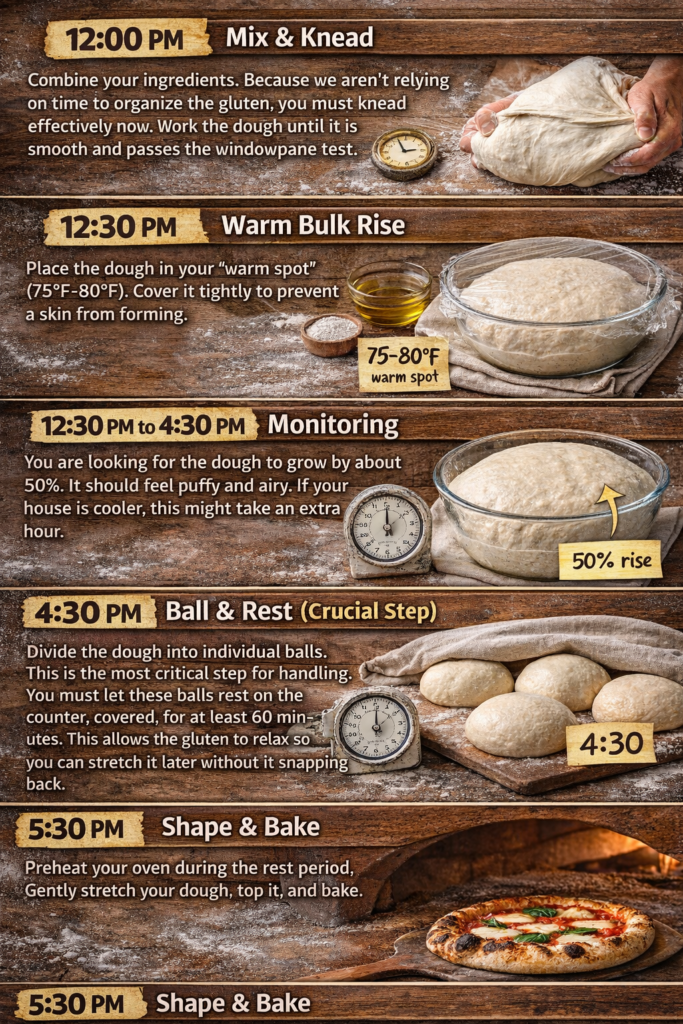
To pull this off, you need a schedule. Here is a realistic roadmap to get pizza on the table by 6:00 PM if you start at lunchtime.
- 12:00 PM – Mix & Knead: Combine your ingredients. Because we aren’t relying on time to organize the gluten, you must knead effectively now. Work the dough until it is smooth and passes the windowpane test.
- 12:30 PM – Warm Bulk Rise: Place the dough in your “warm spot” (75°F-80°F). Cover it tightly to prevent a skin from forming.
- 12:30 PM to 4:30 PM – Monitoring: You are looking for the dough to grow by about 50%. It should feel puffy and airy. If your house is cooler, this might take an extra hour.
- 4:30 PM – Ball & Rest (Crucial Step): Divide the dough into individual balls. This is the most critical step for handling. You must let these balls rest on the counter, covered, for at least 60 minutes. This allows the gluten to relax so you can stretch it later without it snapping back.
- 5:30 PM – Shape & Bake: Preheat your oven during the rest period. Gently stretch your dough, top it, and bake.
Expert Pro-Tips for Maximum Flavor in Minimum Time
Since you are skipping the flavor-building cold ferment, you need to use a few tricks to ensure your crust doesn’t taste bland.
- Use “Young” Discard: For a same-day rise, try to use discard that hasn’t been sitting in the back of your fridge for a month. Younger discard has more viable yeast populations, which ensures a faster, more vigorous rise during that short 4-hour window.
- The Flavor Injection: You lose the complex sourness of a 24-hour ferment, so compensate with ingredients. Add garlic powder, dried oregano, or a pinch of smoked paprika directly into the flour mixture. Brush the crust with garlic-infused olive oil immediately after baking to mimic that artisanal depth.
- Avoid the “Snap-Back”: Without the long cold rest, your dough will naturally be more elastic (springy) and less extensible. If you try to stretch it and it shrinks back to the size of a coaster, stop immediately. Cover it and walk away for 10 minutes. Forcing it will only tear the gluten structure.
Frequently Asked Questions
Is same-day sourdough dough harder to digest? Yes, slightly. The long fermentation process (24+ hours) is what breaks down the majority of fructans (carbohydrates) and gluten proteins. While a same-day sourdough pizza is still fermented and better than commercial yeast dough, it won’t have the full gut-friendly profile of a long-cold-fermented dough.
Can I use baking powder to “cheat” the rise? If you have zero time for a bulk rise (i.e., you need pizza in 30 minutes), you are entering “emergency dough” territory. You can add a teaspoon of baking powder to provide lift, but the texture will be closer to a biscuit or flatbread than a true chewy pizza crust.
Why is my dough resisting stretching? This is almost always due to insufficient resting time after balling. When you divide and shape the dough into balls, you tighten the gluten network. You need to give that network at least 45–60 minutes to relax again before stretching.
Will the crust still be crispy without the fridge? Yes! Crispiness is primarily a result of the Maillard reaction (browning) and proper oven temperature, not fermentation time. As long as you bake on a hot stone or steel at 500°F+, your same-day crust will crackle just like an overnight one.
Conclusion
The verdict is in: you absolutely can skip the cold ferment. While patience is a virtue in sourdough baking, sometimes hunger wins. By manipulating temperature to speed up yeast activity and using mechanical kneading to build structure, you can produce a delicious, airy same-day sourdough discard pizza that rivals the slow method.
So, don’t let a lack of planning stop you. Grab your discard, turn on the oven light, and get ready for pizza night—tonight.