Starter Mastery
Master your starter from Day 1.
A day-by-day guide to activating, feeding, and keeping a healthy sourdough starter. Learn to read peak ripeness by rise, dome, bubbles, and smell, so you mix dough when your starter is ready instead of when a chart says so.
- ✓1:1:1 feeding in grams and cups
- ✓What's normal and what's a red flag, day by day
- ✓Counter, fridge, and travel storage plans
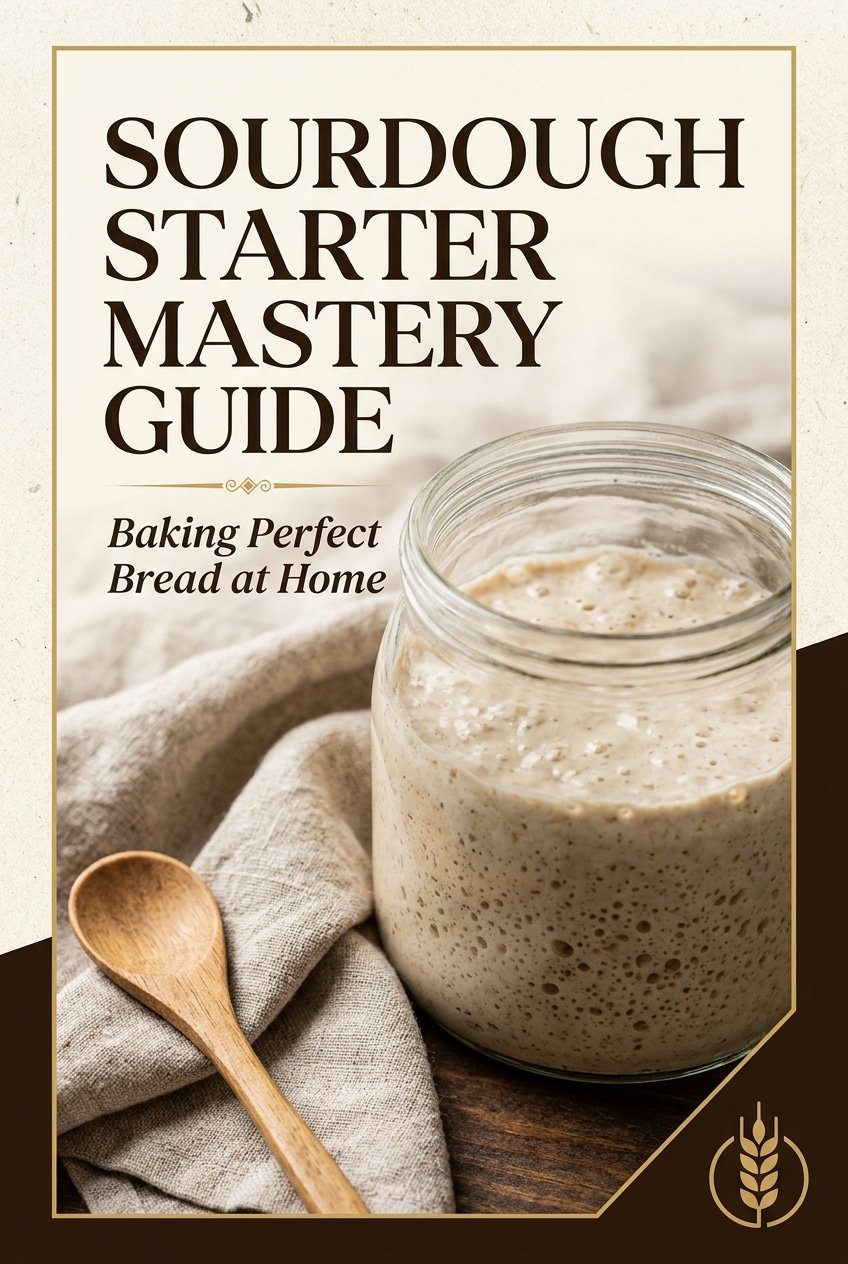
Your starter is sturdier than you think.
The three questions new starter keepers ask most, answered the way the guide answers them.
From flour and water to your first loaf
Each day is one page: what to do, what to expect hour by hour, the common worries for that stage, and a checklist with a line to log your time and temperature.


Know it's ready by looking at the jar.
The guide teaches four signs to confirm peak before you mix dough, then has you log the hours from feeding to peak in your own kitchen.
- 1 Doubled volumeSwollen 50–100% higher than the post-feeding mark.
- 2 Convex domeThe surface bulges upward slightly; not flat or caved in.
- 3 Frothy webbingA dense matrix of tiny bubbles visible through the glass.
- 4 Sweet yeast aromaSmells like ripe bananas, sourdough beer, or brioche.
Your first country boule
Day 7 covers the hydration math behind a starter-leavened loaf, a beginner's country boule, and a quick matrix for first-bake problems.
The starter counts toward your hydration
A 1:1:1 starter is 100% hydration. Every 100g you add brings 50g flour and 50g water with it, so the guide shows you how to subtract it when you build a formula.


More starter, faster bulk
The quick reference chart shows how much starter to use per 500g of flour, and how that changes bulk fermentation time and sourness.
The 4 laws of wild yeast
Real pages from the guide


15 pages, one per stage
A4, print-ready, and set up for a kitchen clipboard. Every day page ends with a checklist and a line to record your times.
- 01 Activate Your StarterYour first 24 hours: mixing and baseline expectations p. 4
- 02 The First FeedingRatios, water temperature, and timing p. 5
- 03 Watching for BubblesSigns of healthy vs. contaminated culture p. 6
- 04 Smell & Activity SignalsReading fermentation stages, hooch, and aromas p. 7
- 05 Feeding Routine Locked InThe 1:1:1 ratio, predictable peak, and timing p. 8
- 06 Storage & TemperatureFridge vs. countertop and seasonal shifts p. 9
- 07 Using Your Starter & First LoafHydration math, peak ripeness, and country boule p. 10
- 08 Troubleshooting & LongevityDiagnostics and long-term care systems p. 11
- 09 Master Quick Reference ChartRatios, temperature curves, and starter dosage p. 12
- 10 FAQ, Part 1Flours, timing, fridge storage, and how much starter to use p. 13
- 11 FAQ, Part 2 & GraduationDiscard uses, equipment, and 5 lifelong principles p. 14
- 12 Printable Fermentation LogA 12-day tracking grid for your kitchen counter p. 15
Questions bakers ask
How long does a starter take to activate? +
5–7 days with consistent 1:1:1 feeding in a 70–72°F room. In colder kitchens (below 65°F), full doubling can take 10–14 days. That is normal.
Is my starter dead if it hasn't changed in 3 days? +
Not necessarily. Below 65°F, slow waking is expected. Move the jar somewhere warmer, such as the top of the fridge or an oven with the light on, and feed 1:1:1 for 2–3 more days before deciding.
Can I use whole wheat or rye flour? +
Yes. Rye ferments noticeably faster; whole wheat slightly slower. A 50/50 blend of unbleached bread flour and whole rye makes a very vigorous culture.
Can I use a store-bought or dehydrated starter? +
Yes. Skip Days 1–3 and begin with the Day 4 feeding protocols. By Day 5 your reconstituted culture should be active and ready to bake.
Do I really need a digital scale? +
A 1g digital scale makes results repeatable. Flour density varies by about 25% depending on how tightly a measuring cup is packed. Cup measures are included, but grams are more accurate.
Starter Mastery
Eight days of feeding, watching, and logging, then a first loaf baked at peak. After that, a plan to keep your starter going on your schedule.
- ✓8 day-by-day chapters with checklists
- ✓Master quick reference chart
- ✓8-issue diagnostic matrix
- ✓17 FAQs answered
- ✓Printable 12-day fermentation log
- ✓15-page PDF, A4, 2026 edition