Quick Answer:
Sourdough lacks sourness when the fermentation environment favors mild Lactic Acid over sharp Acetic Acid. To maximize tang, you must trigger the “Heterofermentative Switch” by using a stiff starter (low hydration), incorporating whole grains (ash buffer), and maintaining the dough in the “Acetic Zone” (10°C–15°C) rather than a standard 4°C refrigerator.
The Biochemistry of Tang: It’s Not Just About “Time”
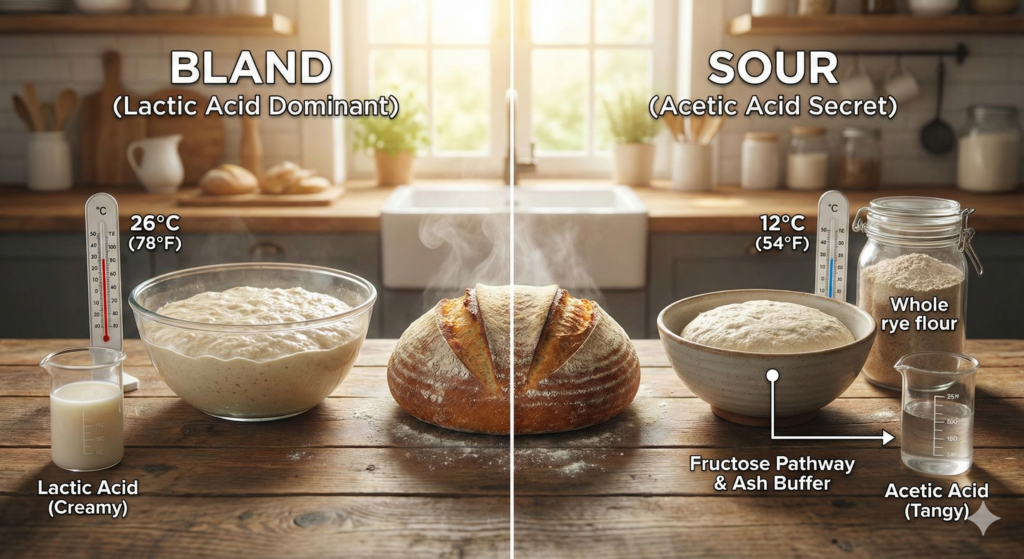
Achieving the signature “San Francisco” tang is not a matter of luck; it is a matter of metabolic engineering. Many home bakers operate under the false assumption that simply extending bulk fermentation will increase sourness. In reality, time is only one variable. Without controlling the specific ideal sourdough proofing temperature, your dough will default to a mild, creamy profile regardless of how long it sits.
To build a high-authority content silo, we must look at the microscopic level. The flavor of your bread is determined by the ratio of two organic acids produced by Lactic Acid Bacteria (LAB):
- Lactic Acid: Mild, creamy, yogurt-like notes (Result of Homofermentative metabolism).
- Acetic Acid: Sharp, vinegary, punchy notes (Result of Heterofermentative metabolism).
If your bread tastes “bland” or “milky,” your fermentation environment is heavily favoring Lactic Acid. To fix this, you must force the bacteria to switch metabolic pathways.
The Heterofermentative Switch
The dominant bacterium in sourdough, Fructilactobacillus sanfranciscensis, is obligately heterofermentative. This means it can produce acetic acid, but it requires specific environmental stressors to do so efficiently. When the dough is warm (24°C–28°C) and hydration is high (wet dough), the bacteria prioritize rapid growth and Lactic Acid production. This creates a high-volume loaf with very little tang.
The Fructose “Electron Acceptor” Pathway
This is the scientific mechanism most baking guides miss. F. sanfranciscensis prefers to use fructose as an external electron acceptor.
Metabolic Mechanism: When fructose is available (commonly found in the bran of whole wheat and rye), the bacteria utilize it to oxidize NADH back to NAD+. This electron transfer allows the bacteria to convert Acetyl-Phosphate into Acetic Acid (generating extra ATP energy) rather than Ethanol.
The Takeaway: If you feed your starter only white flour (which is low in available fructose compared to whole grains), you are starving the bacteria of the fuel they need to produce vinegar-like acidity.
The “Ash Buffer” Paradox (TTA vs. pH)
A common frustration is a loaf that contains whole wheat but still tastes mild. This is due to the Buffering Capacity of high-ash flours.
- Total Titratable Acidity (TTA): The total amount of acid present.
- pH: The strength of the acid (how sour it tastes).
Whole grain flours contain minerals (ash) that act as a buffer, neutralizing the acid as it is produced. This means a whole-wheat loaf requires significantly more acid production to drop the pH to a perceptible “sour” level (pH 3.5–3.7) compared to a white loaf. If you switch to whole grains for flavor but don’t extend the fermentation significantly, the “Ash Buffer” will mask the sourness entirely.
The Temperature Trap: Refrigerator vs. Root Cellar
The most pervasive myth in sourdough is that “putting it in the fridge” guarantees sourness. This heuristic is scientifically flawed.
Why 38°F (4°C) Stalls Flavor Development
Standard residential refrigerators operate at roughly 3°C–4°C (37°F–39°F). At this temperature, the metabolic activity of F. sanfranciscensis drops near zero—it enters a state of dormancy.
If you place your dough in the fridge immediately after shaping, you are not “slow fermenting”; you are “pausing.” The yeast stops rising, and the bacteria stop acidifying. The result is a cold, 48-hour loaf that tastes exactly the same as it did when it went in.
The “Acetic Zone” (50°F–60°F)
To maximize acetic acid, you need to hold the dough in the “Acetic Zone”—typically 10°C–15°C (50°F–60°F).
In this window:
- Yeast activity is significantly repressed (preventing over-proofing).
- Bacterial activity slows but remains active.
- Heterofermentative metabolism is favored due to the cold stress.
This is why traditional “cellar fermented” breads were sour—they were kept cool, but not fridge-cold.
Protocol: The “San Francisco Sour” Method
Standard open-crumb recipes are designed for lightness, not flavor. To get that signature tang, we have to stress the starter and manipulate the variables.
Step 1: The “Stiff Levain” Manipulation
Bacteria produce more acetic acid under osmotic stress (low water availability). Instead of your standard 100% hydration liquid starter, build a stiff starter.
- Ratio: 1:5:5 (Starter:Flour:Water) -> Change to 1:5:2.5
- The Build: 20g Starter + 100g Flour + 50g Water.
- Result: This dough-ball consistency forces the bacteria to work harder, shifting the metabolic output toward acetic acid.
Step 2: The Whole Grain “Spike”
You must provide the fructose electron acceptor.
- The Mix: Ensure at least 15%–20% of your total flour is Whole Rye or Whole Wheat.
- Why Rye? Rye is exceptionally high in pentosans and fructose, acting as “high-octane fuel” for the acetic acid pathway.
Step 3: The “Cellar Simulation” Technique
Since most of us do not have a root cellar, you must manufacture the 55°F environment.
- The Cooler Hack: Place your dough in a small picnic cooler with one frozen water bottle. This usually maintains a temp of 12°C–15°C for 12 hours.
- The Wine Fridge: If available, set a wine cooler to 13°C (55°F).
- Timing: Bulk ferment at room temp until 50% rise, then move to the “Cellar” environment for 12–18 hours.
The Metabolic Connection: Why “Sour” is Slimming
Understanding the acetic acid pathway isn’t just about flavor preference; it is about transforming bread from a high-glycemic starch into a functional food for metabolic health.
The presence of acetic acid in sourdough creates a biological phenomenon often cited in clinical literature as the “Vinegar Effect.” When you successfully engineer a high-acetic-acid loaf (using the protocols above), you are actively lowering the Glycemic Index (GI) of the bread through two powerful mechanisms:
- Delayed Gastric Emptying: High levels of acetic acid slow the rate at which food leaves the stomach. This means the carbohydrates enter the small intestine more slowly, preventing the rapid glucose spike associated with commercial yeast breads.
- Enzymatic Inhibition: Acetic acid has been shown to down-regulate the activity of disaccharidases (enzymes in your gut that break down complex sugars). Essentially, the sourness acts as a “metabolic brake,” forcing your body to digest the carbohydrates over a longer period.
The “Functional Food” Threshold:
If your sourdough is bland, it likely lacks the concentration of organic acids required to trigger these benefits. A mild, under-fermented loaf will spike insulin nearly as fast as conventional white bread. By controlling the fermentation temperature to maximize acidity, you aren’t just making tastier bread; you are engineering a food that supports insulin sensitivity and weight management.
Troubleshooting Bland Loaves (People Also Ask)
Why does my sourdough taste like regular bread?
You likely fell into the “Sweet Spot” trap. Fermenting at warm temperatures (24°C+) creates a “Sweet” sourdough profile dominated by lactic acid and mild yeast esters. To fix this, drop your fermentation temperature and lower the hydration of your starter.
Does adding vinegar to sourdough dough work?
Adding vinegar (acetic acid) directly to the dough is a common “cheat,” but it rarely works well. While it lowers the pH, it lacks the complex esters and aromatic compounds developed during fermentation. Furthermore, adding raw acid early in the mix can tighten the gluten structure prematurely, leading to a tough crumb.
How do I make my sourdough starter more sour?
“Starve” it slightly. Instead of feeding it twice a day (which keeps it sweet and active), feed it once every 24 hours at a ratio of 1:10:10. Allowing the starter to sit in its own waste products (acid) selects for acid-tolerant bacteria that are more aggressive in producing sourness.
Conclusion: Flavor is a Metabolic Choice
Sourness is not an accident; it is the biological outcome of specific stress vectors—hydration, ingredients, and temperature. By understanding the Fructose Pathway and the Ash Buffer, you can stop guessing and start engineering the flavor profile you desire.
If you are struggling to maintain the precise temperatures required for either the “Acetic Zone” or the “Sweet Spot,” you are likely fighting a losing battle against your kitchen’s ambient fluctuation.
If you want to master the metabolic variables of flavor, relying on your kitchen counter is a gamble. To reliably hit the “Acetic Zone” or the “Sweet Spot,” you need an environment that doesn’t fluctuate. Discover the tools that make this possible in our guide on the ideal sourdough proofing temperature
The Resource Library:
Sourdough in Winter: How to Bulk Ferment in a Cold Kitchen
High-Acid Sourdough: The Secret to High-Acid Sourdough
Medical Disclaimer:
*The content provided on this website is for informational purposes only and is not intended to be a substitute for professional medical advice, diagnosis, or treatment. Always seek the advice of your physician or other qualified health provider with any questions you may have regarding a medical condition or dietary changes.*