Quick Answer: How do you fix sourdough that won’t rise in winter?
Sourdough fails in cold kitchens because yeast activity drops faster than enzymatic gluten degradation (proteolysis). To fix this, use 105°F mix water to hit a Final Dough Temperature of 78°F, or utilize a Brod & Taylor Proofer to maintain a consistent environment. Simply adding “more time” often leads to gummy, over-proofed bread.
The “Cold Kitchen” Paradox: Why Winter Dough Fails
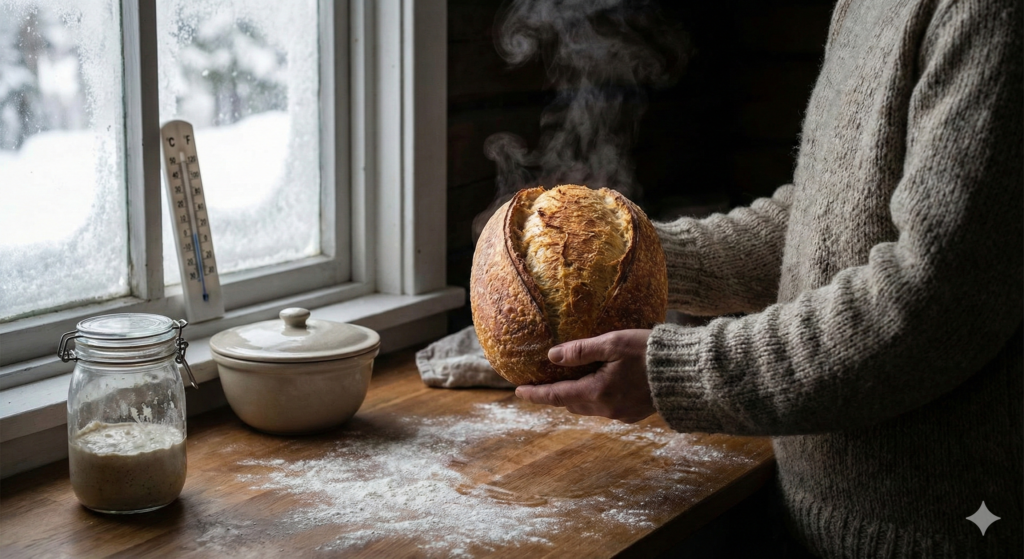
Most home bakers view winter fermentation as a simple game of patience. The assumption is that if the kitchen is 16°C (60°F), one simply needs to wait longer for the dough to double. This is a fundamental misunderstanding of fermentation kinetics.
Temperature is a catalyst that dictates which microbes and enzymes are dominant. In a cold environment, you aren’t just slowing down the process; you are fundamentally altering the biochemistry of your bread. While low-tech workarounds exist, my comprehensive Brod & Taylor proofer review details why precise temperature control is the only way to guarantee the specific pH thresholds required for optimal metabolic health and mineral bioavailability.
“Cold kitchens can mask acetone smell as fermentation slows, then produce it suddenly when temperatures rise — if you’re experiencing this cycling problem, the full diagnosis is in our guide on sourdough starter smells like acetone.”
Without thermal consistency, you risk the “winter flat-loaf”—a dense, gummy bread that failed not because it ran out of fuel, but because the fermentation engine was miscalibrated.
The Science of Thermophilic Fermentation
To produce bread that is gut-healthy and structurally sound, you must understand the microscopic “race” happening inside your bowl.
The Hidden Danger: Enzymatic Kinetic Decoupling
The most significant scientific oversight in casual baking guides is the failure to distinguish between microbial respiration (yeast activity) and enzymatic hydrolysis (protease and amylase activity).
In an ideal bulk fermentation window (24°C–28°C), yeast activity and enzymatic activity are synchronized. The yeast produces $CO_2$ to inflate the gluten network at roughly the same rate that protease enzymes soften the gluten to make it extensible.
However, in a cold kitchen (15°C–18°C), a phenomenon I call Enzymatic Kinetic Decoupling occurs:
- Yeast Dormancy: Wild yeast populations (Saccharomyces cerevisiae and Candida humilis) are highly sensitive to cold. Their metabolic rate drops precipitously, halting gas production.
- Protease Persistence: Proteolytic enzymes (which degrade gluten) are more resilient to cold. They continue to chop gluten proteins into amino acids even when the yeast is effectively asleep.
Clinical Note: This decoupling causes the “False Peak.” You wait 12+ hours for a rise that never comes. By the time you check the dough, it is sticky, tearing, and lacks surface tension. The enzymes have dissolved your gluten structure before the yeast could inflate it.
Impact on Metabolic Health (Glycemic Index)
Temperature also dictates the “sour” in sourdough. Cold temperatures favor the production of Acetic Acid (vinegar-like sharp notes) over Lactic Acid (creamy, yogurt-like notes). While some prefer the sharp taste, the metabolic drawbacks are significant.
Maximum phytase activity—the enzymatic process that neutralizes phytic acid (an anti-nutrient that blocks mineral absorption)—occurs between pH 4.5 and 5.0. To reach this acidity window efficiently before the gluten degrades, the dough benefits from the metabolic velocity found at warmer temperatures. A dough that sits cold for too long may fail to reach the optimal acidification point required to lower the bread’s Glycemic Index (GI).
Protocol: The Baker’s Notebook (Managing the Chill)
After analyzing data from dozens of cold-proofed loaves, I utilize two distinct protocols. One manipulates physics; the other controls the environment.
Method A: The Ambient Adjustment (For the Low-Tech Baker)
If you cannot heat the room, you must heat the dough. This method relies on Thermal Mass—getting the dough warm initially and trying to hold onto that heat.
1. Calculate the “Hot Start”
Do not use room temperature water. Use the following formula to determine your necessary water temperature to hit a Final Dough Temperature (FDT) of 26°C (78°F).
$$Water~Temp = (Target~FDT \times 3) – (Air~Temp + Flour~Temp)$$
Example: If your target is 26°C, your room is 18°C, and your flour is 18°C:
$$(26 \times 3) – (18 + 18) = 78 – 36 = 42$$
You need 42°C (107°F) water.
2. Insulation Stacking
Once mixed, placing the bowl on a cold granite counter is a death sentence for fermentation.
- Wrap the bowl in a heavy towel.
- Place the bowl inside a microwave (turned off) with a cup of boiling water next to it.
- The Aliquot Jar: Always pull a 20g sample of dough and place it in a small, straight-sided spice jar. Mark the starting level. It is much easier to judge a 50% rise in a small jar than in a wide, opaque ceramic bowl.
Method B: The Precision Environment (The Gold Standard)
For the metabolic researcher or serious baker, relying on ambient adjustment is often too variable. The “Gold Standard” protocol eliminates variables entirely.
- Set Point: 25.5°C (78°F).
- Mechanism: Using a dedicated proofing box creates a hermetically sealed climate. This locks in the enzymatic rate, ensuring that the gluten network degrades at exactly the calculated pace relative to gas production.
- Result: This allows for a predictable 4.5 to 5-hour bulk ferment, maximizing phytate degradation without risking proteolysis.
The Metabolic Connection: Turning Bread into Functional Food
Sourdough is often praised for flavor, but its true value lies in its potential to act as a functional food for metabolic health. This transformation is not guaranteed—it is dependent on the quality of fermentation.
If you bake without sufficient fermentation (common in cold kitchens where yeast goes dormant), you are essentially eating a standard high-glycemic starch. Controlling fermentation via temperature unlocks two critical mechanisms for weight management:
- The “Biological Acid Load”: The organic acids produced by bacteria lower the pH of the bread, which biologically inhibits amylase enzymes in your digestive tract. This slows the breakdown of starch into glucose, preventing insulin spikes. In a cold kitchen, sluggish bacteria often fail to produce sufficient acidity to trigger this effect.
- Maximum Carbohydrate Depletion: A healthy, warm culture aggressively consumes simple sugars (maltose and glucose). Cold, dormant yeast leaves these sugars behind, creating a “metabolic mismatch”—a calorie-dense, high-sugar product that the yeast was too cold to eat.
Troubleshooting Winter Sourdough (People Also Ask)
Why is my sourdough sticky but not rising in winter?
This is a classic symptom of proteolysis. Your dough temperature was likely too low to stimulate yeast growth, but warm enough for protease enzymes to break down the gluten. Essentially, your dough digested itself. To fix this, you must increase the dough temperature to speed up the yeast so it can “outrun” the enzyme degradation.
Can I proof sourdough in the oven with the light on?
Proceed with extreme caution. While popular, a standard oven light can heat a small oven cavity to over 35°C (95°F). This temperature promotes explosive bacterial growth (over-souring) and can degrade gluten structure rapidly. If you use this method, prop the oven door open with a wooden spoon to vent excess heat.
How much longer does bulk fermentation take at 18°C (65°F)?
While it varies by hydration and starter strength, a standard drop from 24°C to 18°C will typically double the fermentation time (e.g., from 5 hours to 10+ hours). However, refer to the “Enzymatic Kinetic Decoupling” section above—simply adding time does not guarantee quality.
Final Thoughts
Consistency is the only bridge between a hobbyist baker and a metabolic researcher. While ambient hacks can work, mastering your kitchen’s environment is the true secret to functional food. To see the tool that I rely on for year-round precision, see my comprehensive Brod & Taylor proofer review.
Related Reading Library:
The content provided on this website is for informational purposes only and is not intended to be a substitute for professional medical advice, diagnosis, or treatment. Always seek the advice of your physician or other qualified health provider with any questions you may have regarding a medical condition or dietary changes.