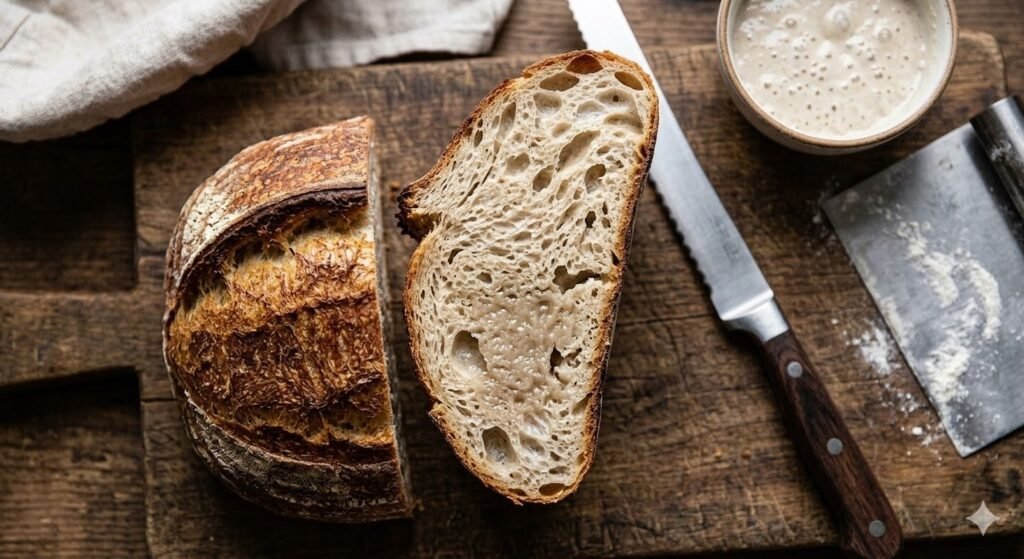
A gummy, dense sourdough is frustrating, but it’s also fixable. Gumminess usually comes from two main culprits: underproofing your dough or not baking long enough. Underproofed bread hasn’t fully fermented, leaving the crumb wet and starchy. Underbaked bread hasn’t set its structure internally. Both create that unpleasant, wet texture that sticks to your teeth. The good news? Once you understand what’s happening, you can fix it in your next bake.
In this guide, we’ll walk through the exact causes of gummy sourdough, including a sneaky mistake called the “Fools Crumb” that tricks bakers into thinking their dough is ready. You’ll learn how to troubleshoot, adjust your technique, and bake bread with a perfectly set, soft crumb instead.
The #1 Reason Your Sourdough Is Gummy: Underproofing
Underproofing is the most common cause of gummy sourdough. When dough doesn’t ferment long enough, it hasn’t developed the bacterial culture and yeast activity needed to properly break down starches. This leaves the crumb wet, starchy, and dense.
Here’s what happens inside underproofed sourdough:
- Incomplete fermentation: The lactic and acetic acids haven’t fully developed, making the bread harder to digest and leaving it starchy
- Poor gas development: Not enough bubbles have formed to create an open crumb structure
- Weak gluten structure: Fermentation time strengthens gluten; cut it short and the dough can’t hold gas efficiently
- Wet interior: Unfermented dough contains more moisture, which doesn’t evaporate properly during baking
The fix is simple: extend your bulk fermentation time. If you’re currently fermenting for 4 hours, try 5–6 hours. If you’re doing overnight cold fermentation, make sure it’s actually 12–16 hours, not just “overnight.” Use the poke test to check readiness instead of relying on time alone.
FAq TroubleShooting
Gummy Sourdough: Causes, Fixes & When It’s Safe to Eat
How to Fix Gummy Sourdough?
Gummy sourdough is usually fixable in your next bake. The key is identifying whether the problem came from underproofing or underbaking.
If it’s underproofing: Extend your bulk fermentation time by 1–2 hours. Use the aliquot jar method to monitor rise instead of relying on time alone.
If it’s underbaking: Bake for the full recommended time (typically 40–50 minutes). Use an instant-read thermometer—the internal temperature should reach 205–210°F. Always cool completely before slicing (at least 1–2 hours), as warm bread feels gummy.
See our detailed guide on fixing gummy sourdough for step-by-step solutions.
Is Gummy Sourdough Over or Under Proofed?
Gummy sourdough is usually underproofed, not overproofed. When dough doesn’t ferment long enough, it hasn’t developed the bacterial activity needed to break down starches, leaving the crumb wet and starchy.
However, gumminess can also come from underbaking. An overproofed loaf that still bakes will have a gummy interior because the structure has already collapsed.
To tell the difference, check your poke test results during final proof. If the indent springs back quickly, you’re underproofing. If it doesn’t spring back at all, you’re overproofing.
Can I Still Eat My Sourdough If It’s Gummy?
Yes, gummy sourdough is completely safe to eat. It’s not spoiled or moldy—it’s just underproofed or underbaked.
The texture won’t be ideal, and it may stick to your teeth or feel wet, but there’s nothing harmful about it. Many bakers still enjoy gummy sourdough toasted, with butter, or dipped in soup. You can also repurpose it as breadcrumbs or croutons.
Focus on fixing the issue in your next bake rather than worrying about eating this one.
Why Is My Sourdough Dense and Gummy?
Dense and gummy sourdough points to one of three issues:
1. Underproofing: Your bulk fermentation time was too short. The dough didn’t develop enough gas or flavor.
2. Underbaking: The bread didn’t bake long enough to set its internal structure. Interior temps should reach 205–210°F.
3. High hydration without proper fermentation: Very wet doughs (80%+ hydration) need extra fermentation time to break down starches. Check your dough hydration level.
The most common culprit is underproofing. Use the visual and tactile cues of bulk fermentation rather than the clock to prevent this.
Does Gummy Sourdough Mean It’s Underbaked?
Gumminess usually means underproofing, but underbaking can definitely make it worse or even be the sole cause.
Here’s how to tell the difference:
Underproofed + properly baked: Dense crumb, smaller holes, but firm crust and set interior structure.
Properly proofed + underbaked: Good oven spring and crust, but gummy, wet interior.
Underproofed + underbaked: Dense, gummy, and sticky throughout—the worst-case scenario.
To avoid underbaking, always bake to internal temperature (205–210°F) rather than relying on color alone. Your oven may run cool, so an instant-read thermometer is essential. Allow proper cooling time before slicing.
What Does Overproofed Sourdough Look Like When Baked?
A baked overproofed loaf has a very distinctive appearance:
Exterior: Flat, pancake-like shape with minimal rise. The dough spread sideways instead of up. The crust may look pale or unevenly colored.
Interior (crumb): Large irregular holes near the top, dense and gummy areas near the bottom. The structure is uneven and unstable.
Oven spring: Weak or almost none. Overproofed dough has no strength left to rise in the oven.
If your loaf looks like this, you’re overproofing during bulk fermentation or final proof. Use the poke test to check readiness instead of relying on time. See how to fix overproofed sourdough for rescue techniques like making focaccia or cold-shaping.
“`The Second Culprit: Underbaking
Even perfectly proofed dough can turn gummy if you don’t bake it long enough. The interior of your bread needs sustained heat to set its crumb structure and drive off moisture.
Most sourdough recipes call for 40–50 minutes of baking, but this varies based on:
- Oven type: Dutch oven (covered) bakes differently than open-pan baking
- Loaf size: A 500g loaf bakes faster than a 1kg boule
- Dough hydration: Higher hydration (wetter dough) needs longer baking times
- Your oven’s accuracy: Home ovens vary; a 450°F oven might actually be 425°F
Pro tip: Tap the bottom of your loaf. A properly baked sourdough sounds hollow and hard. If it sounds dull or feels soft, it needs 5–10 more minutes. Don’t rely on color alone—a gorgeous golden crust can hide a gummy interior.
The Sneaky Mistake: “Fools Crumb” (Big Holes ≠ Proof)
Here’s where many bakers get fooled: Big holes in your dough during bulk fermentation don’t always mean the dough is properly proofed. This is called the “Fools Crumb.”
What’s happening:
- A few large bubbles form early in fermentation because wild yeast and bacteria are active and creating gas
- You see these big holes and think, “Perfect! The dough is ready!”
- But the rest of the dough is still tight and underdeveloped
- You bake it, and instead of an open, even crumb, you get a few large holes surrounded by dense, gummy dough
The lesson: Look for a uniform rise and slight surface dome, not isolated large bubbles. A properly proofed dough will have bubbles throughout, and the surface will feel puffy and light. Use the aliquot jar method to visually track your bulk fermentation progress—it’s more reliable than eyeballing.
How to Fix Gummy Sourdough: A Troubleshooting Checklist
If You Think It’s Underproofing:
- Extend bulk fermentation by 1–2 hours at room temperature, or add 4–6 hours to your cold fermentation schedule
- Keep your dough warmer during fermentation (aim for 75–78°F if your kitchen is cold)
- Use the poke test to confirm readiness: the indent should spring back slowly (over 2–3 seconds)
- Check your sourdough starter feeding ratio—a weak starter ferments slowly and inconsistently
If You Think It’s Underbaking:
- Bake for the full recommended time, even if the crust looks dark
- Remove the Dutch oven lid 15 minutes before the end to deepen browning (optional but helps you see when it’s truly done)
- Use an instant-read thermometer: the internal temperature should reach 205–210°F
- Cool completely before slicing (at least 1 hour, ideally 2–3 hours). Warm bread is soft; cooling sets the crumb
Storage Matters Too: How Long Does Sourdough Bread Last?
Even perfectly baked sourdough can seem gummy if you’re not storing it correctly. How long sourdough bread lasts depends on storage method:
- Room temperature (airtight bag): 3–5 days before going stale
- Freezer: Up to 3 months (slice before freezing for easy thawing)
- Never refrigerate: Cold makes bread stale faster
A freshly baked loaf cooling on the counter will firm up as it cools. If you slice into warm bread, it will seem gummy because the crumb structure hasn’t fully set.
Prevention: Get It Right From the Start
The best way to avoid gummy sourdough is to understand your starter and your kitchen conditions:
- Keep your starter healthy: Feed regularly and use proper feeding ratios based on your temperature
- Monitor your dough temperature: Use the dough temperature guide to ensure consistent fermentation speed
- Trust the poke test over the clock: Every kitchen is different; fermentation time varies wildly
- Keep detailed notes: Track fermentation time, temperature, and results so you learn your patterns
- Bake to internal temperature, not just color: An instant-read thermometer (205–210°F) is your insurance policy
Deepen Your Understanding
Want to master every stage of sourdough baking? Explore these resources:
- Sourdough Gummy Crumb – Deep dive into gummy texture causes
- Bulk Fermentation 101 – Get the timing right
- Sourdough Crumb Guide – What makes a perfect crumb
- How to Know When Sourdough Is Ready – Beyond just the poke test
- How to Dry Sourdough Starter – Backup and storage tips
The Takeaway
Gummy sourdough isn’t a death sentence—it’s a signal that something in your process needs adjustment. Most of the time, it’s simply underproofing or underbaking. Use the poke test to confirm your proof, bake to an internal temperature of 205–210°F, and give your bread time to cool before slicing. Your next loaf will be infinitely better.
Remember: even professional bakers troubleshoot. The difference is they know what to look for.