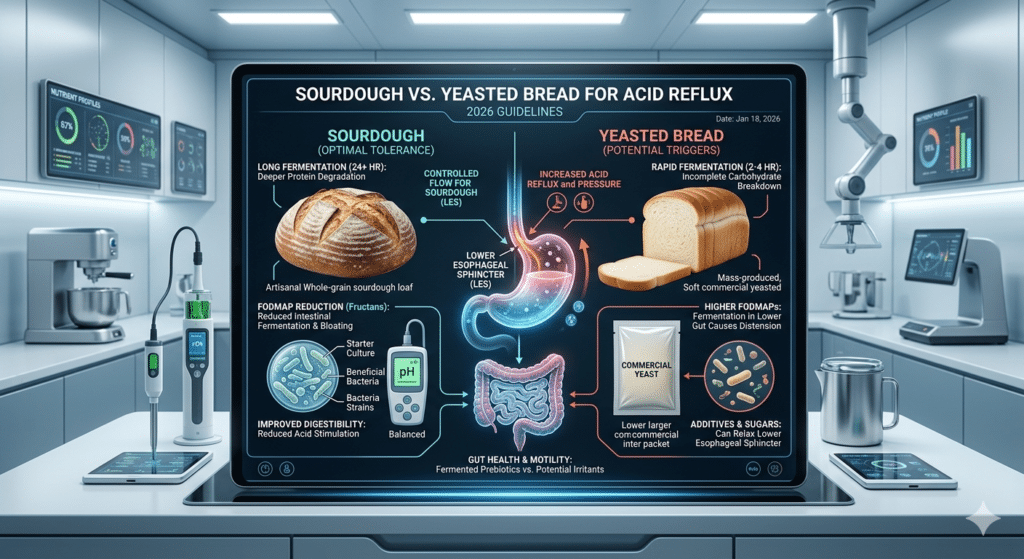
Short answer: Yes — slow-fermented sourdough is generally better tolerated than commercial yeasted bread for people with acid reflux and GERD. During the long fermentation, wild yeast and lactic acid bacteria (LAB) break down fructans and phytic acid, reducing the gas, bloating, and lower esophageal sphincter (LES) pressure that trigger reflux. Commercial yeasted bread ferments too fast to offer those benefits, leaving the fermentable carbs for your gut to handle.
Based on baking trials and fermentation research at the Sourdough Archive Test Kitchen. Last updated April 2026.
Why Commercial Yeasted Bread Often Triggers Reflux
Most store-bought bread — even “artisan-style” loaves — is made with commercial baker’s yeast (Saccharomyces cerevisiae) and rushed through a 1–3 hour rise. That speed is the entire problem.
Commercial yeast does one job: produce CO₂ fast enough to inflate dough in under two hours. It does not ferment the fructans, phytic acid, or complex starches that make bread hard on your digestive system. Those compounds arrive in your stomach fully intact.
Here’s what happens next:
- Fructans ferment in your gut instead of the dough. Your bacteria do the work the baker skipped, producing gas that pressurizes the stomach and pushes the LES open.
- Phytic acid binds minerals and contributes to bloating and slow digestion.
- Gluten arrives unbroken-down, increasing stomach workload and acid output.
- Rapid blood sugar spikes from refined white flour can relax the LES further.
For anyone with GERD, silent reflux, or chronic heartburn, that’s a four-way trigger in a single slice.
Why Sourdough Works Differently
Authentic sourdough uses a live starter culture — a symbiotic mix of wild yeast and Lactobacillus bacteria. Over 12–48 hours of fermentation, those microbes do something commercial yeast cannot: they actually digest the problematic compounds in flour before you eat it.
Three mechanisms make sourdough gentler on reflux:
- Fructan reduction. Research on long-fermented sourdough has shown significant drops in FODMAP content, particularly fructans — the same carbs that trigger IBS and reflux in sensitive people.
- Phytase activation. The acidic environment of a sourdough fermentation activates phytase enzymes that neutralize phytic acid, improving mineral absorption and reducing bloat.
- Partial gluten and starch breakdown. LAB produce proteases and amylases that pre-digest gluten proteins and starches, lowering the digestive workload on your stomach.
The counterintuitive part: sourdough has a lower pH than white bread, yet it’s alkalizing in effect. Because it requires less stomach acid to digest, your body produces less HCl overall — and less acid means less potential for reflux.
Sourdough vs Yeasted Bread: Side-by-Side Comparison
| Factor | Commercial Yeasted Bread | Authentic Sourdough |
|---|---|---|
| Fermentation time | 1–3 hours | 12–48+ hours |
| Leavening agent | Instant/active dry yeast | Wild yeast + Lactobacillus |
| Fructan content | High (unfermented) | Significantly reduced |
| Phytic acid | Intact | Largely neutralized |
| Glycemic impact | High, rapid spike | Lower, slower rise |
| pH level | ~5.5–6.0 | ~3.5–4.5 |
| Pre-digested starch | No | Partially |
| Typical reflux tolerance | Often triggers symptoms | Often well tolerated |
| Shelf life without preservatives | 2–3 days | 4–7 days |
Is Commercial Yeast Itself Bad for Acid Reflux?
The yeast isn’t the villain — the speed is. Baker’s yeast is the same species found in many fermented foods and is generally considered safe. The problem is what it doesn’t do: it doesn’t stick around long enough to break down the compounds that cause reflux.
A loaf made with commercial yeast that undergoes a long cold ferment (18+ hours) will be gentler than a one-hour rapid bake. But it still won’t match sourdough’s FODMAP reduction, because only LAB bacteria produce the specific enzymes that fully digest fructans.
Bottom line: if you have reflux, the fermentation time matters more than the leavening agent — and sourdough gives you both the long fermentation and the beneficial bacteria.
Can You Eat Store-Bought Sourdough With GERD?
Be careful here. The word “sourdough” on a label is not regulated in the United States. Many supermarket loaves labeled “sourdough” are just standard yeasted bread with added vinegar, citric acid, or “sourdough flavor” for the tang — and they’re often worse for reflux than plain white bread.
Read the ingredient list. Real sourdough contains:
- Flour, water, salt
- “Sourdough starter,” “levain,” “wild yeast culture,” or “fermented flour”
Red flags that indicate fake sourdough:
- Commercial yeast listed as an ingredient (with no starter mentioned)
- Added vinegar, citric acid, lactic acid, or “natural flavoring”
- Dough conditioners (DATEM, azodicarbonamide, mono- and diglycerides)
- Shelf life over 10 days without refrigeration
If it’s not clearly fermented, you’re getting white bread with a sour aftertaste — and all the reflux triggers that come with it.
How Long Should Sourdough Ferment to Help With Reflux?
Research on low-FODMAP sourdough suggests a minimum 12-hour total fermentation is needed for meaningful fructan reduction. Most reflux-friendly home bakers aim higher:
- Bulk ferment: 4–8 hours at room temp
- Cold retard: 12–24 hours in the fridge
- Total fermentation: 16–30 hours
Commercial “overnight” sourdoughs from real bakeries typically hit this window. Rapid same-day sourdoughs (under 8 hours total) offer some benefit but less than a true cold-retarded loaf.
If you bake at home and have GERD, a 24-hour cold ferment is the sweet spot for digestibility.
White Sourdough vs Whole Wheat Sourdough for Reflux
Counterintuitively, white sourdough is often better tolerated during active reflux flares than whole wheat. Whole wheat contains more fiber and more fructans to begin with, and an inflamed esophagus or stomach lining can react poorly to high-fiber foods.
General progression for GERD sufferers:
- Flare-up phase: long-fermented white sourdough, toasted, small portions
- Stable phase: mix white and whole wheat sourdough
- Remission phase: whole grain or rye sourdough for maximum gut benefit
Rye sourdough is often singled out as especially gentle because rye’s natural enzymes work synergistically with LAB fermentation.
Does Toasting Sourdough Help With Reflux?
Yes — and there’s real science behind it. Toasting causes starch retrogradation, a process that converts some of the digestible starch into resistant starch. Resistant starch behaves more like prebiotic fiber than a simple carb, meaning:
- It digests slower, reducing blood sugar spikes
- It feeds beneficial gut bacteria
- It puts less pressure on the LES
Toasting doesn’t fix fake sourdough or undo a rushed fermentation, but for a properly made loaf, a well-toasted slice is easier on reflux than fresh-from-the-oven.
Related: Toasted Sourdough, Calories, and Resistant Starch
What Real GERD Sufferers Report
We analyzed hundreds of comments across Reddit’s r/GERD, r/Sourdough, and health forums. The pattern is consistent:
- Most people who switched from commercial bread to authentic sourdough report reduced heartburn within 1–2 weeks
- A minority (roughly 10–15%) find sourdough still triggers symptoms — usually linked to histamine sensitivity rather than the bread itself
- Nearly everyone who tried “supermarket sourdough” reports no improvement, matching the fake-sourdough problem described above
Individual tolerance varies. The standard advice: test one slice with a neutral topping (like ricotta or avocado), wait 3–4 hours, and track symptoms for a week before scaling up.
Frequently Asked Questions
Usually, but start small. One slice of toasted white sourdough with a neutral topping (avocado, ricotta, soft scrambled egg) is a common “safe test” meal. Avoid spicy, fatty, or tomato-based toppings during flares.
Yes — and it’s arguably the best option because you control fermentation time. Use a long cold retard (18–24 hours), bake at high hydration, and stick to unbleached flour. Start with our beginner sourdough recipe.
It’s much less likely to than commercial bread because the fructans are pre-digested. If you’re bloating from authentic sourdough, the likely culprit is a non-ideal fermentation time or a histamine sensitivity. See our full guide on sourdough bread bloating.
Often, yes. Rye has more soluble fiber and lower gluten, and rye sourdough ferments particularly deeply. Many GERD sufferers find it the gentlest of all breads once they’re past an active flare.
For most people, yes — a slice or two daily of well-fermented sourdough is well tolerated and may even improve digestive symptoms over time. If you’re in an active flare, start with smaller portions and toasted slices.
No. Although sourdough has a lower pH than yeasted bread, your stomach acid is naturally far more acidic (pH 1.5–3.5). The small amount of lactic acid in sourdough doesn’t meaningfully add to stomach acidity, and in practice it requires less stomach acid to digest than white bread.
The Bottom Line
Commercial yeasted bread is one of the most common — and most overlooked — reflux triggers in the modern diet. The problem isn’t yeast itself; it’s the speed. Without proper fermentation, fructans, phytic acid, and unbroken gluten arrive at your stomach fully intact and cause the exact conditions that drive acid into your esophagus.
Authentic long-fermented sourdough solves this by doing the digestive work before the bread reaches your mouth. For most people with GERD, heartburn, or chronic reflux, switching from commercial yeasted bread to a properly made sourdough is one of the highest-impact dietary changes you can make.
Just make sure it’s the real thing.
Related Reading
- Is Sourdough Bread Good for Acid Reflux? — broader overview
- Sourdough vs White Bread for Acid Reflux — the specific white bread comparison
- Is Bread Good for Acid Reflux? — all bread types ranked
- Why Sourdough Doesn’t Cause Bloating
- Sourdough Gut Health Benefits
- No-Yeast Sourdough Discard Pizza Dough — reflux-friendly alternative
This article is for informational purposes and is not medical advice. If you experience persistent reflux, unexplained weight loss, or difficulty swallowing, consult a qualified healthcare professional.