Fool’s Crumb vs Open Crumb — What Is the Difference
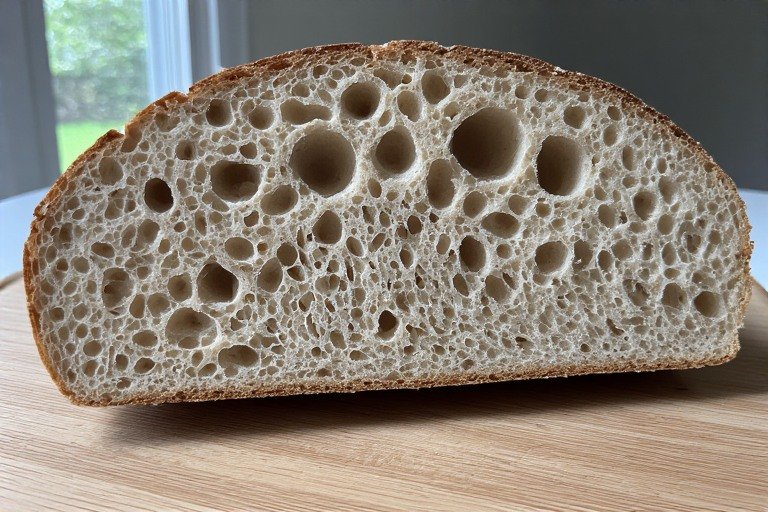
Before diagnosing the problem it helps to understand what you are actually looking at, because not all large holes are a problem.
A genuinely open crumb has holes that are relatively evenly distributed throughout the loaf — larger toward the top, smaller toward the bottom, with a network of gluten holding it all together. The holes are surrounded by a soft, light, well-aerated crumb.
Fool’s crumb looks similar at a glance but is actually a defect. The large holes are surrounded by tight, dense, gummy crumb rather than an open network. The loaf often has a pyramid or dome shape and the crumb texture is unpleasant to eat — chewy and slightly undercooked-feeling in the dense areas even when the loaf is fully baked. If that description matches what you are seeing, one of the causes below is responsible.
4 Causes of Large Uneven Holes — and the Fix for Each
Cause 1: Under-Fermentation
This is the most common cause of fool’s crumb. When bulk fermentation is cut short, the yeast has not had enough time to produce gas evenly throughout the dough. The gas that does exist collects in a few large pockets rather than distributing into hundreds of small, even bubbles. The result is a crumb with a handful of large holes surrounded by dense, under-developed dough.
How to tell if this is your issue: Look at the crumb carefully. Are the areas between the large holes tight and slightly gummy? Does the base of the loaf look denser than the top? Both are signs of under-fermentation.
The fix: Extend bulk fermentation until the dough has grown by 50–75% and shows bubbles on the surface and a domed top. Do not rely on time alone — temperature changes how fast your dough ferments. A dough at 20°C needs significantly longer than one at 26°C. Use volume increase as your guide, not the clock.
Cause 2: Weak or Loose Shaping
Shaping is where gas distribution gets locked in. If you shape the dough loosely — without building enough surface tension — large air pockets form or survive inside the loaf that were not there at the end of bulk fermentation. These pockets expand dramatically in the oven, creating the large irregular holes characteristic of fool’s crumb.
Too much flour during shaping makes this worse. A heavily floured surface stops the dough from gripping the bench and building tension as you work it. The dough slides rather than drags, and the surface stays loose.
The fix: Shape on a lightly floured or bare bench so the dough grips and you can build real tension. Use a bench scraper to drag the dough toward you in short, firm strokes until the surface is taut and smooth. The seam on the bottom should be fully pinched closed. If you feel large bubbles during shaping, gently press them out rather than folding them in.
Cause 3: Insufficient Gluten Development
Gluten is the network that traps gas bubbles and holds the crumb structure together. Without a strong gluten network, gas bubbles merge into larger ones rather than staying small and distinct, and the dough lacks the strength to hold an even structure through the oven spring. Weak gluten is often visible before baking — the dough feels slack, tears easily during stretch and fold, and does not hold its shape well.
The fix: Complete your full set of stretch and folds during bulk fermentation — typically four sets at 30-minute intervals. Each set builds strength and structure. If your dough still feels weak and tears easily by the end of bulk fermentation, add one or two additional sets on the next bake. Switching to a higher-protein bread flour also makes a significant difference if you have been using all-purpose.
Cause 4: Air Trapped During Shaping
Sometimes the large holes are not spread throughout the crumb but concentrated in one area — typically just under the crust or running in a tunnel through the middle of the loaf. This is almost always a shaping issue where a single large air pocket got folded into the dough and expanded dramatically during baking.
This can happen when you fold rather than roll during shaping, use too much flour that prevents the dough layers from sealing, or do not fully close the seam at the bottom.
The fix: When shaping, press the dough gently into an oval first to release any obvious large bubbles. Then fold and roll toward you rather than simply folding over. Press the seam firmly closed at each step and make sure the final bottom seam is completely sealed before placing in the banneton.
Quick Fix Table
| What You See | Most Likely Cause | Fix |
|---|---|---|
| Large holes surrounded by dense gummy crumb | Under-fermentation | Extend bulk until 50–75% volume rise |
| Large holes spread throughout, dough felt slack | Weak gluten development | Complete all stretch and fold sets, use bread flour |
| Large holes with loose, irregular shape | Loose shaping, no tension | Shape on bare bench, build surface tension |
| One large tunnel or hole near the crust | Air pocket trapped during shaping | Press out bubbles before shaping, seal seam fully |
| Holes only at the top, dense at the bottom | Dough too warm during proof | Proof in fridge, reduce bulk fermentation time |
[In-article image]
Prompt: Side by side cross-section comparison — left showing fool’s crumb with large irregular holes and dense surrounding crumb, right showing an ideal even open crumb, natural light, wooden board
Alt text: comparison of sourdough fools crumb large holes versus ideal open crumb structure
How to Tell When Your Bulk Fermentation Is Actually Done
Because under-fermentation is the leading cause of large uneven holes, getting bulk fermentation right is the most important single fix. Here is what to look for before moving to shaping:
The dough should have increased in volume by 50–75% from its starting size. The surface should look slightly domed and show small bubbles. When you tilt the container, the dough should move as a single aerated mass — not slosh like liquid, but not feel stiff either. The edges should be slightly pulling away from the sides of the container. If it passes those checks, it is ready to shape. If not, give it more time and check again in 30 minutes.
What to Do Next
Fool’s crumb is fixable once you know which variable is off. Most bakers trace it to fermentation time or shaping tension — fix one of those two and the crumb improves significantly on the very next bake.
→ Sourdough Baking Problems — Every Fix in One Place — full troubleshooting hub
→ Why Is My Sourdough Bread Dense? — dense crumb without the large holes
→ How to Shape a Sourdough Boule and Batard — shaping technique step by step