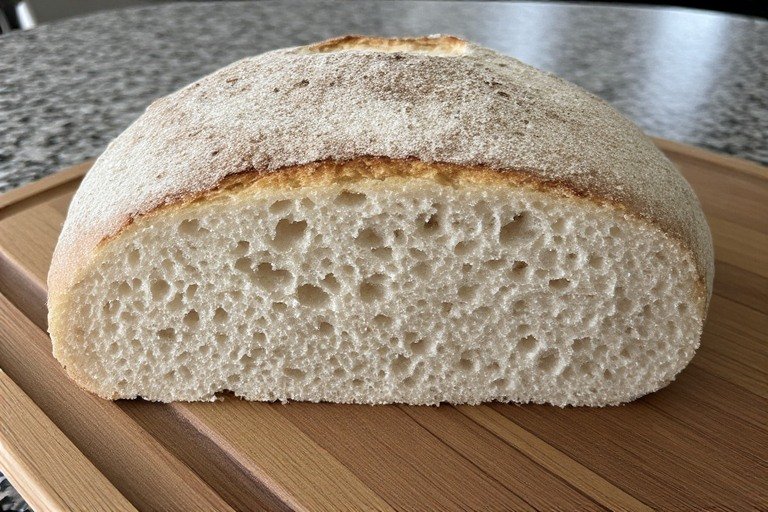
Every sourdough baking failure has a cause — and a fix. This guide covers every common baking problem home bakers face: crust, crumb, rise, and flavor. Jump straight to your problem below and get a fast, practical fix.
Jump to Your Problem
- Crust Problems — pale, burnt, too soft, too thick
- Crumb Problems — gummy, dense, tight, uneven holes
- Rise & Oven Spring Problems — flat, no ear, score not opening
- Flavor Problems — not sour, bland, too yeasty
Crust Problems
Crust issues are almost always caused by temperature, steam, or timing — and each one produces a different result. Find your specific crust problem below to get the right fix.
- Why Is My Sourdough Pale After Baking? 6 Fixes for a Golden Crust
- Why Is My Sourdough Burnt on the Bottom? 10 Easy Fixes
- Sourdough Crust Too Soft
- Sourdough Crust Too Thick
Crumb Problems
A bad crumb — gummy, dense, tight, or uneven — usually points to fermentation timing or baking temperature. These guides break down exactly what went wrong and how to correct it next bake.
- Why Is My Sourdough Gummy? Causes and Fixes
- Why Is My Sourdough Bread Dense? Causes and Fixes
- Large Holes in Sourdough Crumb
Why Is My Sourdough Crumb Too Tight?
A tight, closed crumb (the opposite of gummy — small, uniform holes packed close together with no big open pockets) is usually a sign of underproofing combined with tight shaping. Extend your bulk fermentation using the poke test rather than a timer, and handle the dough more gently during shaping to preserve the gas structure your starter already built. If your starter is weak, tight crumb often happens alongside a shorter-than-normal rise — check with a float test first.
Rise & Oven Spring Problems
If your loaf is spreading flat, refusing to spring in the oven, or not opening on the score, the cause is usually in your shaping, fermentation, or scoring technique. Start with the guide that matches what you’re seeing.
Why Doesn’t My Sourdough Have an Ear?
The “ear” — that curled flap along the score line — comes from a sharp, shallow-angle cut combined with strong oven spring. No ear usually means one of three things: the blade angle was too steep (aim for 30-45°, almost flat against the dough), the score wasn’t deep enough to guide the expansion, or the dough had already lost surface tension from overproofing before it hit the oven. Score at a shallow angle with a fresh, sharp blade, and confirm your dough is proofed correctly (not over) using the poke test.
Why Won’t My Score Open in the Oven?
A score that stays closed instead of opening up usually means insufficient steam, a dull blade, or a score that’s too shallow. Make sure your Dutch oven lid is sealing well for the first 20 minutes of baking (this traps the steam that keeps the crust elastic enough to expand), score at least ½ inch deep with a fresh blade, and confirm your dough isn’t underproofed — a weak rise won’t have enough gas pressure to force the score open regardless of technique.
Flavor Problems
Sourdough flavor comes from fermentation — small changes to timing, temperature, and flour make a big difference. These guides help you dial in exactly the flavor you’re after.
Why Does My Sourdough Taste Bland?
Bland sourdough usually means fermentation was too short or too warm/fast, which doesn’t give the acid-producing bacteria enough time to develop flavor compounds. Try a longer, cooler bulk fermentation (or a cold retard in the fridge overnight), and make sure your starter itself is mature and well-established (a young starter under 3-4 weeks old often produces milder flavor). Using a portion of whole wheat or rye flour in your mix also boosts flavor development noticeably.
Why Does My Sourdough Taste Too Yeasty?
An overly yeasty, beer-like flavor usually means the dough fermented too fast and too warm, favoring rapid yeast activity over the slower bacterial fermentation that builds complex sourdough flavor. Slow things down with a cooler bulk fermentation and a longer cold proof in the fridge (12-24 hours) — the extended cold time lets acid-producing bacteria catch up and mellows the yeasty edge.
Still Can’t Find Your Problem?
If your issue isn’t listed here, it may be starter- or proofing-related rather than a baking-stage issue — check the starter troubleshooting guide or proofing problems guide.