Disclosure: As an Amazon Associate, I earn from qualifying purchases. This post contains affiliate links.
For a comprehensive review of the Brod & Taylor itself, see our full Brod & Taylor Folding Proofer review with 3+ years of real-world data.
Amazon is now full of folding proofer knockoffs at $50–$80. The Brod & Taylor costs $200. Before you assume the cheap one is good enough — or that the expensive one is overpriced — read this honest breakdown of what you actually get for the difference.
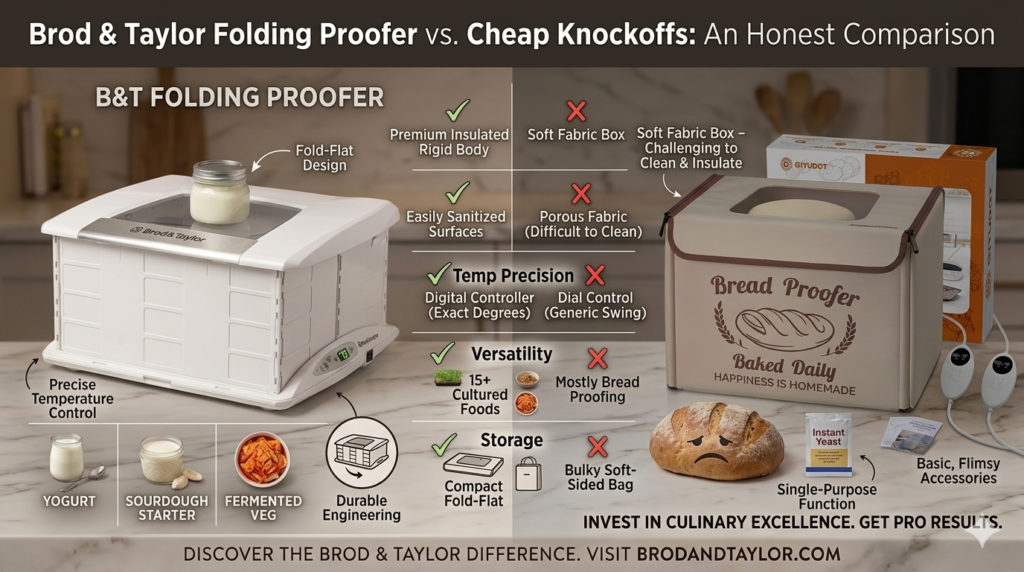
The folding proofer category that Brod & Taylor essentially invented has attracted a wave of budget competitors. Brands like GIYUDOT, CrsaSwivo, Yacumx, and dozens of unbranded options now crowd the Amazon search results with similar-looking boxes at a fraction of the price. Some are genuinely decent for casual bakers. Some will frustrate you. And a few key differences between budget and premium will determine which side of that line you land on.
This comparison is honest in both directions. The Brod & Taylor is the better product — but not for every baker. We’ll tell you exactly when the cheaper option is fine and when it will cost you more than you saved.
Quick Verdict
| Your Situation | Buy This |
|---|---|
| You bake once or twice a month and mostly want to speed up proofing in winter | Budget knockoff is probably fine |
| You bake weekly and need timing you can count on | Brod & Taylor |
| You make yogurt, black garlic, or slow cook regularly | Brod & Taylor — most knockoffs cap at 113°F, not 195°F |
| You’re a beginner on a tight budget just getting started | Budget knockoff to start, upgrade later if you stick with it |
| You bake serious sourdough and temperature precision matters to your results | Brod & Taylor — the calibration difference is real |
| You want a unit that lasts 5+ years with warranty support | Brod & Taylor |
Side-by-Side Spec Comparison
| Feature | Brod & Taylor FP-105 | Budget Knockoffs (e.g. GIYUDOT, CrsaSwivo) |
|---|---|---|
| Price | ~$200 | $50–$90 |
| Temperature Range | 70–195°F (21–90°C) | 50–113°F (10–45°C) — most models |
| Slow Cook Mode | ✅ Yes — up to 195°F | ❌ No — most max out at 113–130°F |
| Heating Method | Radiant aluminum base plate — calibrated to warm dough, not air | Fabric-insulated box with side/bottom heating elements — measures air temp |
| Temperature Sensor | Calibrated base plate thermostat | NTC air temperature sensor |
| Humidity Control | Included water tray | Included humidor / humidity tray |
| Built-in Timer | ❌ No | ✅ Yes — 24–48 hour timer on most models |
| Viewing Window | ❌ No | ✅ Some models have acrylic window |
| Capacity | ~25 liters — fits two large bannetons | Varies — some larger, some smaller |
| Folds Flat | ✅ Yes — 2.75″ thin | ✅ Yes on most models — varies by brand |
| Warranty | 3-year Brod & Taylor warranty with registration | Typically 1-year limited or no warranty |
| Customer Support | US-based, known for replacing units outside warranty | Varies — often email-only, slow response |
| Slow Cook Capability | ✅ Black garlic, bone broth, yogurt, slow cook meals | ⚠️ Yogurt only — cannot reach black garlic temps |
| Brand History | 10+ years, small US business, invented the category | New entrants, limited track record |
The 4 Differences That Actually Matter
1. Temperature Ceiling: The Biggest Deal-Breaker
This is the difference that eliminates the budget option for a large group of bakers: most cheap proofers max out at 113°F.
That’s just above yogurt temperature (110°F) — so yogurt making works. But anything above that is off the table. Black garlic requires 140°F held for 3–4 weeks. Bone broth needs 185–195°F. Traditional slow cooking runs at the same range. The Brod & Taylor’s slow cook mode reaches 195°F. No budget knockoff we’ve found matches this.
If you only plan to proof dough and make yogurt, the 113°F ceiling is fine. If you want everything the Brod & Taylor is capable of — especially black garlic, which many owners describe as the purchase that single-handedly paid for the unit — you need the higher temperature ceiling.
2. What the Temperature Sensor Actually Measures
This is subtle but genuinely important for sourdough consistency.
The Brod & Taylor was engineered and calibrated so that its display temperature represents the temperature of your dough — not the air inside the box. The aluminum base plate warms the bowl and the bowl warms the dough, and the thermostat was calibrated around this relationship. When you set 78°F, your dough reaches approximately 78°F.
Most budget knockoffs use an NTC sensor that measures air temperature inside the box. This sounds fine in theory — but air temperature and dough temperature are different things, especially when you’re using covered containers that retain heat or large thermal masses that take time to warm through. The practical result is that with a budget proofer, you often need to do more trial and error to figure out what display setting actually gets your dough to the temperature you want.
For a casual baker proofing once a month, this calibration difference is minor. For a weekly baker who needs timing to be predictable, it’s the difference between a reliable schedule and constant guesswork.
3. Warranty and Longevity
The Brod & Taylor comes with a 3-year warranty and the brand has a well-documented reputation for replacing units — sometimes even after the warranty period — without a fight. Multiple long-term owners have reported receiving free replacements years after purchase.
Budget knockoffs typically offer a 1-year warranty at most, with customer service that often amounts to an overseas email address. If the unit fails after 14 months, you’re buying another one.
At $60 for a knockoff vs. $200 for the Brod & Taylor, you only need the cheap one to fail twice in 6 years for the Brod & Taylor to have been the better financial decision — before counting the time cost of diagnosing and returning a failed unit.
4. What the Knockoffs Actually Do Better
Fairness requires saying this clearly: the budget proofers have two genuine advantages the Brod & Taylor lacks.
Built-in timer. Most budget models include a 24–48 hour countdown timer with automatic shutoff. The Brod & Taylor has no timer — you set the temperature and it runs until you turn it off. For bakers who forget to check on things, a timer is genuinely useful. The Brod & Taylor’s workaround is a separate plug-in outlet timer, which costs $10–15 and works fine — but it’s an extra step.
Viewing window. Some budget models include a transparent acrylic panel that lets you check on your dough without lifting the lid and letting heat escape. The Brod & Taylor has no window — you open the lid to check. For most bakers this is trivial. For those who check frequently or are proofing something delicate, a window is a nice feature.
These are real advantages. They’re just not advantages that change the baking outcome.
What the Baking Community Says
The Brod & Taylor has been in the sourdough community for over a decade and has earned genuine trust — not just marketing. America’s Test Kitchen, one of the most rigorous equipment testing organizations in the US, reviewed and recommended it, noting that it does an excellent job providing consistent, stable temperatures over long periods with very little fluctuation.
The budget knockoffs are newer and reviews are more mixed. The positive reviews tend to come from occasional bakers who are happy to have any warm box. The negative reviews — units that show error codes, temperature sensors that drift, or units that stop working after a few months — are more common in the budget category than in the Brod & Taylor’s review history.
This doesn’t mean every cheap proofer is bad. Some bakers use budget units for years without issue. But the pattern of complaints — temperature inconsistency, short lifespan, poor support — is significantly more common in the knockoff category.
The Honest “Save Your Money” Cases
There are genuine situations where a $60 knockoff is the right call and spending $200 makes no sense:
- You’re a beginner testing the waters. If you’re not sure whether you’ll stick with sourdough, a budget proofer lets you experience the difference temperature control makes without a $200 commitment. If it transforms your baking, upgrade. If sourdough turns out not to be your thing, you’re out $60 not $200.
- You bake once or twice a month in winter only. Occasional bakers in mild climates who just want to speed up a single winter loaf now and then will get enough from a budget option.
- You only need dough proofing — no slow cook, no yogurt, no black garlic. If you will never use any of the Brod & Taylor’s non-bread capabilities, the temperature ceiling difference matters much less and the lower price is harder to argue against.
The Honest “Spend the $200” Cases
- You bake weekly and timing matters. Predictable fermentation schedules require accurate, calibrated temperature control. The Brod & Taylor delivers this reliably. Budget options require more trial-and-error.
- You want to make yogurt, black garlic, bone broth, or use it as a slow cooker. The 195°F ceiling and slow cook mode are exclusive to the Brod & Taylor in this product category. No knockoff comes close.
- You want to buy once and not replace it. The 3-year warranty and brand track record make this a long-term purchase. Most budget units are not.
- You’re already spending money on quality flour, a Dutch oven, and good tools. If you’re serious enough about your baking to invest in the other gear, the proofer is the piece that ties it all together.
A Note on GIYUDOT Specifically
GIYUDOT is the most prominent of the budget competitors and worth addressing directly since it appears as an Amazon “also bought” alongside the Brod & Taylor constantly.
GIYUDOT’s key specs: 50–113°F temperature range, 48-hour timer, NTC air temperature sensor, five-layer fabric insulation, stainless steel shelf, and an interior of approximately 16″ × 12″ × 12″. It’s a well-specified unit for the price and reviews suggest it works reasonably well for basic dough proofing and yogurt making.
Where it falls short against the Brod & Taylor: the 113°F ceiling rules out black garlic and slow cooking, the air-temperature sensor requires more personal calibration to nail dough temperatures precisely, and the brand’s track record for long-term reliability and warranty support is much thinner. It also doesn’t share Brod & Taylor’s radiant base-plate heating design, which is the foundation of the B&T’s accuracy for dough specifically.
GIYUDOT’s genuine wins: the timer is useful, the viewing window on some models is convenient, and the $50–70 price point makes it accessible. For what it does well, it does it adequately.
Frequently Asked Questions
Is the Brod & Taylor worth $200 when knockoffs exist for $60?
For weekly bakers who want reliable timing, yes. For occasional bakers on a budget, the knockoffs are adequate for basic proofing. The price gap is justified primarily by the 195°F temperature ceiling (enabling black garlic, bone broth, and slow cooking), the calibrated dough-temperature accuracy of the base plate design, the 3-year warranty, and the brand’s decade-long track record. If you’ll use all of those things, the $200 is defensible. If you only need warm air for dough, the gap is harder to justify. See our full guide on whether the Brod & Taylor Proofer is worth it for the complete cost analysis.
Can a cheap proofer make black garlic?
No — not with current budget models. Black garlic requires holding garlic at 140°F for 3–4 weeks. Most budget proofers cap at 113°F. This is one of the clearest capability gaps between budget and premium in this category.
Do cheap proofers hold temperature accurately?
Moderately. Budget proofers use NTC air sensors which work well enough for casual baking. The issue is that air temperature and dough temperature are not the same thing, so the display reading requires personal calibration to understand what your dough actually reaches. The Brod & Taylor was engineered so its display represents dough temperature directly, which is why experienced bakers find it more predictable out of the box.
What’s the best cheap alternative if I don’t want to spend $200?
For dough proofing only, GIYUDOT is the most consistently reviewed of the budget options. For a DIY approach that costs almost nothing, our DIY proofing box cooler method produces surprisingly good results for bakers who don’t mind a less precise setup. See our full cheap alternatives to the Brod & Taylor proofer guide for all options side by side.
Does the Brod & Taylor have a timer?
No — it runs continuously until switched off. This is a genuine advantage the budget competitors have. The workaround most Brod & Taylor owners use is a standard plug-in outlet timer ($10–15), which gives you the same automatic shutoff functionality. It’s an extra piece of kit but not a difficult problem to solve.
Ready to make your decision? Read our full Brod & Taylor Folding Proofer review, check out our best proofing boxes for sourdough buyer’s guide, or if you’re leaning budget, see all your cheap alternatives to the Brod & Taylor.
Related reading: Is the Brod & Taylor Proofer Worth It? · Proofer vs. oven light: which works better? · Brod & Taylor temperature settings cheat sheet