Before comparing rye sourdough to wheat sourdough, it’s worth clearing up a mix-up that shows up constantly in search results: “rye” and “sourdough” aren’t competing categories. Rye is a flour type; sourdough is a fermentation method. You can make rye bread with commercial yeast, and you can make wheat bread with a sourdough starter — the real comparison isn’t “rye vs. sourdough,” it’s rye-flour sourdough versus wheat-flour sourdough, which is what this guide actually covers.

This is one guide in our full rye sourdough bread recipe collection.
The Core Difference: Gluten Structure vs. Pentosan Structure
Wheat sourdough rises and holds its shape because of gluten — a stretchy protein network that traps fermentation gas inside thin, elastic walls, producing the open, airy crumb wheat sourdough is known for. Rye flour contains meaningfully less gluten-forming protein than wheat — by some measures roughly a third as much — and the gluten it does have forms weaker, less elastic chains. Rye’s structure instead comes primarily from pentosans, a soluble fiber that forms a sticky gel when hydrated, along with gelatinized starch. That gel can trap gas and rise, but nowhere near as efficiently or elastically as gluten does, which is the root cause of nearly every practical difference between the two doughs.
| Factor | Wheat Sourdough | Rye Sourdough |
|---|---|---|
| Primary structure | Gluten network | Pentosan gel + gelatinized starch |
| Dough handling | Elastic, stretchy, can be shaped by hand | Sticky, paste-like at higher %, often pan-baked |
| Crumb | Open, irregular holes possible | Tight, dense, small uniform holes at best |
| Kneading | Develops structure, worth doing | Does very little, often skipped entirely |
| Typical hydration | 65-80% | 75-100%+ depending on rye % |
| Bulk fermentation speed | Baseline | 30-50% faster at the same temperature |
| Does sourdough leavening matter structurally? | Helpful for flavor, not required for rise (commercial yeast works fine) | Functionally necessary above ~50% rye — more on this below |
Why Rye Actually Needs Sourdough Fermentation (and Wheat Doesn’t)
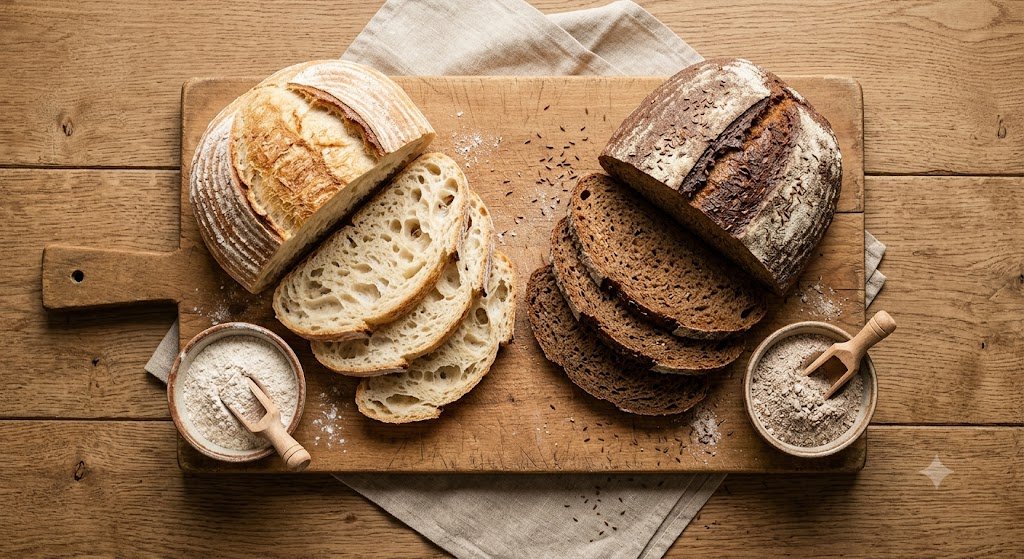
This is the most underexplained part of the rye-vs-wheat comparison, and it’s a genuinely important technical difference, not just a tradition. Rye flour contains an unusually active enzyme called amylase, which breaks down starch. Rye’s amylase stays active at higher temperatures than wheat’s does — active enough that, left unchecked, it continues breaking down the dough’s starch structure well into the baking process, causing the crumb to disintegrate rather than set properly.
Sourdough fermentation’s acidity is what solves this. The lower pH produced by a sourdough starter’s lactic acid bacteria inhibits rye’s amylase enzyme, allowing the starches to gel and set correctly during baking instead of breaking down faster than the bread can cook. This is why traditional high-percentage rye breads are essentially always leveled with sourdough rather than commercial yeast — it’s not just a flavor preference, it’s what makes the loaf’s structure work at all. Wheat doesn’t have this problem to nearly the same degree, which is why wheat bread rises just fine with commercial yeast and sourdough is a flavor and digestibility choice rather than a structural necessity.
Flavor and Aroma: More Different Than You’d Expect
Rye and wheat sourdough don’t just taste different in degree — they produce genuinely different aroma compounds during fermentation and baking. Wheat sourdough tends toward creamy, coconut-like notes from specific lactone compounds, along with more prominent spice notes. Rye sourdough leans toward fruitier, more floral characteristics — apple and rose notes are notably stronger in rye than in wheat — along with a more pronounced vegetal, potato-like, nutty character that wheat sourdough doesn’t really have. Rye also develops an extra buttery aroma compound during fermentation that wheat sourdough lacks, and during baking, rye produces more pronounced roasted, woody, and popcorn-like notes from Maillard browning than wheat does at an equivalent bake. If you’ve noticed rye sourdough tasting more complex or “earthier” than wheat sourdough beyond just being denser, this is why — the underlying chemistry is measurably different, not just a matter of perception.
Digestion and Health: Where the Real Differences Are
Both rye and wheat sourdough benefit from the same fermentation advantages — sourdough’s lactic acid bacteria reduce phytic acid (improving mineral absorption) and break down some of the fermentable carbohydrates (FODMAPs) that trigger digestive discomfort in sensitive individuals, regardless of which flour is used. Where rye and wheat genuinely differ:
- Fiber content: Rye’s pentosans are distributed throughout the whole grain, not concentrated in the bran the way wheat’s fiber largely is, giving whole grain rye a distinct fiber profile even compared to whole wheat.
- Glycemic index: Rye bread generally scores lower on the glycemic index than wheat bread — commonly cited in the 45-65 range for rye versus 70-75 for typical wheat bread — meaning a more gradual blood sugar rise after eating, largely due to rye’s fiber structure slowing digestion.
- Satiety: Rye’s fiber structure appears to trigger stronger, longer-lasting fullness signals than wheat, an effect researchers have tied to slower gastric emptying with rye specifically.
- Gluten content: Rye contains meaningfully less gluten than wheat and a structurally different gluten profile, which is why rye dough can’t build the same elastic network — but rye is not gluten-free, and this reduced gluten content offers no safety for anyone with celiac disease or a diagnosed gluten intolerance.
For a deeper look at the digestive and gut health angle specifically, see our dedicated rye sourdough gut health guide once published.
Practical Baking Differences You’ll Actually Notice
Handling
Wheat sourdough is worked with stretch and folds, shaped by hand into a boule or batard, and scored for a dramatic ear. Rye sourdough above about 50% rye is mixed, not kneaded, and scraped into a pan rather than hand-shaped — treating rye dough like wheat dough is the single most common source of frustration for bakers moving from one to the other. For the full breakdown of what’s normal handling at each rye percentage, see our why is my rye sourdough dough so sticky guide.
Crumb Expectations
An open, airy crumb is achievable and expected in wheat sourdough. It is not achievable in high-percentage rye, regardless of technique, because the structural mechanism simply can’t produce it — see is rye sourdough supposed to be dense for the full explanation of what density is normal at each rye percentage.
Fermentation Timing
Rye’s more aggressive enzyme activity means bulk fermentation and proofing both move roughly 30-50% faster than an equivalent wheat dough at the same temperature. Bakers used to wheat’s longer, more forgiving fermentation windows often overproof their first few rye bakes by applying wheat timing out of habit.
Cooling and Slicing
Both benefit from cooling before slicing, but rye needs it far more urgently — a wheat loaf sliced slightly warm is a minor issue, while a high-percentage rye loaf sliced before its full 2-4+ hour (or, at 100% rye, up to 24-hour) rest will look and taste distinctly gummy, since the crumb is still actively finishing its structural set during that time.
Shelf Life
Rye sourdough consistently outlasts wheat sourdough on the counter — often 5-10 days versus wheat’s typical 2-4 days — thanks to rye’s higher acidity and its dense, moisture-retentive pentosan structure holding onto water longer than an open wheat crumb does.
Nutritional Comparison at a Glance
Comparing whole grain rye sourdough to whole wheat sourdough, using standard per-100g figures for the flours themselves before fermentation adjustments:
| Nutrient (per 100g flour) | Whole Wheat | Whole Rye |
|---|---|---|
| Fiber | ~11g | ~15g |
| Protein | ~13g | ~10g |
| Glycemic index (baked bread) | ~70-75 | ~45-65 |
| Gluten-forming protein | Higher | Roughly one-third of wheat’s level |
Rye’s higher fiber and lower glycemic index are its clearest nutritional advantages; wheat’s higher protein and stronger gluten are what make it the easier, more versatile flour to bake and shape with. Neither figure changes the fact that both are genuine sources of gluten and unsuitable for anyone avoiding gluten for medical reasons.
Cost and Availability
Bread flour is cheaper and more widely available than rye flour in most U.S. grocery stores, where rye is often limited to a single “medium rye” or “dark rye” option rather than the light/medium/dark/pumpernickel range serious rye baking benefits from. If you’re baking rye regularly, ordering whole grain rye flour online or from a specialty baking supplier is usually worth it both for selection and for freshness — rye flour’s oils go rancid faster than white flour’s, so buying in smaller quantities more often tends to produce better results than a single large bag that sits for months.
Common Misconceptions About the Rye vs. Wheat Comparison
- “Rye sourdough is just wheat sourdough with a different flour.” The structural mechanism is fundamentally different — gluten versus pentosan gel — which changes handling, hydration, fermentation speed, and achievable crumb, not just flavor.
- “You can substitute rye for wheat 1:1 in any sourdough recipe.” Rye absorbs significantly more water and can’t build gluten structure, so a straight substitution without adjusting hydration and expectations will produce a failed or badly underhydrated dough.
- “Rye is gluten-free or safe for celiacs.” It isn’t — rye contains gluten, just less of it and in a different form than wheat. This is one of the most persistent misconceptions in rye baking content generally.
- “Sourdough fermentation matters equally for both grains.” It doesn’t — sourdough’s acidity is functionally necessary for rye’s structure to set properly during baking, while for wheat, sourdough is primarily a flavor and digestibility choice rather than a structural requirement.
Which One Should You Reach for Depending on What You’re Making
- Sandwich bread for daily use: Wheat sourdough, or a low-percentage rye blend (10-20%), for a lighter, more familiar texture that still slices and toasts easily.
- Deli-style or pastrami/corned beef sandwiches: A moderate rye blend (30-40%) with caraway, for the classic tangy, hearty flavor without the density of a high-rye loaf.
- Long keeping quality, minimal waste: Higher-percentage rye (50%+), since it stays fresh significantly longer than wheat sourdough on the counter.
- Open, artisan-style crumb for show or dipping: Wheat sourdough — this is the one job rye structurally cannot do as well, regardless of technique.
- Pairing with strong flavors (smoked fish, sharp cheese, cured meats): Rye sourdough, whose bolder, earthier flavor profile holds up to assertive toppings better than a milder wheat crumb.
Do You Need a Different Starter?
Either a wheat/all-purpose starter or a dedicated rye starter will leaven either type of dough — the microbes aren’t flour-specific. A rye starter ferments faster and typically develops a more pronounced sourness, which is why it’s the traditional choice for rye-forward baking specifically, but it isn’t a hard requirement. If you’re building one from scratch, our how to make a rye sourdough starter guide covers the full process, including why rye starters typically establish faster than wheat starters do.
A Brief Historical Note on Why These Two Grains Split
Wheat and rye ended up as the dominant bread grains of different regions largely due to climate, not preference. Wheat needs warmer, drier growing conditions and became the staple across Southern and Western Europe, the Mediterranean, and eventually much of North America. Rye tolerates cold, wet, poor soil far better than wheat does, which made it the practical staple across Northern and Eastern Europe — Germany, Poland, the Baltics, Scandinavia, Russia — for centuries. The baking traditions that developed around each grain reflect those constraints: wheat regions developed techniques focused on maximizing gluten’s open, airy potential, while rye regions developed techniques (large preferments, scalds, long fermentation, sourdough as a structural necessity) built around working with a grain that behaves completely differently. Understanding that history is part of why treating rye sourdough as “wheat sourdough with a substitution” misses what actually makes it a distinct craft.
Which Should You Bake First?
If you’ve never made sourdough at all, wheat is the more forgiving place to start — the dough gives more visual and tactile feedback (a clear rise, a windowpane test, a dramatic oven spring) that helps build intuition for fermentation timing. If you’ve already got wheat sourdough down and are looking for a genuinely different challenge with a different flavor payoff, rye is a natural next step — just go in expecting a different process, not a harder version of the same one. Starting around 20-30% rye blended with bread flour, rather than jumping straight to a high-percentage loaf, is the easiest on-ramp; our full rye sourdough bread recipe guide walks through that progression in detail.
Frequently Asked Questions
Is rye sourdough healthier than wheat sourdough?
Rye sourdough generally has a lower glycemic index, more evenly distributed fiber, and stronger satiety effects than wheat sourdough, making a reasonable case for “healthier” in those specific respects. Neither is gluten-free, and both benefit similarly from sourdough fermentation’s effects on phytic acid and FODMAPs — the comparison depends on which specific health factor matters most to you.
Can I use the same starter for both rye and wheat sourdough?
Yes — a single starter, whether built on rye, wheat, or all-purpose flour, can leaven either type of dough. The flour you feed your starter and the flour you use in your final dough don’t have to match.
Why does rye sourdough taste so different from wheat sourdough?
The two ferment into genuinely different aroma compounds — rye develops more fruity, floral, and vegetal notes along with an extra buttery compound wheat doesn’t produce, while wheat leans toward creamy, coconut-like, and spicier notes. This is a real chemical difference in fermentation byproducts, not just a difference in flour flavor.
Is it true that rye bread can’t be made without sourdough?
Not entirely true, but close at higher rye percentages. Rye’s active amylase enzyme needs sourdough’s acidity to be inhibited so the dough’s starch structure can set properly during baking — without that acidity, high-percentage rye bread tends to fall apart structurally. Lower-percentage rye blends with more wheat flour have more leeway to use commercial yeast successfully.
Which rises more, rye sourdough or wheat sourdough?
Wheat sourdough rises significantly more, both in bulk fermentation volume and in oven spring, because gluten’s elasticity allows far more gas expansion than rye’s pentosan gel structure can accommodate. This is a structural ceiling for rye, not a sign of a fermentation problem.
Rye Sourdough — More Guides