⚡ The Loophole: Most people buy dedicated yogurt makers ($50–$150). Sourdough bakers buy the Brod & Taylor ($200) and get yogurt capability PLUS bread proofing, kombucha, kefir, and black garlic—all in one tool. Cost per use? Less than any dedicated machine.
If you already own a Brod & Taylor for sourdough, you’re sitting on one of the most underrated yogurt makers on the market. If you’re thinking about buying one, yogurt-making alone could justify the investment—never mind the bread, kombucha, and everything else.
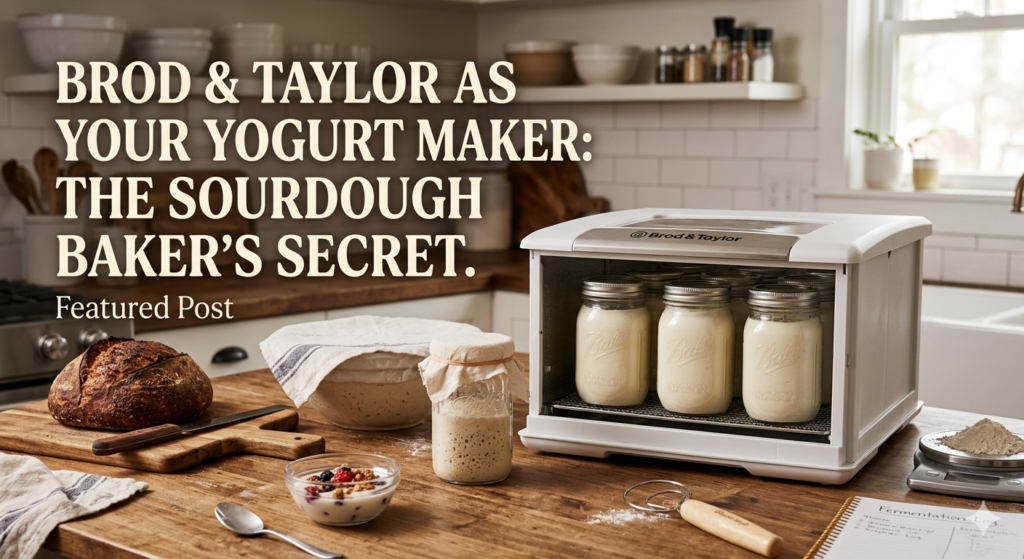
Here’s what makes it different from dedicated yogurt makers, and why so many sourdough bakers have quietly replaced their Instant Pots and Euro Cuisines with the Brod & Taylor.
Why Sourdough Bakers Use the Brod & Taylor for Yogurt (Not a Dedicated Machine)
The standard advice is: “Get a yogurt maker for yogurt, a bread proofer for bread.”
But that’s advice for people who only do one thing. If you bake sourdough, you already own a Brod & Taylor (or you’re thinking about it). So the question isn’t “Should I buy a yogurt maker?” It’s “Can my Brod & Taylor do yogurt well enough to replace one?”
The answer is: better than well enough.
The Brod & Taylor proofer has the narrowest temperature range and best accuracy of any yogurt maker on the market, with digital temperature control that allows you to make yogurt that’s creamy, stable, and perfectly set.
Brod & Taylor vs Dedicated Yogurt Makers (The Real Comparison)
Let’s compare the Brod & Taylor to the yogurt makers most sourdough bakers consider:
| Feature | Brod & Taylor | Euro Cuisine YM80 | Instant Pot | Bear Yogurt Maker |
|---|---|---|---|---|
| Upfront Cost | $200 | $50–70 | $100–150 | $60–80 |
| Capacity | 1 cup to 8 quarts | 1–2 quarts fixed | Single batch (1–2 qt) | 1–2 quarts fixed |
| Temperature Control | ±1–2°F (precise) | ±3–5°F (good) | ±2–4°F (good) | ±2–4°F (good) |
| Multi-Use? | YES (bread, kombucha, kefir, black garlic, etc.) | NO (yogurt only) | YES (if you buy it for multi-use anyway) | NO (yogurt + maybe cheese) |
| Batch Flexibility | 1 cup, 2 cups, 4 cups, 8 quarts—YOUR choice | Fixed container (1–2 qt) | Fixed pot | Fixed container |
| Cost Per Batch (5 years) | $0.11 per batch | $0.40 per batch | $0.30 per batch | $0.35 per batch |
| Counter Space | Folds away (minimal) | Permanent (medium) | Permanent (large) | Permanent (medium) |
| Glass Jars? | YES (you choose) | NO (plastic) | NO (metal) | NO (plastic/stainless) |
The key difference? If you’re already a sourdough baker, you own the Brod & Taylor. The marginal cost of making yogurt in it is nearly zero. For Euro Cuisine or Bear owners, yogurt is all they get. For Brod & Taylor owners, yogurt is just one of 9+ uses.
The Capacity Advantage (This Is Why Bakers Love It)
Here’s the advantage that never makes it into yogurt maker reviews:
Most yogurt makers have either a one- or two-quart capacity. The Folding Proofer easily fits as much as eight quarts or as little as one cup at a time. No other home yogurt maker comes close to this capacity.
So your options are:
- Making just for yourself? Use 1 quart jar. Done.
- Family of 4 eating daily? Use 2 quarts. Done.
- Meal prepping for the week? Use 4–8 quarts. Done.
- Experimenting with different flavors? Use 4 small jars of different varieties. Done.
Dedicated yogurt makers force you into fixed batch sizes. The Brod & Taylor says: “Make whatever amount makes sense for you.”
High-Low Yogurt Method (Why Texture Matters)
There’s a technique called the “High-Low Method” that most home yogurt makers can’t do properly. But the Brod & Taylor can.
The High-Low method starts the culture hot for faster culturing, then lowers the temperature for the second stage of culturing to achieve the creamiest texture and most stable set.
In practice:
Step 1: Heat milk to 165°F, cool to 115°F
Step 2: Add yogurt starter
Step 3: Culture at 120°F for 1 hour (kills any pathogens, speeds fermentation)
Step 4: Lower to 86°F for 3+ hours (allows cream line to form, prevents whey separation)
Step 5: Result = thick, creamy, stable yogurt with minimal graininess
Most dedicated yogurt makers hold a single temperature (like 110°F) for the entire 8 hours. That works, but you sacrifice texture and creaminess.
The Brod & Taylor lets you do the High-Low method because you can change the temperature mid-fermentation. That’s the difference between “okay yogurt” and “creamy, stable yogurt that tastes homemade.”
Step-by-Step: Making Yogurt in the Brod & Taylor
Here’s exactly how to make a batch:
Equipment You Need
- 1–8 quart glass jars (your choice of size and quantity)
- Thermometer (or instant-read digital one)
- Milk (whole, 2%, or even non-dairy)
- Yogurt starter (store-bought with live cultures, or your own from a previous batch)
- Brod & Taylor set to dry mode (NO water tray for yogurt)
The Process (4 Steps, Total Time: 4–6 Hours)
Step 1: Heat Milk (5 minutes active)
Heat milk to 165°F on the stovetop (or microwave). This kills any competing bacteria and denatures whey proteins for a creamier set.
Step 2: Cool Milk to 115°F (15 minutes)
Place pot in an ice bath or run cool water. Stir occasionally. Don’t skip this—adding starter to hot milk kills the cultures.
Step 3: Add Starter & Set Temperature (5 minutes)
In a small bowl, mix 2–3 tablespoons starter with ¼ cup cooled milk to create a slurry. Pour into main pot and stir gently. Pour into jars. Set Brod & Taylor to 120°F (dry mode, no water tray).
Step 4: High-Low Fermentation (4–5 hours)
Culture at 120°F for exactly 1 hour. Then lower to 86°F and ferment for 3–4 more hours until set (tilt jar gently—it should hold its shape).
Result: Creamy, thick, stable yogurt. Chill and enjoy. Reserve 3 tablespoons for next batch.
Cost Breakdown: Brod & Taylor Yogurt vs Store-Bought
Let’s do the actual math:
Cost Per Batch
- Whole milk (1 quart): $1.50
- Yogurt starter: $0.10 (from previous batch)
- Electricity (4 hours at $0.06/hour): $0.24
- Total cost per batch: $1.84
- Yield: 1 quart (4 servings)
- Cost per serving: $0.46
Compare to Store-Bought
- Organic yogurt (store): $1.50–2.50 per 6-oz container
- Cost per quart equivalent: $4.00–6.67
- Your savings per batch: $2.16–4.83
- If you make 2 batches/week: $225–500/year in savings
- Brod & Taylor cost: $200
- Payback period (yogurt alone): 5–11 months
Homemade yogurt costs only about one-third as much as store-bought. Savings add up quickly: after just 19 weeks of yogurt making, you can save enough money to recoup the purchase price of your Proofer.
Greek Yogurt: The Upgrade (Straining Method)
Want thick, creamy Greek yogurt? Add a 20-minute straining step:
- After fermentation: Line a large colander with cheesecloth or coffee filters
- Pour yogurt into lined colander: Whey drains, yogurt thickens
- Strain for 20 minutes (thin Greek): 50% thickness increase
- Strain for 1–2 hours (thick Greek): 70% thickness increase
- Bonus: Keep the whey for sourdough bread, kombucha, or fermented foods
Greek yogurt cost per quart: still under $2. Store-bought Greek: $6–8 per quart.
Flavor Variations (Your Brod & Taylor Experiments)
Once you’ve mastered plain yogurt, try these:
Vanilla Yogurt
Add 1 teaspoon vanilla extract + 1 tablespoon honey per quart. Stir in after fermentation.
Honey-Sweetened Yogurt
Skip added sugar during fermentation. Stir in 1–2 tablespoons honey per quart after fermentation (adjust to taste).
Probiotic “Shots” (Extra Long Fermentation)
Instead of fermenting for 4 hours, culture for 12–24 hours at 86°F. This creates a tarter yogurt with more live cultures. Perfect for gut health.
Fruit Yogurt
Layer yogurt + jam in jars before serving. Or blend yogurt + frozen berries.
The Dual-Use Schedule (Yogurt + Sourdough)
Here’s why Brod & Taylor yogurt is actually genius for sourdough bakers:
Monday Morning (Baking Day):
6:00 AM – Mix sourdough dough, place in Brod & Taylor at 76°F
10:00 AM – Dough reaches peak bulk fermentation, shape and cold proof
10:30 AM – Move dough to fridge, remove water tray from Brod & Taylor
10:30 AM – Start yogurt fermentation at 120°F (first hour of High-Low method)
11:30 AM – Lower yogurt temp to 86°F, let ferment 3–4 hours
3:00 PM – Yogurt is set, move to fridge
Why this works:
- Dough ferments in morning (when you’re around)
- By afternoon, dough is cold-proofing (doesn’t need Brod & Taylor)
- Yogurt ferments in afternoon/early evening
- No conflicts, one machine does both jobs, 0% downtime
Troubleshooting Brod & Taylor Yogurt
Problem: Yogurt is too thin (didn’t set)
Cause: Temperature too low, or fermentation time too short
Fix: Increase Brod & Taylor setting by 2°F, or ferment 1 extra hour
Problem: Yogurt is grainy or has liquid whey on top
Cause: Overheated initially (starter killed) or fermented too hot for too long
Fix: Cool milk below 115°F before adding starter; don’t exceed 120°F for initial hour
Problem: Yogurt tastes too sour
Cause: Overfermentation
Fix: Reduce fermentation time by 30 minutes; start harvesting at 4 hours instead of 5
Problem: Yogurt tastes bland
Cause: Old starter culture, or fermentation time too short
Fix: Use fresh starter (less than 2 weeks old); ferment full 4–5 hours for more tang
Problem: Mold or pink discoloration (DISCARD BATCH)
Cause: Contaminated starter or jar
Fix: Sterilize all equipment before next batch; buy fresh starter
Should You Buy a Brod & Taylor Just for Yogurt?
NO. There are cheaper yogurt makers ($50–80).
YES (if you bake sourdough). You already own it (or are buying it for bread). Yogurt is free after that.
MAYBE (if you’re considering both a yogurt maker AND a proofer). The Brod & Taylor at $200 costs less than a $100 Instant Pot + $70 Euro Cuisine = $170. Plus you get multi-use.
Comparison: Brod & Taylor Yogurt vs Instant Pot Yogurt
Instant Pot is popular for yogurt. Here’s how Brod & Taylor compares:
Instant Pot Advantages
- Can heat AND ferment in same pot (one-pot method)
- Smaller, takes up less space
- Cheaper ($100–150)
Brod & Taylor Advantages
- Batch size flexibility (1 cup to 8 quarts)
- High-Low method possible (better texture)
- Glass jars (plastic-free)
- Also does bread, kombucha, black garlic, kefir (Instant Pot is mainly yogurt + pressure cooking)
- Better long-term accuracy (±1–2°F vs ±2–4°F)
- If you already have it for sourdough, marginal cost is $0
Real Owner Stories
“I bought the Brod & Taylor for bread. I tried yogurt on a whim. Now I make Greek yogurt every week. Replaced my Instant Pot for this.” — Marcus, sourdough baker, Colorado
“The capacity is insane. I can make 2 quarts for the family on Monday and 4 quarts for the week on Friday. No dedicated yogurt maker lets you do that.” — Jennifer, busy mom + baker
“I made yogurt for 6 months in an Instant Pot, then bought the B&T for bread. The yogurt texture is noticeably creamier. It’s the High-Low method.” — David, Portland baker
Related Resources
- Brod & Taylor Proofer Review — Complete pillar post with 3+ years of testing data
- Brod & Taylor vs Cheap Proofer Knockoffs — Why the real thing beats budget alternatives
- Brod & Taylor vs Sourdough Home — Head-to-head comparison of premium proofers
- Is the Brod & Taylor Worth It? — Cost-benefit analysis and ROI breakdown
- Brod & Taylor Temperature Settings Guide — Exact temperatures for yogurt, bread, kombucha, and more
- 9 More Uses for Your Brod & Taylor — Beyond bread and yogurt
- Troubleshooting: Brod & Taylor Not Heating — Fixes for common temperature issues
- Cheap Alternatives to the Brod & Taylor — Budget options and how they compare
Final Verdict: Brod & Taylor for Yogurt
If you already bake sourdough or are thinking about buying a proofer, the yogurt capability is a bonus feature you shouldn’t ignore. The Folding Proofer easily fits as much as eight quarts or as little as one cup at a time, with digital temperature control that delivers creamier, more stable yogurt than dedicated makers.
You’ll save money on yogurt, gain flexibility in batch sizes, and never need a separate yogurt maker again.
Want complete Brod & Taylor details? Read our full Brod & Taylor review after 3+ years of testing bread, yogurt, and fermented foods.