Key Takeaways
- The Holy Grail: A perfect “Open Crumb” is lacy and custardy, not just “full of big holes.”
- The Imposter: “Fool’s Crumb” has big holes (tunnels) but is surrounded by dense, gummy dough. This is a sign of underproofing.
- The Sponge: If the crumb looks uniform but fragile and tears easily, it is overproofed.
- The Fix: Your crumb is your report card. Read it correctly to know if you need more time (bulk fermentation) or less heat.
You slice into your loaf. The crust crackles, the steam releases, and you look inside.
This moment—the “crumb reveal”—is the most honest part of sourdough baking. The outside of a loaf can lie (a pretty score can hide a gummy interior), but the crumb never lies. It is a forensic record of your fermentation.
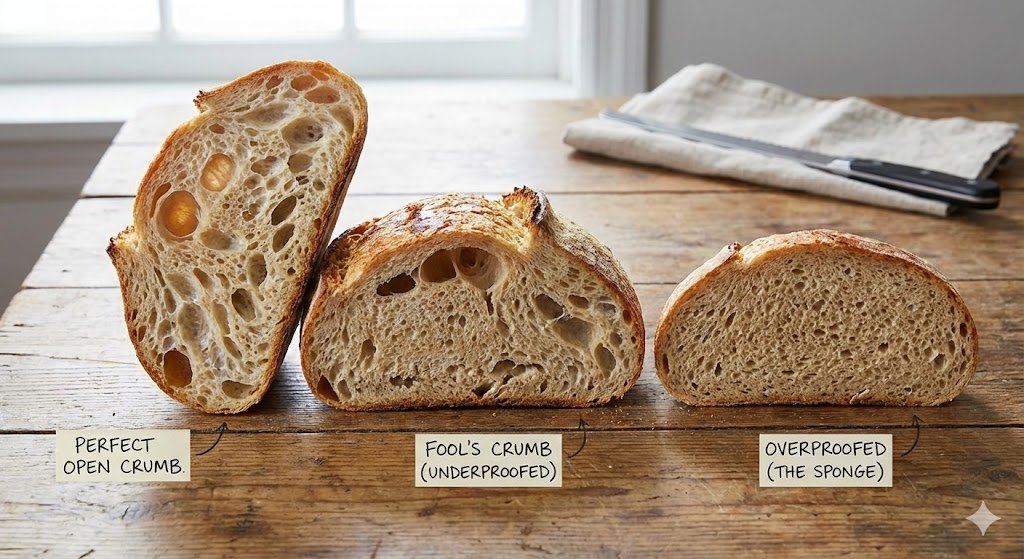
But many bakers, especially beginners, misread the signs. They see a big hole and think, “Success! Open crumb!” when they are actually looking at a major defect.
In this visual guide, we will break down the three main types of sourdough crumb, how to spot the deceptive “Fool’s Crumb,” and what your bread is trying to tell you.
1. The Goal: The “Open Crumb” (Wild Crumb)
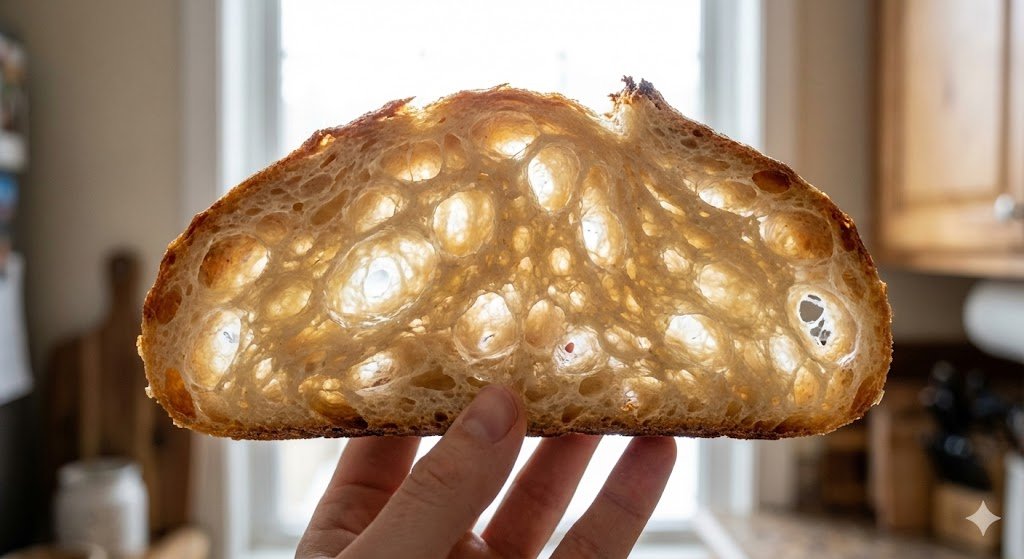
This is what Instagram goes crazy for. But “Open Crumb” doesn’t just mean “air.”
A true open crumb (often called a “Wild Crumb”) is characterized by a network of alveoli (gas pockets) that are:
- Evenly Distributed: There are holes everywhere, from the bottom crust to the top crust.
- Lacy, Not Hollow: The dough between the holes is thin, translucent, and fully cooked (custardy).
- Irregular: A mix of large, medium, and small bubbles that looks organic, not like a manufactured sponge.
How it happens: This is the result of a perfect Bulk Fermentation where the gluten was strong enough to stretch without breaking, and the yeast was active enough to inflate it fully.
2. The Deception: “Fool’s Crumb” (Underproofed)
The Diagnosis: This is the most common mistake in sourdough baking.
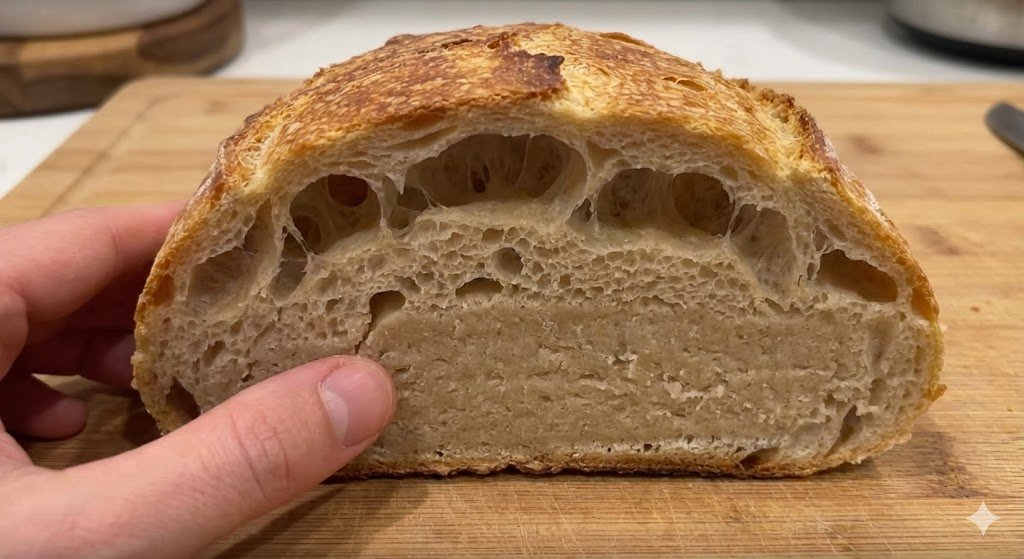
You cut the loaf and see huge, cavernous holes. At first glance, you might celebrate. But look closer. Are those big holes surrounded by areas of tight, dense, gummy dough?
The Cause: You cut the bulk fermentation too short. This is the classic signature of Underproofed Sourdough. If you are unsure if your bread is dense or just irregular, check our detailed diagnosis guide: Why Is My Sourdough So Dense?.
This is Fool’s Crumb. It “fools” you into thinking the bread is airy, but it is actually dense and heavy.
The Anatomy of Fool’s Crumb:
- Tunneling: The big holes are often “tunnels” located near the top crust. This happens because the gluten structure wasn’t developed enough to trap the gas evenly, so the bubbles rushed to the top.
- Dense Bottom: The bottom inch of the loaf is practically solid dough.
- Gummy Texture: The dough between the holes feels wet and sticky.
The Cause:
You cut the bulk fermentation too short. The yeast produced some gas (the big tunnels), but didn’t have enough time to aerate the entire loaf. This is a classic symptom of Underproofed Sourdough.
3. The Collapse: The “Sponge” (Overproofed)
The Diagnosis:
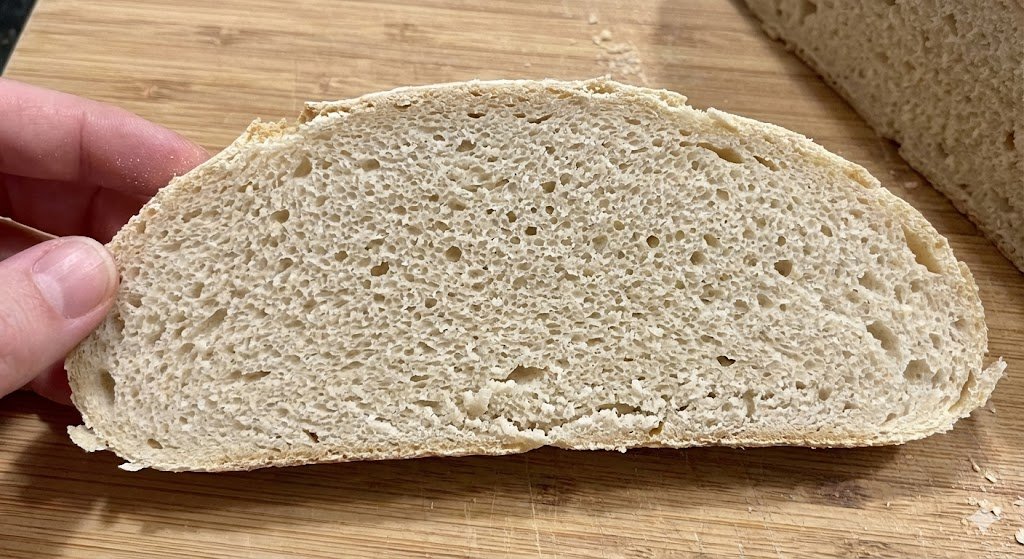
The loaf is flat. When you slice it, the crumb looks incredibly uniform—almost like store-bought sandwich bread—but “shredded.”
The Anatomy of Overproofed Crumb:
- Fragile: If you touch the crumb, it falls apart or tears. It lacks elasticity.
- Yellow/Grey Tint: The dough may look darker than usual because the sugars have been fully consumed.
- No Structure: There are no distinct “walls” to the bubbles; it looks like a collapsing sponge.
The root cause of both overproofing and underproofing is usually the same: not knowing the correct rise percentage for your dough temperature. The bulk fermentation temperature chart gives you that number before you even start mixing.
The Solution: Don’t toss it! The flavor is likely amazing (very sour) and perfect for savory toppings. Turn this failure into dinner with our Overproofed Sourdough Focaccia Rescue Recipe.
The Cause:
The acid load became too high and dissolved the gluten network. The structure literally melted.
- The Solution: Don’t toss it! The flavor is likely amazing (very sour). Use it for Overproofed Sourdough Focaccia.
Sourdough Crumb Chart: Diagnosing Your Slice
Use this sourdough crumb chart to match your slice to its cause. Compare hole placement, texture, and loaf shape across a perfect open crumb, fool’s crumb (underproofed), and an overproofed sponge, then use the fix in the last row.
| Feature | Open Crumb (Perfect) | Fool’s Crumb (Under) | Overproofed (Over) |
| Hole Placement | Even top-to-bottom | Tunnels at top, dense at bottom | Small/Uniform throughout |
| Texture | Soft, Custardy | Gummy, Rubber-like | Dry, Crumbly, Fragile |
| Loaf Shape | Tall, Round | Pyramid / Pointy | Flat / Puddle |
| The Fix | Eat it! | More Time | Less Time |
How to “Read” The Holes
When troubleshooting, ignore the biggest hole and look at the smallest ones.
- Round, shiny small holes: Indicates healthy fermentation.
- Jagged, torn small holes: Indicates the dough was handled too roughly or the gluten was weak.
- Micro-tiny holes (like a bagel): Indicates the starter was weak or the dough is severely underproofed.
Frequently Asked Questions
What is a sourdough crumb chart?
A sourdough crumb chart is a visual guide that matches what your sliced loaf looks like to its likely cause, usually fermentation timing. It helps you tell a true open crumb from fool’s crumb (underproofed) and a collapsed, overproofed crumb, and shows what to change on your next bake.
Why do I get big holes near the crust but dense dough at the bottom?
This is the textbook definition of “Tunneling.” Your oven might be too hot (setting the crust before the inside rises), but 90% of the time, it is because the dough was underproofed.
Can I fix a dense crumb after baking?
No. Once the starch sets at 210°F, the texture is permanent. However, you can prevent it next time by extending your bulk fermentation.
Is an open crumb always better?
Not necessarily! For sandwich bread or toast, a tighter, more uniform crumb is actually preferred so the butter doesn’t leak through. “Open crumb” is a stylistic goal, not a requirement for delicious bread.
Final Thoughts
Don’t be obsessed with giant holes. Focus on evenness. A loaf with small, even holes that is light and fluffy is far better than a loaf with giant tunnels that eats like a rubber tire.
If your crumb looks like a crime scene (dense bottom, flying crust), stop blaming your hydration or your flour. Look at your timing. You are likely dealing with Underproofed Sourdough.