Disclosure: As an Amazon Associate, I earn from qualifying purchases. This post contains affiliate links.
If there is one piece of gear that changed my sourdough game from “decent” to “bakery-quality,” it wasn’t a fancy mixer or an expensive proofing box. It was this humble $50 cast iron pan.
The Lodge 3.2 Quart Cast Iron Combo Cooker is widely considered the “secret weapon” of home sourdough bakers. While brands like Le Creuset and Staub get all the aesthetic glory, this affordable cast iron set actually performs better for bread baking thanks to one specific design feature that solves the biggest headache beginners face: The Risk of Burning Yourself.
But here’s the thing—it’s NOT the only option. If you’re shopping for the best cast iron Dutch oven or bread baking vessel for sourdough, you’ve got at least 5 solid alternatives ranging from $50 to $400. This guide covers all of them so you can make the right choice for YOUR baking style, budget, and loaf size.
What Makes a Dutch Oven (or Combo Cooker) Perfect for Sourdough?
Before we dive into products, let’s talk about what actually matters when choosing a bread baking vessel:
- Superior oven spring – The steam traps heat and keeps your dough flexible while it rises, creating that beautiful puffed loaf.
- Thin and crispy crust – Steam gelatinizes the starch on your bread’s surface, creating that coveted mahogany color and crackle.
- Light, airy crumb – A tightly sealed vessel maintains consistent steam throughout the bake, preventing the dough from crusting over too early.
- Even heat distribution – Cast iron’s thermal mass means your crust develops evenly without burning.
- Safety and ease of use – You shouldn’t have to risk burned hands or deflated dough just to load your bread.
The combo cooker excels at ALL of these. But so do several other options (at different price points). Let’s compare.
What is the “Inverted” Dutch Oven Method?
Standard Dutch ovens are designed for soup, not bread. They have high, scorching hot walls that you have to reach inside of to drop your dough. This leads to:
- Burned knuckles/forearms.
- Deflated dough from dropping it too hard.
- Poor scoring because you can’t reach the dough easily.
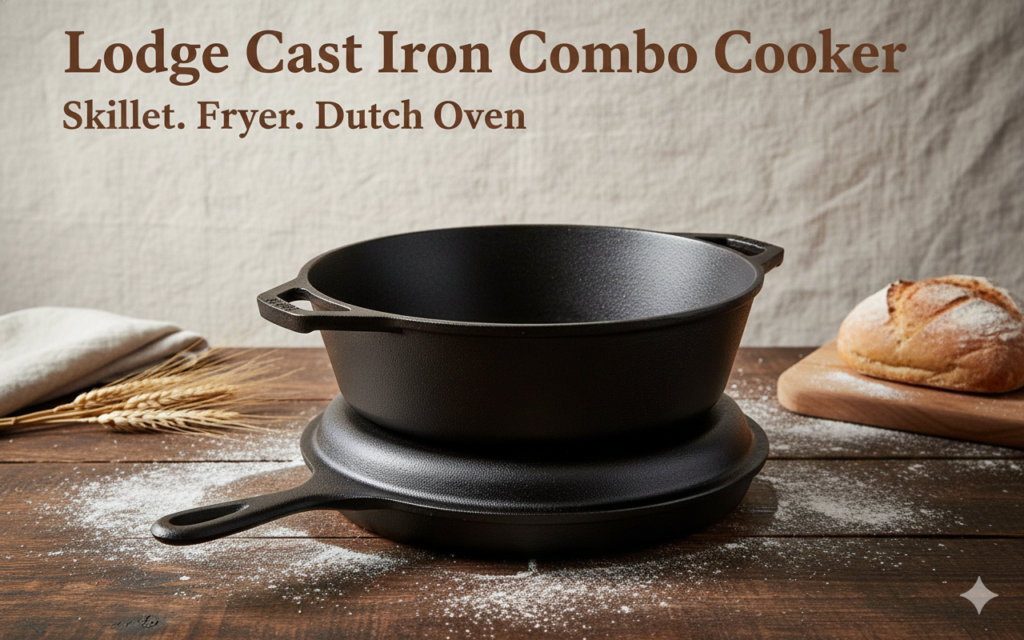
The Lodge Combo Cooker solves this because it is two pieces in one: a deep pot and a shallow skillet that interlock.
The Hack: Instead of baking in the deep pot, you use the shallow skillet as the base and the deep pot as the lid.
This gives you a completely flat baking surface with zero obstructions. It puts you in control, not the pot.
Step-by-Step: How to Bake Sourdough in a Combo Cooker
Using the “Inverted Method” is simple, but following the correct workflow is crucial for safety and maximum oven spring.
Step 1: The Preheat
Place both the shallow skillet and the deep pot in your oven while it preheats to 500°F (260°C). Do not stack them yet; place them side-by-side or on different racks to ensure airflow. Let them soak up heat for at least 45 minutes to one hour. This thermal mass is non-negotiable for a good crust.
Step 2: The Safe Transfer
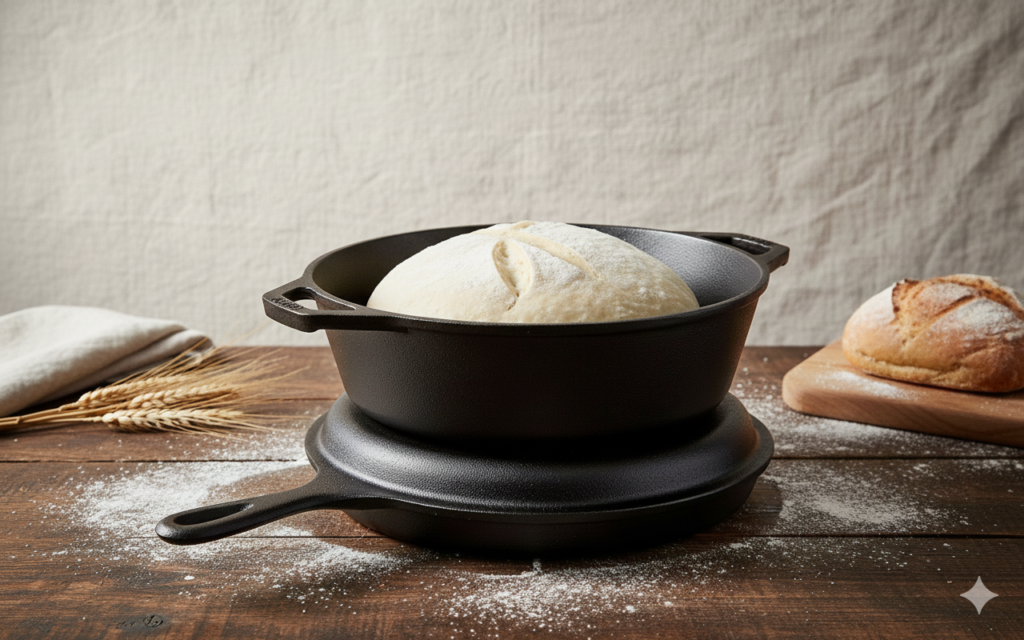
Remove only the shallow skillet from the oven using thick mitts. Place it on a heat-safe surface (stovetop or wooden board). Because the walls are only an inch high, you can gently slide your dough (on a parchment paper sling) directly onto the center.
- Result: No dropping, no deflating, no burns.
Step 3: Score with Confidence
With the dough sitting on the exposed shallow pan, you have 360-degree access. You can now use your scoring lame to create intricate designs or a deep functional score for an “ear” without the hot walls of a pot blocking your hand angle.
Step 4: The Steam Trap
Take the deep pot out of the oven and invert it over the dough, locking it onto the skillet base. This creates a tightly sealed chamber. Place the entire assembly back into the oven.
- Tip: You can throw 1-2 ice cubes into the corner of the skillet pan just before closing the lid to generate massive extra steam.
Step 5: The Reveal (Crucial)
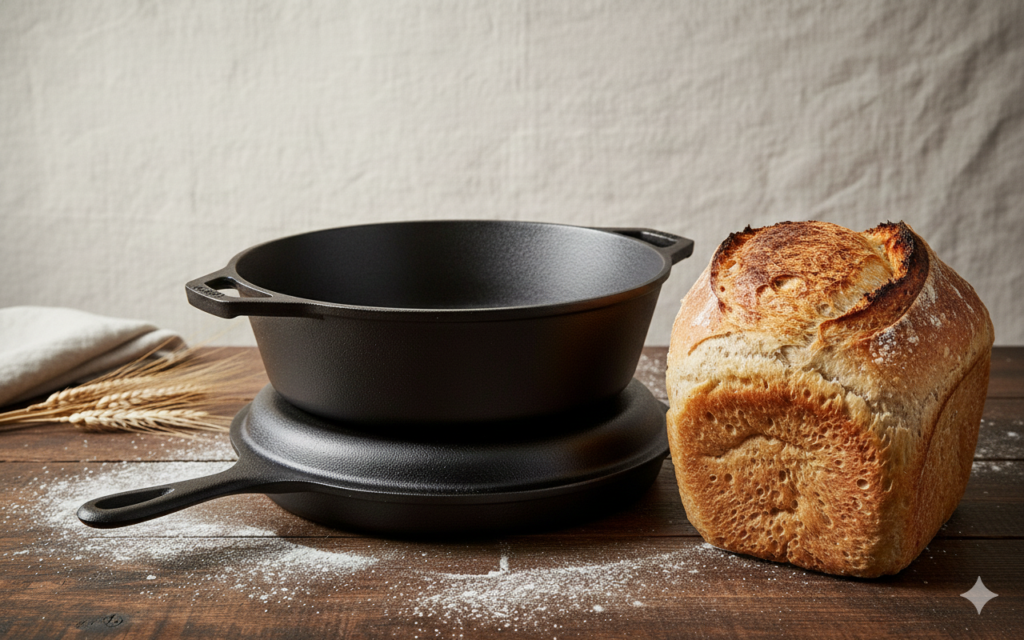
After baking for 20 minutes, you must remove the lid (the deep pot). This is the magic moment.
- Why? The lid traps steam for the rise, but if you leave it on, the crust will stay pale and soft.
- Bake for another 15-20 minutes uncovered until the crust is a deep, shiny mahogany.
Once it cools, slice it with a Bow Knife to keep that airy crumb structure intact.
The Science: Why “Dead Air” Matters
Why does this ~$50 pan often beat a $400 pot? It comes down to thermodynamics and steam density.
Sourdough needs steam to gelatinize the starch on the crust, keeping it flexible so the loaf can expand (rise) before it hardens.
- A 6-Quart Dutch Oven has too much empty space (“dead air”) around a standard loaf. The steam released by the bread dissipates into this large volume, minimizing its effect.
- The 3.2 Quart Lodge fits a standard loaf snugly. This reduces the air volume around the dough, meaning the steam creates a much denser humidity cloud.
The Math: Denser Steam = Better Gelatinization = Shinier Crust + Bigger Blisters.
Lodge Combo Cooker vs. Le Creuset: Is Enamel Worth It?
I love enameled cast iron for braising short ribs, but for bread? Raw cast iron wins.
| Feature | Lodge Combo Cooker | Le Creuset (Standard Dutch Oven) | Winner for Bread |
|---|---|---|---|
| Price | ~$50 | $300 – $450 | Lodge |
| Material | Raw Cast Iron | Enameled Cast Iron | Lodge (More durable) |
| Max Temp | Virtually Unlimited | ~500°F (Knobs can melt/crack) | Lodge |
| Loading | Easy (Shallow Base) | Difficult (High Walls) | Lodge |
| Steam Trap | Excellent (Tight Seal) | Good (looser fitting lids) | Lodge |
| Maintenance | Needs Seasoning | No Seasoning Needed | Le Creuset |
| Hand Safety | Superior (Flat base) | Risky (Deep walls) | Lodge |
The Verdict: Do not risk cracking the enamel on a $400 pot by heating it empty to 500°F. Use the Lodge which is virtually indestructible and puts YOU in control of the baking process.
The Full Lineup: 5 Other Bread Baking Vessels Ranked Against the Combo Cooker
Option 1: Challenger Bread Pan ($200-250)
Best For: Serious home bakers who want premium results and don’t mind paying for it.
Pros: Superior color development on crust, cast iron design mirrors professional bakery equipment, produces exceptional “ear,” highly devoted fanbase online.
Cons: Heavy (harder to maneuver), very pricey, steeper learning curve, loading is more difficult than combo cooker.
Verdict vs Lodge Combo: Better crust quality BUT costs 4-5x more and loading is riskier. Only pick this if budget isn’t a concern and you want to upgrade after mastering the basics.
Option 2: Staub 5.5 Quart Round Cast Iron Cocotte ($277-300)
Best For: Luxury kitchen aesthetic + reliable performance for multiple uses (bread AND braising).
Pros: Beautiful enameled finish, excellent heat retention, lifetime durability, works great for non-bread cooking too.
Cons: Expensive, enamel can craze at high temps with empty oven preheats, traditional pot design (harder to load bread safely), overkill if you only bake bread.
Verdict vs Lodge Combo: Better looking but harder to use and 5-6x the price. Enameled Dutch ovens are fine for sourdough IF you’re willing to tolerate potential enamel discoloration at high temps and accept the burn risk.
Option 3: Regular Lodge 5 Quart Cast Iron Dutch Oven ($60-70)
Best For: Traditional sourdough bakers who like the classic pot-with-lid setup and need versatility beyond bread.
Pros: Affordable (same price as combo cooker), extremely versatile (works for soup, roasts, stews, braising), excellent heat retention, same brand reliability as combo cooker.
Cons: Deep walls make loading risky (burn danger), steam trap is less efficient due to larger air volume around standard loaves, requires careful parchment maneuvering.
Verdict vs Lodge Combo: Same price, but combo cooker is SAFER and creates denser steam for better oven spring. This is your backup option if combo cookers are out of stock—it works, but isn’t ideal for bread-only users.
Option 4: KUHA Cast Iron Bread Pan ($60-80)
Best For: Budget-conscious bakers wanting a dedicated bread pan with modern design.
Pros: Affordable, pre-seasoned, includes silicone handles for extra safety, newer design with customer testimonials, good reviews on Amazon.
Cons: Less established brand than Lodge (fewer online resources/community tips), smaller pool of user feedback, less proven track record over time.
Verdict vs Lodge Combo: Similar price and performance, but combo cooker is more battle-tested with decades of proven results. KUHA is a solid alternative if you can’t find the Lodge in stock or prefer supporting newer brands.
Option 5: Grande Jones Dutchess ($350-400)
Best For: Premium bakers with an open budget and strong aesthetic taste. Want to make a statement in the kitchen.
Pros: Stunning ombré colors (cherry red, lavender, teal), oval shape fits batards PERFECTLY, heirloom quality (lifetime investment), beautiful enough to display on open shelving.
Cons: VERY expensive (7-8x the combo cooker), primarily a luxury/aesthetic item, traditional pot design with all the loading risks, overkill for functionality.
Verdict vs Lodge Combo: Wildly overpriced for sourdough functionality. Lodge does the same job for 1/7th the cost. Buy this ONLY if you’re a luxury collector or want the most beautiful pot in your kitchen. For pure performance, it’s a waste.
Lodge Combo Cooker vs Traditional Dutch Oven (5-6 Quart): When to Choose Each
CHOOSE COMBO COOKER IF:
- You’re a beginner worried about burning yourself
- You want maximum safety + ease of loading
- You’re baking 500g flour loaves (standard recipe)
- You want the tightest steam seal possible
- Budget is a factor ($50 vs $60+)
- You prefer a flat-bottom design
CHOOSE TRADITIONAL 5-6 QUART DUTCH OVEN INSTEAD IF:
- You want to bake multiple loaves at once (use multiple pots side-by-side)
- You need larger capacity (800g+ flour loaves)
- You prefer the classic “pot with lid” aesthetic
- You already own a Dutch oven and don’t want to buy new gear
- You plan to use it for OTHER cooking (soups, roasts, braising, etc.)
REAL TALK: Most home bakers bake 1-2 loaves at a time using 500g flour recipes. For that use case, the combo cooker wins on safety + steam efficiency. If you’re baking large batches or bigger loaves, a 5-6 quart traditional Dutch oven works fine—just expect to reach into hot walls and accept slightly looser steam control.
Sizing Guide: Is 3.2 Quarts Actually Big Enough?
This is the #1 fear people have. “It looks so small!”
The 3.2 Quart capacity is optimized for standard home recipes. It comfortably fits:
- Round Boules: Up to 1kg total dough weight (approx 500g-600g flour).
- Oval Batards: Standard 10-inch oval bannetons fit perfectly.
Because the base is round, your oval loaves will bake with slightly rounded ends, but they still achieve amazing height. Unless you are baking massive 1.5kg miches for a party, this size is perfect.
Pro Tip: Test fit your banneton in the combo cooker BEFORE baking. Make sure there’s at least 1 inch of space around all sides for steam circulation.
Maintenance for Bread Bakers
Since you are using this primarily for bread, maintenance is actually easier than normal cast iron skillets.
- Use Parchment Paper: Always bake with parchment. This means your bread never actually touches the iron, so there is zero sticking.
- No Soap Needed: Since there is no food residue, you usually just need to wipe it out with a dry cloth after it cools.
- Prevent Rust: If it looks dry, rub a tiny drop of neutral oil (canola/grapeseed) on it while it’s still warm. Store it in a dry place.
Expanded FAQ: 10 Critical Questions
Should I preheat the lid (the deep pot) too? Yes! If the lid is cold, it will act as a heat sink, absorbing heat away from your loaf rather than radiating heat into it. This can ruin your oven spring. Always preheat both pieces side-by-side or on separate racks.
Will parchment paper burn at 500°F? Most parchment is rated for 450°F, but it generally works fine at 500°F inside a combo cooker. Because it is trapped in a low-oxygen environment (sealed inside the pot), the paper will turn brown and brittle, but it typically will not catch fire. Just don’t let the corners stick out past the pan.
Can I use this for things other than bread? Absolutely. Use the shallow skillet for frying eggs, searing meat, or sautéing vegetables every morning. Use the deep pot for soups, stews, braising, roasting vegetables, or even baking brownies. It’s a true kitchen workhorse.
Does it create a good “ear”? Yes. Because the steam is so concentrated and you can score at the proper 45-degree angle without hitting the pot walls, the Lodge Combo Cooker is famous for producing prominent ears. This is one major advantage over traditional Dutch ovens with high walls.
Can I bake oval batards in the round combo cooker? Yes, but they’ll have slightly rounded ends. Use a smaller oval banneton (10-inch) and there’s plenty of space. Many bakers actually prefer the rounded-end look.
What’s the difference between the combo cooker and a traditional 5-quart Dutch oven? The combo cooker has a flat base + cloche lid (inverted method). A traditional Dutch oven is a pot with a domed lid. The combo cooker is safer to load and creates denser steam; the traditional Dutch oven is more versatile for other cooking tasks and works for larger loaves.
Can I use a combo cooker for cold fermentation baking? Yes! You can bake directly from cold dough (skip the 45-minute preheat step, or reduce to 30 min). You’ll get less oven spring but MORE crust color and a more open crumb. Great for overnight bakes when you want to bake first thing in the morning.
How does the combo cooker compare to the Challenger Bread Pan? The Challenger produces slightly better crust color due to superior heat retention and premium materials. But it costs $200 vs $50 and is harder to load. For most home bakers (especially beginners), the combo cooker wins on value and safety. Upgrade to Challenger after you’ve baked 50+ loaves successfully.
Can I bake TWO loaves in the combo cooker at once? Technically yes if they’re tiny (250g each), but the steam distribution gets compromised and you won’t get optimal results. Bake one loaf per combo cooker for best results. If you need to bake multiple loaves, buy 2-3 combo cookers ($150 total) instead of one expensive Dutch oven.
Is the combo cooker worth it vs a cheap enameled Dutch oven? 100%. Cheap enameled Dutch ovens from Amazon ($30-40) often have loose-fitting lids, won’t handle 500°F safely without enamel damage, and have deep walls (major burn risk). The Lodge combo cooker is the same price with superior design, proven safety, and decades of track record. Buy the combo cooker.
Final Verdict: Which Should You Buy?
BUY THE LODGE COMBO COOKER IF:
- You want the safest, easiest bread baking vessel ($50, no contest)
- You’re baking standard 500g flour loaves
- You’re a beginner scared of burning yourself
- You want maximum steam concentration for perfect oven spring
- You want proven, battle-tested design (thousands of positive reviews)
BUY A 5-6 QUART DUTCH OVEN INSTEAD IF:
- You bake larger loaves (800g+) or multiple loaves regularly
- You want to use it for other cooking (soups, roasts, braising, etc.)
- You prefer traditional aesthetics
- You want an enamel finish that never needs seasoning
SPLURGE ON CHALLENGER IF:
- Budget isn’t a concern ($200+)
- You want the absolute best crust color + ear
- You’re baking seriously (selling, feeding 50+ people)
- You’ve already mastered the basics and want to upgrade
VERDICT: For 90% of home sourdough bakers, the Lodge Combo Cooker is the right choice. It’s affordable, safe, proven, and produces bakery-quality bread. Start here. Upgrade later if you want to.
Your Next Steps
- Order the Lodge Combo Cooker (link above on Amazon)
- Grab high-temp oven gloves (you’ll need them for safety)
- Get parchment paper (store brand is fine)
- Bake your first loaf using the inverted method above
- Share your results – tag us on Instagram @sourdougharchive
You’ve got this. Bakery-quality sourdough is 100% within reach, and a $50 pan is the secret weapon to get you there.
Happy baking!