Description
You have a working starter. You’ve baked more than a few loaves. And the results still change from week to week: a side burst one bake, a flat puddle the next, a gummy band you can’t explain. This guide finds which stage actually failed and gives you one fix to test on your next bake.
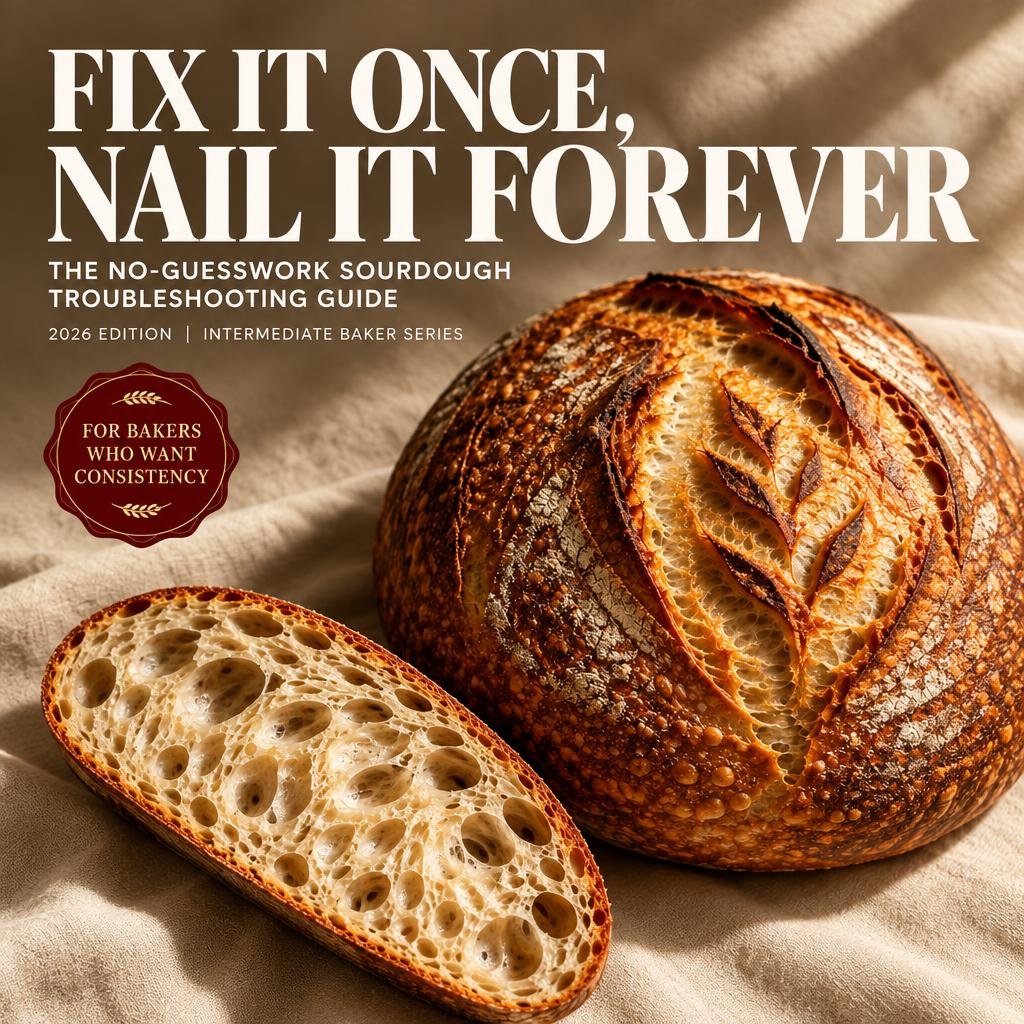
Most sourdough troubleshooting advice matches a symptom to a fix. The problem is that one symptom can have four different causes. A flat loaf can come from over-proofing, weak shaping, a warm kitchen, or a new bag of flour, and the fixes point in opposite directions. Fix It Once is a 19-page printable sourdough troubleshooting guide PDF that teaches you to read the evidence first, confirm the cause, and then change only one variable.
Find your loaf in 30 seconds
This is a preview of the Quick Triage Matrix from page 5. Start with the symptom, run the first check, and look for the clue that points to one cause.
| What you see | Check first | What it usually means |
|---|---|---|
| Score seals and the side bursts | Score angle, depth, and seam | A rupture 1–2 cm from the score means the slash was not the expansion path. Read more on scoring sourdough. |
| Dough spreads at turn-out | Bulk vs. post-retard handling | Strong at bulk but weak after retard means fermentation passed its structural peak. See dough spreading instead of rising. |
| Giant tunnels next to gummy zones | The fully cooled crumb and proof record | Tall holes beside tight, paste-like crumb means fermentation was incomplete, not that the bake was too short. See why sourdough turns gummy. |
| Pale, leathery, or lifted crust | Actual oven heat and lid-off time | A pale matte crust points to weak heat or steam. A broad gap under the top plus explosive spring points to under-proofing. See pale sourdough after baking. |
| New flour makes dough tight or slack | A same-water 90-minute rest | Late relaxation means delayed water uptake. Early spread means the flour is weaker at that hydration. |
| Your routine suddenly races or spreads | Final dough temperature | Above 25°C (78°F), early bubbles and slackness mean schedule drift. Learn how dough temperature controls fermentation. |
What’s inside the guide
Every diagnostic section follows the same four steps: ranked likely causes, a test to prove which cause is yours, a fix for each confirmed cause, and a single “next bake” instruction.
-
Fermentation diagnosticsWhy the same timetable gives different loaves, and how to read temperature, aeration, and strength instead of the clock. Includes the poke test bake point.
-
Shaping and structure failuresDough that puddles at turn-out or rips during shaping, and how to tell excess fermentation from weak dough strength.
-
Scoring and oven springSealed scores, side blowouts, and no ear. Exact score angle and depth, plus the preheat and steam schedule behind better oven spring.
-
Crumb problemsTunnels, gummy bands, and a single cavern under the crust. How to separate a proofing problem from a baking problem using internal temperature.
-
Crust issuesPale, thick, leathery, or lifted crust, and the steam-to-dry handoff that controls it. Related: crust too thick.
-
Flour and hydration variablesWhat to change when a new flour turns your dough into a brick or a puddle, including whole grain, fresh-milled, and rye. Background: sourdough hydration explained.
-
It worked once, then stoppedSeasonal temperature drift, starter timing, and the silent swaps that break a routine that used to work.
-
Combination problemsWhen two causes stack together, such as a cold kitchen plus a weak starter. How to untangle them and fix the earliest stage first.
Plus the tools that make it stick
A visual atlas of nine loaf photos that maps what you see to the right section, the 3-Bake Practice Plan (isolate, confirm, lock it in), a tear-out quick reference of every “next bake” instruction, printable bake logs, a field vocabulary, and 32 cited technical sources.
Is this guide for you?
Yes, if you…
- Have a starter that reliably rises
- Have baked several loaves with mixed results
- Want to know why a fix worked, so you can repeat it
- Bake in a kitchen that changes with the seasons
Not yet, if you…
- Are still building your first starter. Start with the free Starter SOS guide and starter not doubling fixes.
- Haven’t baked a full loaf yet
Free library vs. the guide
The free troubleshooting library answers one question at a time, like how to fix overproofed sourdough or how to tell when bulk is done. Fix It Once connects those answers into one system. It shows you which question to ask first, how to prove the cause before you change anything, and how to confirm a fix across three bakes so it isn’t a lucky loaf.
Questions
Is this a physical book?
No. It’s an instant PDF download in US Letter size, designed to print cleanly on a home printer in color or grayscale. You can also read it on a phone, tablet, or computer.
How is this different from free sourdough troubleshooting charts?
Most charts give one fix per symptom. This guide ranks up to four likely causes for each problem, gives you a test to confirm which one applies to your loaf, and then gives a specific fix with numbers: temperatures, percentages, and time increments.
Does it cover sourdough starter problems?
It covers how starter timing and strength affect your bread, including using a starter at the wrong moment. It is not a guide to building a new starter. For that, use the free Starter SOS guide.
Will it help with a flat or gummy loaf?
Yes. Flat, spreading loaves are covered in the fermentation, shaping, and scoring sections. Gummy crumb is covered in the crumb section, which shows how to tell under-fermentation from underbaking.
Do I need special equipment?
A kitchen scale and a probe thermometer make the diagnostic steps much easier, since the guide measures dough temperature and internal loaf temperature. A covered baker helps with the crust section. See the Dutch oven guide if you don’t have one.
Does it work for rye and whole wheat?
Yes. The flour and hydration section covers whole grain, high-extraction, fresh-milled, and rye flours, including why rye can’t be judged by wheat-style strength.
How do I get the file after I buy?
The download link appears on the order confirmation page and in your confirmation email right after checkout.

Reviews
There are no reviews yet.