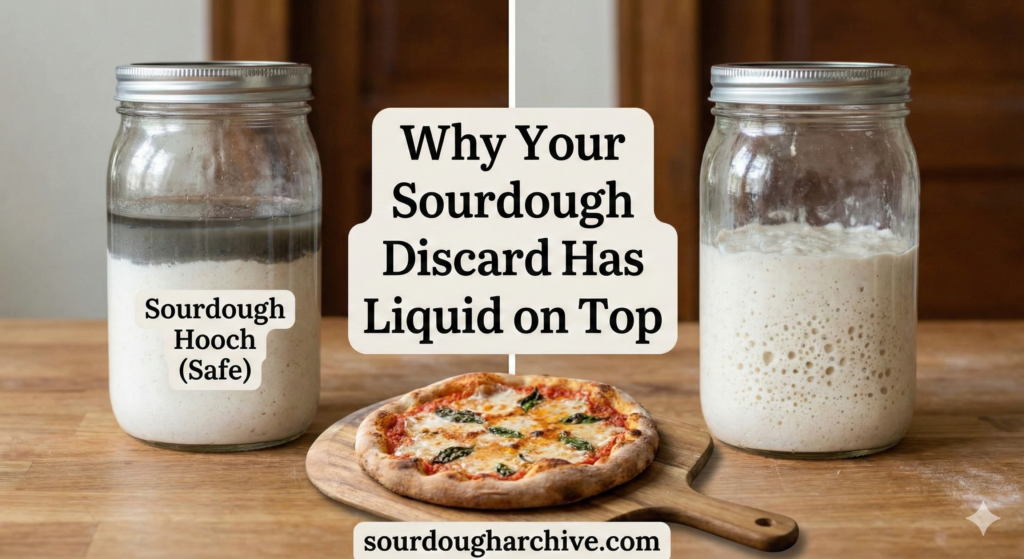
You reach into the back of your fridge to grab your jar of starter, only to find a layer of dark, murky liquid sitting on top of the flour mixture. It looks ominous—almost like dirty dishwater—and your instinct might be to throw the whole thing in the trash. Stop! That liquid is not a sign of spoilage; it is a biological signal called “hooch,” and it is completely natural. In fact, that liquid is often the secret ingredient to the deep, tangy flavor profile found in most sourdough recipes.
“If hooch is accompanied by a sharp acetone or nail polish remover smell, your starter has moved past hungry into active starvation — see the full recovery protocol in our guide on sourdough starter smells like acetone.”
In fact, that liquid is often the secret ingredient to the deep, tangy flavor profile found in my favorite sourdough discard pizza dough recipe.
The first time I encountered hooch, I was convinced I had killed my starter. I saw a grey layer of liquid and immediately assumed it was mold juice. I dumped a month-old culture down the disposal, only to learn later that I had wasted the most flavorful stage of the fermentation process. Don’t make my mistake—let’s dive into the science of why this happens and how you can use it to your advantage.
What is Sourdough Hooch? (The Science of Fermentation)
In professional baking terms, that liquid layer is simply alcohol produced as a byproduct of fermentation.
Is your starter producing hooch AND not rising? That’s a hunger and fermentation issue covered in full in the Why Your Sourdough Starter Isn’t Rising: Complete Diagnostic Guide.
When your starter is “active,” the yeast and bacteria are happily feeding on the starches in the flour. As the food supply runs out, the starter transitions from an active starter to sourdough discard. The yeast becomes stressed and “hungry,” and as the solids settle at the bottom, the alcohol separates and rises to the top.
Don’t throw that discard away! Try making these sourdough discard crackers with rosemary and sea salt or these fluffy sourdough discard pancakes instead.
If your starter seems sluggish even after feeding, here’s a deeper look at a sourdough starter that won’t double and how to fix it.
- The Signal: Hooch is your starter’s way of saying, “I’m starving! Feed me or use me!”
- The Composition: It is mostly water and ethanol (alcohol), which gives it that strong, boozy smell similar to beer or nail polish remover (acetone).
Hooch is a sign your starter is over-fermented, but other factors may be affecting its performance too. For a full troubleshooting breakdown, visit why your sourdough starter isn’t working.
The Great Debate: Should You Pour It Off or Stir It In?
One of the most common questions I get is whether to keep the hooch or discard it. The answer depends entirely on your flavor preference for your final bake.
Option 1: Stir It In (For the Sourdough Purist)
If you love a pizza crust that punches you in the mouth with sourness, stir the liquid back in.
- Why: That liquid is concentrated acidity. Mixing it back into the discard lowers the overall pH of your mixture.
- Baking Result: This is perfect for savory recipes like pizza, focaccia, or artisan crackers where a sharp tang is desired.
Option 2: Pour It Off (For a Milder Flavor)
If you prefer a more subtle, nutty flavor, or if you are making sweet treats like discard pancakes or brownies, pour the liquid off before weighing your discard.
- Why: Removing the hooch removes the most intense sour notes.
- Baking Result: A milder flavor profile that won’t overpower delicate toppings or sweet ingredients.
Baker’s Tip: If you pour the hooch off, you are lowering the hydration of your discard. Be sure to replace that lost liquid volume with a tablespoon of water if your batter feels too thick. Always use your digital scale to measure the remaining discard accurately to ensure your recipe ratios stay correct.
Safety Check: When is Liquid a Warning Sign?
While hooch is safe, it can look alarming. Here is how to distinguish between a hungry starter and a spoiled one.
The Color Spectrum
- Clear to Grey: This is normal for discard that has been in the fridge for 1–2 weeks.
- Dark Grey to Black: This indicates the discard has been neglected for a long time (3+ weeks). It is still safe to use, but the flavor will be very intense.
If you’re not sure what’s wrong overall, read:
How to fix a sourdough starter that isn’t working
- Pink, Orange, or Green: STOP. If you see any bright neon colors or fuzzy growth on the surface or rim of the jar, this is mold. Unlike hooch, mold cannot be scraped off safely. The spores have likely penetrated the entire mixture. Throw it out and sterilize your jar.
(Unsure if your discard is too old? Check my guide on How Long Sourdough Discard Is Good For to be certain.)
How Hooch Affects Gluten Development
Hooch is highly acidic. While acid adds flavor, it also acts as a dough conditioner that breaks down gluten.
- The “Slack” Effect: If you stir in a lot of dark hooch, your dough may feel stickier or “slack.” The acid weakens the gluten development, making the dough very extensible (stretchy).
- The Pizza Advantage: This is actually beneficial for pizza! A highly extensible dough is easier to hand-stretch paper-thin without tearing.
- Cold Proofing is Key: To counteract the stickiness, I always recommend a cold proofing stage in the fridge. This firms up the dough and makes it manageable, even if you used very acidic, hooch-covered discard.
Once you’ve got the hooch under control and your starter is active, here’s how to use your sourdough starter to bake a great loaf.
Final Pro Tip: Preventing the Buildup
If you find hooch forms too quickly (within a few days), your starter is running out of food too fast.
- Adjust Your Ratio: Switch to a higher feeding ratio (e.g., 1:5:5 – 1 part starter, 5 parts flour, 5 parts water) to give the yeast more food before it goes into the fridge.
- Thicker is Better: A stiffer starter (less water) produces hooch much slower than a runny one.
Ready to embrace the tang? Take that hungry, hooch-topped discard and turn it into a masterpiece. Head over to my sourdough discard pizza dough recipe and fire up the oven!
Related Starter Guides:
- Why Your Sourdough Starter Isn’t Rising: Complete Diagnostic Guide
- Sourdough Starter Not Doubling
- How to Strengthen a Weak Sourdough Starter
- Sourdough Starter Smells Like Acetone Fix
- Sourdough Starter Smell Guide
- Revive a Dried Sourdough Starter
- 72-Hour Sourdough Starter
- How to Keep Your Sourdough Starter Warm
- Winter Sourdough Guide