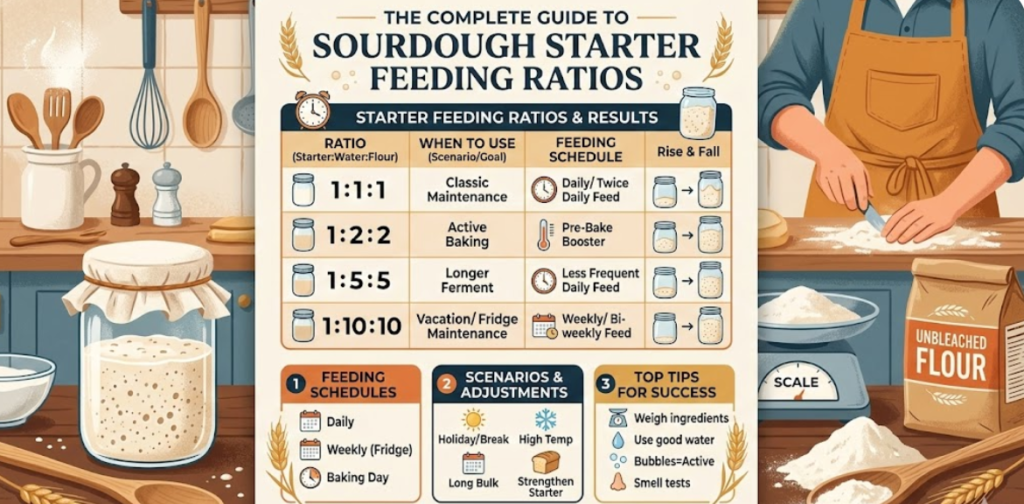
Quick Answer: Sourdough Starter Chart
A sourdough starter chart is a reference showing how much starter, flour, and water to combine at each feeding — expressed as a ratio by weight (starter : flour : water). The most common ratios are 1:1:1 (daily maintenance), 1:2:2 (before baking), and 1:3:3 or higher (warm kitchens or weak starters). The right ratio depends on your kitchen temperature, baking schedule, and starter health.
| Goal | Ratio | Example (grams) | When to Use | Time to Peak |
|---|---|---|---|---|
| Daily maintenance | 1:1:1 | 25g + 25g + 25g | Routine feeding at 68-74°F | 6-8 hours |
| Preparing to bake | 1:2:2 | 20g + 40g + 40g | Night before baking | 8-12 hours |
| Strengthening weak starter | 1:3:3 | 10g + 30g + 30g | After neglect or sluggish starter | 10-14 hours |
| Slowing fermentation (warm, 78F+) | 1:4:4 to 1:5:5 | 10g + 50g + 50g | Summer heat, warm kitchens | 12-16 hours |
| Faster fermentation (cool, under 66F) | 1:1:1 | 30g + 30g + 30g | Winter baking, cold kitchens | 8-12 hours |
Pro tip: Time to peak always varies. Use these numbers as starting estimates, then track your own starter’s behavior. After a few days of observation you will know its rhythm precisely.
Getting your feeding ratio right is one of the most impactful things you can do as a sourdough baker. Feed too little and your starter over-ferments, becoming overly acidic and weak. Feed too much and it may never reach peak activity when you need it. This sourdough starter chart gives you a simple system whether you bake every day or only once a month.
If you are brand new to sourdough, start with our sourdough starter recipe first so you understand what you are actually feeding. If your starter is not rising at all, see our troubleshooting guide for a starter that will not double.
Sourdough Feeding Ratio Chart: How Much to Feed Your Starter
This sourdough feeding ratio chart shows how much starter, flour, and water to mix at each feeding. Use 1:1:1 for daily maintenance, 1:2:2 the night before baking, and 1:3:3 to 1:5:5 in a warm kitchen or when you feed less often. The ratio is always starter : flour : water by weight, so it scales to any amount.
Sourdough Starter Chart by Temperature
Kitchen temperature is the single biggest variable in fermentation speed. The warmer it is, the faster your starter eats through its food — which means you need to give it more. Here is the complete sourdough starter chart for adjusting your feeding ratio by temperature.
| Kitchen Temp | Recommended Ratio | Approx. Time to Peak | Notes |
|---|---|---|---|
| 60-65°F (15-18°C) | 1:1:1 | 12-16 hours | Very slow — use warm water (80°F) to help; consider proofing in oven with light on |
| 65-70°F (18-21°C) | 1:1:1 | 10-14 hours | Slow but reliable; smaller ratio keeps starter active enough to peak |
| 70-75°F (21-24°C) | 1:1:1 to 1:2:2 | 6-10 hours | Ideal range for most bakers; either ratio works well |
| 75-80°F (24-27°C) | 1:2:2 | 5-8 hours | Activity speeds up noticeably; 1:2:2 prevents over-fermentation |
| 80°F+ (27°C+) | 1:3:3 to 1:5:5 | 4-8 hours | High ratios essential to prevent collapse between feedings |
If your starter is peaking and collapsing before you can use it, increase the ratio by one step. If it is barely rising at all, decrease the ratio or use warmer water (80-85°F) at feeding time.
How to Calculate Sourdough Feeding Ratios
A sourdough feeding ratio is written as three numbers — starter : flour : water — and each number represents a proportion by weight. You do not need to use any specific quantity; the ratio scales up or down to fit whatever amount you need.
The formula: Starter (g) x Ratio Multiplier = Flour (g) and Water (g)
Step-by-step example — 1:2:2 ratio:
- Decide how much starter to keep — let’s say 25g.
- The ratio is 1:2:2, so the multiplier is 2.
- Flour = 25g x 2 = 50g.
- Water = 25g x 2 = 50g.
- Combine: 25g starter + 50g flour + 50g water = 125g total.
If your recipe calls for 100g of active starter, work backward: at a 1:2:2 ratio you need 20g old starter + 40g flour + 40g water = 100g of levain.
A Quick Note on Sourdough Hydration Percentage
When flour and water are added in equal amounts (as in all the ratios above), your starter runs at 100% hydration. That simply means the weight of water equals the weight of flour. Most recipes assume 100% hydration unless stated otherwise. Our sourdough hydration guide breaks this down in more detail.
Sourdough Starter Feeding Schedule
| Storage Method | Feeding Frequency | Ratio to Use | Notes |
|---|---|---|---|
| Counter (68-75°F) | Every 12-24 hours | 1:1:1 to 1:2:2 | Adjust ratio up if starter collapses before next feeding |
| Counter (warm, 78°F+) | Every 8-12 hours | 1:3:3 to 1:5:5 | High ratio needed to prevent over-fermentation |
| Refrigerator | Once per week | 1:2:2 or 1:3:3 | Feed, let bubble 1-2 hrs at room temp, then return to fridge |
| Before baking | 1-2 feedings before mixing | 1:2:2 | Use at peak — domed, doubled, not yet collapsed |
Room Temperature (Counter)
Feed once every 12-24 hours using the ratios above, adjusted for your kitchen temperature. If your starter consistently peaks and falls before the next feeding, either increase the ratio or move it to a cooler spot.
Refrigerator Storage
Feed once per week. Take the starter out, discard all but 25g, feed at 1:2:2 or 1:3:3, let it sit at room temperature for one to two hours until you see some bubbles, then return it to the fridge. The day before you plan to bake, pull it out and give it one or two room-temperature feedings to wake it up.
Before Baking
Give your starter a 1:2:2 feeding 8-12 hours before you plan to mix your dough. Use it when it has roughly doubled in size and the surface is domed — not yet collapsed. This is when yeast activity is at its peak and acidity is balanced.
Visual Signs Your Starter Is Ready to Use
| Sign | What It Looks Like | What It Means |
|---|---|---|
| Doubled in size | Risen to 2x post-feeding level | Peak yeast activity — ideal time to use |
| Domed surface | Top is rounded and convex, not flat or sunken | Still at or near peak — good to use |
| Bubbles throughout | Small bubbles visible on sides and top | Active fermentation — healthy starter |
| Float test passes | Small spoonful floats in water | Enough gas produced — ready for most recipes |
| Smells yeasty/tangy | Pleasant sour, beery, or yogurt-like smell | Healthy acid balance — good to use |
| Collapsed surface | Top has fallen flat or sunken inward | Past peak — feed again before using |
Sourdough Starter Troubleshooting Chart
| Problem | Likely Cause | Fix |
|---|---|---|
| Not doubling | Weak yeast, too cold, chlorinated water | Feed 1:1:1 every 12 hrs with whole wheat mix; use filtered water; warm location |
| Collapsing too quickly | Running out of food; kitchen too warm | Increase to 1:3:3 or 1:5:5; move to cooler spot; use cooler water |
| Too runny | Over-fermented or wrong flour ratio | Confirm feeding by weight not volume; switch to bread flour |
| Too stiff | Flour absorbing more water than expected | Add a few extra grams of water; whole grain flours absorb more |
| Smells like vinegar | Over-fermented; too much acetic acid | Discard to 10g; feed at 1:5:5 for 2-3 feedings to dilute acid |
| Smells like acetone | Yeast exhausted; hooch forming | See our guide on fixing acetone smell |
| Hooch (liquid on top) | Hungry starter; fed too infrequently | Pour off hooch, discard, feed immediately at 1:2:2 |
| Pink or orange streaks | Bacterial contamination | Discard entire starter — do not use. Start fresh. |
Remember: Troubleshooting takes two to three days of consistent feeding to show results. Do not change multiple variables at once.
Can I Use Different Flours When Feeding?
| Flour Type | Fermentation Speed | Notes |
|---|---|---|
| White bread flour | Standard baseline | Most predictable; gives strong gluten structure |
| All-purpose flour | Slightly slower | Lower protein — reliable but less vigorous than bread flour |
| Whole wheat (partial) | 20-30% faster | Excellent for boosting weak starters; adds nutrients |
| Rye (partial) | 30-40% faster | Even small amounts dramatically accelerate fermentation |
| Spelt | Slightly faster | More extensible — monitor closely to avoid over-fermentation |
Frequently Asked Questions
What is a sourdough feeding ratio chart?
A sourdough feeding ratio chart is a quick reference that lists the starter : flour : water proportions to use for each goal, such as maintenance, pre-bake feedings, or slowing fermentation in warm weather. Pick the row that matches your goal and kitchen temperature, then scale the weights to the amount you need.
What is the best sourdough starter feeding ratio?
For most home bakers, 1:2:2 (one part starter, two parts flour, two parts water by weight) is the most versatile ratio. It works well for both daily maintenance and pre-bake feedings in a typical 68-75°F kitchen. If your kitchen is cooler, 1:1:1 is a reliable default.
Is a 1:1:1 feeding ratio enough?
Yes, for daily maintenance in moderate temperatures. However, if your kitchen is warm (above 75°F) or you are preparing to bake and want a more vigorous levain, switching to 1:2:2 or 1:3:3 will give you a stronger rise and a milder flavor.
Can I feed my starter 1:5:5?
Absolutely. A 1:5:5 ratio is excellent for hot environments or when you want to skip a feeding and buy extra time. It takes significantly longer to reach peak — usually 10-16 hours — which makes it a useful tool for overnight levains or less frequent feeding schedules.
How often should I feed my sourdough starter?
At room temperature, feed every 12-24 hours. In a warm kitchen (78°F+), feed every 8-12 hours or increase your ratio. In the fridge, once per week is sufficient. Always give at least one room-temperature feeding before using your starter in a recipe.
Should I feed my sourdough starter by weight or volume?
Always by weight. A cup of flour can vary by 40g or more depending on how it is scooped. Feeding by weight ensures your hydration percentage stays consistent, which makes your starter — and your bread — far more predictable.
Does the feeding ratio change in winter?
Yes. Cold slows fermentation, so most bakers drop to 1:1:1 in winter to help the starter peak in a reasonable timeframe. Using warm water (80-85°F) at feeding time also helps compensate for cool ambient temperatures without changing the ratio. For more seasonal tips, check out our winter sourdough guide.
What does hooch on top of my starter mean?
Hooch is a grey or dark liquid that forms on top of a hungry starter. It is a byproduct of alcohol fermentation and means your starter has run out of food. It is not harmful — pour it off or stir it in, then feed immediately. To prevent hooch, increase your feeding frequency or ratio.
How do I know my starter is strong enough to bake with?
Your starter is ready to bake with when it consistently doubles within 4-8 hours of feeding, has a domed surface at peak, smells pleasantly sour and yeasty, and passes the float test. If it meets all four criteria reliably, your starter is strong enough to leaven bread.
Keep Learning
- Sourdough Hydration Explained — understand hydration percentages and how they affect your starter and dough
- Bulk Fermentation for Beginners — what happens after your starter goes into the dough
- Sourdough Bulk Fermentation Chart — temperature and time reference for the bulk ferment stage
- How Long Can You Cold Proof Sourdough — the final fermentation stage after shaping
- Overproofed vs. Underproofed Sourdough — how to diagnose and fix fermentation problems