Sourdough Bagels — Chewy, Crusty & Made from Scratch
These sourdough bagels have a crackly crust, a genuinely chewy crumb, and that subtle tang you can't get from commercial yeast. You only need a handful of pantry staples and an active starter — no specialty equipment required.
⬇ Jump to Recipe
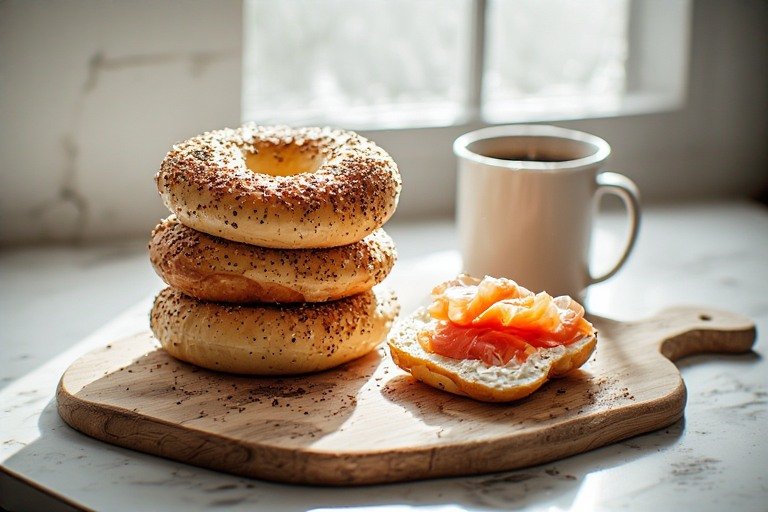
Homemade sourdough bagels — chewy, golden, and made with wild yeast starter.
- 450 g (3 ½ cups) bread flour — plus more for dusting
- 150 g (⅔ cup) active sourdough starter (100% hydration, fed & bubbly)
- 200 g (¾ cup + 1 tbsp) water, room temperature
- 10 g (1 ¾ tsp) fine sea salt
- 15 g (1 tbsp) honey or barley malt syrup (divided: 10 g dough, 5 g boiling water)
- For the boiling bath: 2 L water + 1 tbsp baking soda + 1 tbsp honey/malt syrup
- Toppings (optional): everything bagel seasoning, sesame seeds, poppy seeds, flaky salt
- Mix the dough. In a large bowl, combine flour, starter, water, salt, and 10 g honey. Mix until no dry flour remains. The dough will feel stiff — that's correct for bagels. Cover and rest 30 minutes.
- Knead. Turn onto an unfloured surface and knead 8–10 minutes until smooth and elastic. It should pass the windowpane test.
- Bulk ferment. Place in a lightly oiled bowl, cover tightly, and ferment at room temperature (70–75°F / 21–24°C) for 8–12 hours, until roughly 50–75% risen and bubbly.
- Divide & shape. Turn dough onto a lightly floured surface. Divide into 8 equal pieces (~100 g each). Shape each into a tight ball, then poke your thumb through the center and stretch the hole to about 2 inches wide. Place on a parchment-lined sheet pan.
- Proof. Cover with a damp towel and rest 30–60 minutes at room temperature, until slightly puffed but NOT fully proofed.
- Preheat oven. Set oven to 450°F (230°C) with a rack in the upper-middle position.
- Boil. Bring the boiling bath to a vigorous simmer. Boil bagels 2 at a time, 30 seconds per side (1 minute total). Remove with a slotted spoon back to the sheet pan.
- Top. Immediately after boiling, dip or sprinkle bagels with your chosen toppings.
- Bake. Bake at 450°F for 22–25 minutes until deep golden brown with a hard crust. Cool on a wire rack at least 15 minutes before slicing.
- Starter must be active: Feed 6–8 hours before mixing; it should be domed and bubbly.
- Stiff dough is normal: Bagel dough is much drier than bread dough. Don't add extra water.
- Longer boil = thicker crust: For a softer crust, boil only 20 seconds per side.
- Make ahead: After shaping, refrigerate overnight uncovered on the pan. Boil and bake cold from the fridge.
- Freeze: Once baked and cooled, freeze in a zip bag up to 3 months. Toast from frozen.
Step-by-Step: How to Make Sourdough Bagels
Step 1 — Feed Your Starter (6–8 Hours Before Mixing)
Feed your starter at a 1:1:1 ratio (starter : water : flour). It's ready when domed, bubbly, and passes the float test. Using starter past its peak will give you flat, dense bagels. Don't have one yet? Start here: how to make a sourdough starter. If yours isn't rising, see why your sourdough starter isn't doubling.

Your starter should look like this — domed, bubbly, and active before mixing. Learn more about feeding and maintaining your sourdough starter.
Step 2 — Mix & Rest the Dough
Combine all dough ingredients in a large bowl. Mix until a shaggy dough forms with no dry streaks. Cover and let rest 30 minutes (autolyse). This rest makes kneading easier.
Step 3 — Knead to a Smooth, Elastic Dough
Knead on a bare counter (no flour) for 8–10 minutes. The dough will start rough and become smooth and taut. Test: stretch a small piece thin — if it's translucent without tearing, you're done.
Step 4 — Bulk Ferment (8–12 Hours)
Place in a lightly oiled bowl, cover tightly with plastic wrap or a lid, and ferment at room temperature. In a warmer kitchen (76°F+), check at 7 hours. You want 50–75% volume increase with visible bubbles under the surface. New to this step? Read the full bulk fermentation guide for beginners and the best bulk fermentation temperatures for sourdough.
Step 5 — Divide and Shape
Use a kitchen scale to divide into 8 pieces of about 100 g each. Shape into tight balls by pulling the dough under itself. Rest 5 minutes, then poke through the center and stretch to a 2-inch hole. Set on parchment-lined baking sheets.

Shaped and ready to proof — holes should be about 2 inches wide.
Step 6 — Proof (30–60 Minutes)
Cover with a damp towel and let rest. The bagels should puff slightly — they won't double. If you press one gently and it springs back slowly, they're ready. If it springs back instantly, give them more time. Not sure what to look for? See the full underproofed vs overproofed sourdough guide.
Step 7 — Boil the Bagels
This step is non-negotiable for chewy sourdough bagels. Bring a wide pot of water to a rolling simmer. Add baking soda and malt syrup. Slide in 2 bagels at a time. Boil 30 seconds, flip, 30 seconds more. The baking soda gelatinizes the crust so the bagels stay chewy inside.

Boil 30 seconds per side — don't skip this step. It's what makes them bagels.
Step 8 — Top & Bake
While still wet from the boiling bath, press toppings firmly onto the surface. Bake at 450°F (230°C) for 22–25 minutes. Pull them when deep brown — not just golden. The color is the flavor.
Tips for Chewy Sourdough Bagels Every Time
For the bulk fermentation timing on this recipe, use the sourdough bulk fermentation chart as your guide — bagel dough ferments similarly to lean sourdough at the same temperature.

The crumb should be chewy and tight — not airy like sandwich bread.
- Use bread flour, not all-purpose. The higher protein content (12–14%) builds the gluten network that gives bagels their chew.
- Keep the dough stiff. Bagel dough hydration is around 55–60%. Resist adding more water.
- Don't skip the boil. Boiling sets the crust, giving that signature chew. Skipping it produces a bread roll, not a bagel.
- Add baking soda to the water. It raises the pH and creates a shinier, chewier crust. Barley malt syrup adds sweetness and color.
- Don't over-proof. Over-proofed bagels flatten in the boiling bath. Slightly under-proofed is better than over.
- Bake hot. 450°F is not optional. A hot oven creates oven spring and crust set.
Overnight Sourdough Bagels (Cold Proof Method)
This is the easiest way to fit sourdough bagels into a busy schedule — and cold proofing actually improves flavor.
- Evening, Day 1: Mix and knead the dough. Complete bulk ferment at room temperature (8 hours).
- Before bed: Shape bagels, place on parchment-lined pans, and slide uncovered into the refrigerator.
- Morning, Day 2: Preheat oven to 450°F. Bring boiling bath to a simmer. Boil bagels directly from the fridge — no need to temper them. Bake as normal.
Cold-proofed sourdough bagels often have better crust texture and a slightly deeper tang. This is the method I recommend for beginners. Learn more about cold fermenting sourdough and how long you can cold proof sourdough.
Sourdough Bagel Variations
Everything Sourdough Bagels
Mix 1 tbsp each: sesame seeds, poppy seeds, dried minced garlic, dried minced onion, and flaky salt. Press onto wet bagels generously before baking.
Cinnamon Raisin Sourdough Bagels
Add 1 tsp cinnamon and 15 g sugar to the dough during mixing. Fold in 80 g raisins during the last 2 minutes of kneading. These are best with no toppings — a cinnamon sugar crust tends to burn.
Sesame Sourdough Bagels
Dip the entire wet bagel into a shallow bowl of toasted sesame seeds. Both sides. Don't be shy.
Asiago & Herb
Press shredded Asiago cheese onto the tops before baking. Add dried rosemary or thyme to the dough during mixing (1 tsp).
Jalapeño Cheddar
Fold 60 g shredded sharp cheddar and 1 finely diced jalapeño into the dough during kneading. Top with extra cheese before baking.
Have leftover sourdough discard after making these? Put it to work: sourdough discard crackers, fluffy sourdough discard pancakes, or sourdough discard tortillas.
Sourdough Bagels FAQ
Ready to Bake Your Sourdough Bagels?
Sourdough bagels are one of the most satisfying things you can make with a starter. They take patience, but none of the steps are difficult — and the results are far better than anything from a grocery store bag. Once you nail the basics, the variations are endless.
If you try this recipe, leave a comment below and let me know how they turned out. And if you have questions about your starter or fermentation times, I'm happy to help troubleshoot.