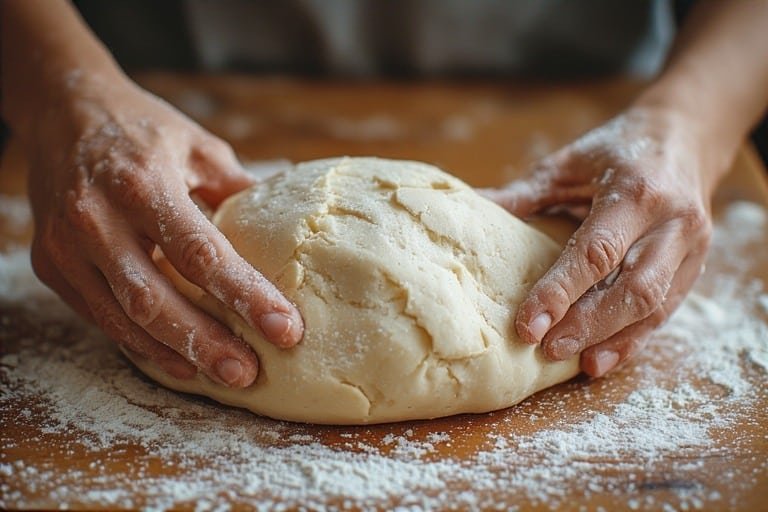
When your dough fights you back
You’ve done the bulk. You’ve done the folds. You turn the dough out to shape it and… it acts like it’s offended. Every time you try to tighten it up, it just springs back, refuses to hold shape, and basically tells you to leave it alone.
That shrinking-back thing has a name: gluten memory. It’s actually a sign that your gluten is strong — maybe too strong, right now — and you just need to work with the dough instead of against it. Here’s why it happens and how to fix it.
Dough that shrinks back during shaping is a classic sign of underfermentation — the gluten is too tight and the yeast hasn’t produced enough gas. The bulk fermentation chart shows the minimum rise percentage your dough needs before it’s ready to shape.
What “shrinking back” actually means
You know it when you feel it:
- You stretch the dough, let go, and it immediately snaps back
- You try to build surface tension and the skin wrinkles
- The dough feels rubbery, bouncy, resistant
- After pre-shaping, the ball barely relaxes
This isn’t weak dough. This is tight dough. Different problem, different fix.
👉 Related: How to shape sourdough boule & batard
Cause #1: The gluten is too tight (you skipped the rest)
When you pre-shape (or fold, or work) the dough, you’re tightening up the gluten network. Those strands need time to relax before you can shape them again. Without rest, they spring back like a stretched rubber band.
How to fix it:
- After pre-shaping, rest the dough uncovered for 20–30 minutes
- Room temp is fine; cover loosely with a tea towel if your kitchen is dry
- Test with a gentle push — if it still snaps back hard, rest another 10 minutes
- THEN do your final shape
Most beginners don’t rest long enough. The rest is where the magic happens.
👉 Related: Sourdough folding techniques guide
Cause #2: Dough is too cold
Cold dough is stiffer and less cooperative. If you’re pulling dough straight out of the fridge and trying to shape it immediately, it’ll fight you.
How to fix it:
- If bulk fermenting in the fridge, let dough come to room temp for 30–60 minutes before shaping
- If cold-retarding after shaping, shape at room temp first
- Cold dough shapes well for the final into-banneton move, but not for building initial tension
Exception: Some bakers intentionally shape cold dough for very wet doughs (85%+ hydration) because it’s easier to handle. That’s a different move — you’re not trying to build much tension, just pocket-fold and drop into the banneton.
Cause #3: Too much gluten development
Yes, this is a thing. If you did 6 sets of stretch-and-folds, used high-protein bread flour, AND the dough is on the lower-hydration side, you may have built a gluten network that’s way too stiff for easy shaping.
How to fix it:
- For your next loaf, cut back to 3–4 sets of folds
- Try 72–75% hydration instead of 65–70%
- If mixing by hand, stop when the dough is smooth and elastic — not when it’s springy and tough
- Consider coil folds or lamination instead of aggressive stretch-and-folds
Strong gluten is great. Rigid gluten isn’t.
👉 Related: Sourdough hydration explained · Sourdough dough too wet
Cause #4: You’re fighting the dough instead of working with it
When dough shrinks back, the instinct is to push harder, stretch more, force it. This makes it worse. You’re just building more tension into an already tight network.
How to fix it:
- Use a light touch — gentle coaxing, not wrestling
- Let gravity do some of the work (a good shaping technique uses the bench for tension)
- If it resists, STOP. Walk away for 10 minutes. Come back. It’ll cooperate.
- One pre-shape + one final shape is plenty. Don’t re-shape 4 times.
Dough doesn’t want to be molded. It wants to be guided.
Cause #5: Underproofed dough
If your dough snaps back hard AND feels dense and tight, you might just be under-fermented. Fermentation gases help the dough soften and become more extensible. Underproofed dough is tight by nature.
Signs you’re underproofed:
- Dough is dense and barely risen
- No visible bubbles on the sides of your bulk container
- Dough feels like a firm, tight ball
- Poke test: dough springs back immediately and fully
How to fix it:
- Extend bulk fermentation — look for 50–75% rise, not a fixed time
- Warm up your bulk environment (75–78°F is ideal)
- Check your starter strength — weak starter = slow bulk
👉 Related: Bulk fermentation for beginners · Sourdough underproofed vs overproofed
The fix that works 90% of the time: pre-shape + rest
Most shrinking-back problems disappear when you add a proper pre-shape and rest. Here’s the full flow:
- Bulk fermentation done → gently turn dough onto lightly floured counter
- Pre-shape: use a bench scraper to fold the dough onto itself, forming a loose ball. Don’t fight it, don’t overwork it.
- Rest uncovered, 20–30 minutes. This is the part people skip. Don’t skip it.
- Final shape: flip the pre-shaped ball so the smooth side is down. Fold, stitch, and tighten into a taut ball or batard.
- Drop into banneton seam-side up.
The rest is where the dough stops fighting. Without it, you’re trying to shape a stressed rubber band.
👉 Related: Shaping and scoring guide
FAQs
How long should the rest between pre-shape and final shape be? 20–30 minutes usually. If dough still snaps back hard, rest another 10. You’re waiting for the gluten to relax, not for the dough to ferment more.
Does resting the dough overproof it? No. 20–30 minutes at room temp is too short to meaningfully over-ferment. You’re resting the gluten, not finishing the proof.
Should I flour the counter during shaping? Lightly. Too much flour prevents you from building surface tension (the dough slides). Work on a mostly unfloured counter for the final shape — the friction is what creates tension.
What if I skipped the pre-shape entirely? Your dough will probably fight you more. Not a disaster — just final-shape gently, expect some wrinkling, and rest 10 minutes if it snaps back during shaping.
Can I use olive oil on my hands instead of flour? Yes, especially for wet doughs. Oil prevents sticking without changing the dough’s hydration. Many pros shape with wet or oiled hands.
Still having shaping issues?
- Dough not holding shape at all? → Sourdough dough spreading not rising
- Dough tearing instead of stretching? → Need more gluten development — try folding techniques
- Sticky mess that won’t cooperate? → How to fix sticky dough
- Full shaping walkthrough: Shaping and scoring guide
Shrinking-back dough isn’t broken. It just needs a minute. Give it rest, use a lighter touch, and your next shape will be clean, tight, and cooperative.