Rye sourdough gets talked about online with a lot of confidence — “supports immune function,” “keeps candida in check,” “packed with probiotics.” Some of that holds up under actual research. Some of it doesn’t, and a few claims have specifically failed to hold up when regulators reviewed the clinical evidence behind them. This guide separates what’s genuinely well-supported from what’s marketing language borrowed from supplement copy, so you can make an informed decision rather than a hopeful one.
This is one guide in our full rye sourdough bread recipe collection. This content is educational, not medical advice — if you have a specific digestive condition, talk to a doctor or dietitian about what’s right for you.
What’s Actually Well-Supported by Evidence
Fiber content and regularity
This is the most solid, least controversial benefit. Whole grain rye is genuinely high in fiber, including pentosans — a soluble fiber distributed throughout the entire rye grain rather than concentrated mainly in the bran the way it is in wheat. That fiber adds bulk to stool and supports regular bowel movements, a straightforward, well-documented mechanism rather than a stretch claim.
Lower glycemic response
Multiple studies, including research from the University of Eastern Finland, have linked rye consumption to better blood sugar management compared to wheat bread. Rye’s fiber structure slows digestion and glucose absorption, producing a more gradual blood sugar rise. This is one of the more consistently replicated findings in rye-specific nutrition research, not just a single small study.
Improved mineral bioavailability from fermentation
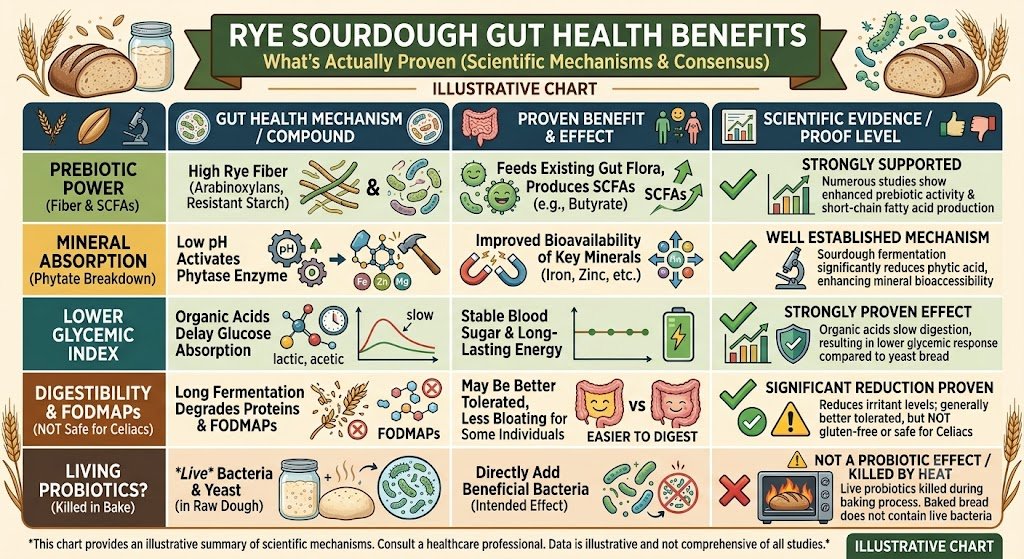
Sourdough fermentation breaks down phytic acid — a compound naturally present in whole grains that binds to minerals like iron, zinc, and magnesium and can inhibit their absorption. Reducing phytic acid through fermentation is a real, measurable effect that improves how much of those minerals your body can actually absorb from the same flour, and this applies to rye sourdough specifically since rye is often used in the highest-percentage whole grain forms.
Lignans and antioxidant compounds in rye bran
Whole grain rye, particularly its bran layer, is a notable dietary source of lignans — plant compounds that gut bacteria convert into enterolignans, which have been studied for potential antioxidant and hormone-modulating effects. Rye is consistently cited as one of the richer dietary sources of these compounds compared to other common grains. As with the metabolite research above, this is an active area of nutrition science with real biological plausibility, but the clinical significance for any individual’s health outcomes is still being established rather than definitively proven, and it shouldn’t be read as a guarantee of a specific health outcome.
What’s Promising but Still Early or Preliminary
Rye-specific metabolites and gut bacteria interaction
A notable metabolomics study found that both the lactic acid bacteria involved in rye fermentation and the bacteria already living in the gut interact to produce betaine derivatives from compounds found in rye — derivatives that, in earlier research, appeared to reduce oxygen demand in heart muscle cells. This is genuinely interesting research and helps explain some of rye’s associations with cardiovascular health, but it’s still an emerging area studied primarily in animal and in vitro models rather than large-scale human clinical trials. Treat this as a promising research direction, not a settled, guaranteed health outcome.
Microbiome diversity effects
Some smaller studies have found positive shifts in gut microbiome composition after regular sourdough consumption, but results are mixed — one frequently cited 2017 study on wholemeal sourdough found positive microbiome effects in only about half of participants, not universally. Individual gut microbiomes vary enough that a food affecting one person’s microbiome favorably doesn’t guarantee the same effect for everyone.
Where the Marketing Gets Ahead of the Science
“Rye sourdough is a probiotic food”
This is one of the most repeated claims online, and it’s largely inaccurate for baked bread specifically. Baking temperatures kill the live lactic acid bacteria and yeast present in the dough — the bread you eat doesn’t contain live, active cultures the way yogurt or kefir does. What survives baking are the fermentation byproducts (organic acids, broken-down phytic acid, altered starch structure) and, more accurately, rye’s fiber can act as a prebiotic — food that feeds beneficial bacteria already in your gut — rather than a probiotic that introduces new live bacteria. If a source describes baked sourdough bread as “full of probiotics,” that’s a meaningful inaccuracy worth being skeptical of.
“Sourdough fermentation eliminates gluten” or “keeps candida overgrowth in check”
Fermentation reduces gluten somewhat and can make bread easier to digest for people with mild sensitivities, but it does not eliminate gluten, and rye sourdough bread remains unsafe for anyone with celiac disease. Claims linking sourdough to controlling candida or yeast overgrowth in the gut are not well substantiated by clinical research and should be treated as unverified marketing language rather than an established benefit.
Official health claim reviews have been stricter than blog content
It’s worth knowing that when specific health claims about high-fiber rye sourdough bread’s effect on post-meal blood sugar were formally submitted for regulatory approval in the EU, they were rejected — not because rye sourdough showed no effect, but because the supporting studies compared it to a glucose solution rather than to a comparable bread made without sourdough fermentation, which wasn’t rigorous enough to isolate sourdough’s specific contribution. This doesn’t mean the underlying benefit is false, but it’s a useful reminder that confident claims in blog content often outrun what’s actually been rigorously proven in controlled comparisons.
The Bloating Question
If you’re new to whole grain rye and notice bloating after switching, that’s commonly your gut adjusting to a meaningfully higher fiber intake rather than a sign of intolerance. Gut bacteria populations shift and adapt to increased fiber over a period of days to weeks, and a gradual increase in intake — rather than switching straight from white bread to a dense 100% rye loaf — tends to make that adjustment period more comfortable. If bloating is severe, persistent, or accompanied by other symptoms, that’s worth discussing with a doctor rather than pushing through it, since it could indicate something beyond normal fiber adjustment.
Satiety and Appetite: A Well-Documented Secondary Benefit
Beyond digestion specifically, rye’s fiber structure has been studied for its effect on fullness and appetite. Research from Swedish institutions has found that rye bread can extend feelings of fullness meaningfully longer than white bread — some studies cite a difference of several hours — largely because its fiber slows gastric emptying, meaning food stays in the stomach longer before moving into the small intestine. This isn’t a direct “gut health” benefit in the microbiome sense, but it’s a genuinely well-supported effect with practical relevance for anyone managing appetite or trying to reduce snacking between meals, and it’s one of the more consistently replicated findings in the rye research literature.
FODMAPs, IBS, and Long Fermentation
For people managing irritable bowel syndrome or general sensitivity to fermentable carbohydrates, long sourdough fermentation has research support for reducing FODMAP content in the finished bread — some studies cite reductions as high as 90% for properly long-fermented sourdough compared to quickly risen commercial bread. Because rye structurally requires a longer, more thorough fermentation to work at all (covered above), rye sourdough is more likely to have actually undergone that full FODMAP-reducing fermentation than a “sourdough” label slapped on a quickly risen commercial loaf with only a token fermentation step. That said, individual tolerance varies significantly, and anyone with a diagnosed IBS or FODMAP sensitivity should treat this as a potentially helpful direction to discuss with a dietitian, not a guaranteed fix, and should introduce any new bread cautiously rather than assuming fermentation makes it universally safe.
A Historical Note: The Nordic Diet Connection
Rye’s reputation for gut and metabolic health isn’t purely a modern marketing invention — it’s tied to decades of observational research on traditional Nordic diets, where whole grain rye has been a dietary staple for centuries. Populations with high traditional rye consumption have been studied extensively for cardiovascular and metabolic outcomes, and much of the more rigorous research behind rye’s health reputation (including the University of Eastern Finland work referenced above) comes out of exactly these long-running Nordic and Scandinavian research programs, rather than newer, less-established studies. This context matters because it means rye’s health associations are backed by a genuinely long research tradition, even though — as covered above — not every specific claim made about it in marketing content holds up to the same rigor.
Practical Tips for Getting the Most Benefit
- Choose whole grain rye, not just “rye-flavored.” Check that whole rye flour is listed as a primary ingredient, not just added for color or flavor behind a wheat-flour-majority dough.
- Favor higher rye percentages if fiber and mineral bioavailability are your main goal, understanding that this trades off against the lighter, more familiar texture of lower-percentage blends.
- Introduce rye gradually if you’re not used to a high-fiber diet, to minimize the adjustment-period bloating discussed above.
- Don’t rely on rye sourdough as a “probiotic” strategy — if live cultures specifically are your goal, that comes from unbaked fermented foods like yogurt, kefir, or unpasteurized sauerkraut, not from baked bread.
- Pair with a generally high-fiber, varied diet rather than treating any single food, including rye sourdough, as a complete solution for gut health — the research consistently points to dietary variety and overall fiber intake as more impactful than any one ingredient.
Does Rye Percentage Change the Gut Health Benefit?
Broadly, yes — the fiber, phytic-acid-reduction, and mineral-bioavailability benefits scale with how much whole grain rye is actually in the loaf, not with rye flavor or darkness alone. A dark-colored loaf that gets its color from molasses or cocoa rather than a high percentage of actual rye flour won’t deliver the same fiber content as a genuinely rye-forward loaf — worth checking the ingredient list rather than judging by color, similar to the point we cover in our dark rye sourdough (pumpernickel-style) guide. Higher-percentage rye loaves, like our 100% rye sourdough bread, deliver the most concentrated version of these fiber and mineral benefits per slice, though their density also means a little goes further, so portion size matters when comparing benefit per typical serving.
Does Sourdough Fermentation Matter More for Rye Than for Wheat?
In one specific respect, yes — rye structurally depends on sourdough’s acidity to set properly during baking (covered in depth in our rye sourdough vs wheat sourdough guide), which means virtually all traditional high-percentage rye bread is fermented long enough to get meaningful phytic-acid reduction as a side effect of that structural requirement. Commercially yeasted wheat bread, by contrast, can be risen in a couple of hours with minimal fermentation-driven nutritional benefit. This is part of why rye sourdough specifically tends to carry a stronger nutritional reputation than “sourdough” as a general category — the grain itself effectively forces a longer, more beneficial fermentation process.
A Reasonable, Evidence-Grounded Summary
- Solid: higher fiber than wheat, supports regularity, lower glycemic impact, improved mineral absorption from phytic acid breakdown.
- Promising but early: specific gut-bacteria-derived metabolites linked to cardiovascular markers, microbiome diversity shifts.
- Overstated or inaccurate: “probiotic” claims about baked bread, gluten elimination, candida/yeast overgrowth control.
- Individual: results vary meaningfully person to person, and formal health-claim reviews have found much of the supporting research less rigorous than marketing suggests.
Frequently Asked Questions
Does eating rye sourdough replace the need for other fiber sources?
No — the research supporting rye’s benefits is generally in the context of a varied diet with multiple fiber sources, not as a single-food solution. Rye sourdough can be a genuinely beneficial part of a high-fiber diet, but treating any one food as sufficient on its own isn’t supported by the broader nutrition research.
Is rye sourdough bread a probiotic food?
No, not in the way that term is usually meant — baking temperatures kill the live bacteria and yeast present in the dough, so the finished bread doesn’t contain live active cultures the way yogurt or kefir does. Rye’s fiber can act as a prebiotic, feeding bacteria already present in your gut, which is a different (and more accurate) mechanism than the probiotic claim often made.
Can rye sourdough help with blood sugar control?
Research links rye consumption to a lower glycemic response and better blood sugar management compared to wheat bread, and this is one of the more consistently supported findings in rye nutrition research. It shouldn’t be treated as a substitute for medical guidance if you’re managing diabetes or another blood sugar condition specifically.
Why do I feel bloated after eating rye sourdough for the first time?
This is commonly your gut adjusting to a significant increase in fiber intake, which typically improves over days to weeks as your gut bacteria adapt. Introducing rye gradually rather than switching abruptly from low-fiber white bread tends to make this transition more comfortable.
Is 100% rye sourdough healthier than a lower-percentage rye blend?
It generally delivers more fiber and mineral-bioavailability benefit per slice, since those benefits scale with the amount of actual whole grain rye in the loaf. That said, 100% rye is also denser and more filling, so the meaningful comparison is benefit per typical serving, not just benefit per 100 grams.
Is rye sourdough safe for people with celiac disease?
No — rye contains gluten, and sourdough fermentation reduces but does not eliminate it. Rye sourdough bread, at any percentage, is not safe for anyone with celiac disease or a diagnosed gluten intolerance.
Rye Sourdough — More Guides
- 📖 Rye Sourdough Bread Recipe
- 🌾 How to Make a Rye Sourdough Starter
- 🍞 Why Is My Rye Sourdough Dough So Sticky?
- ⚖️ Is Rye Sourdough Supposed to Be Dense?
- 🌑 100% Rye Sourdough Bread
- 🍫 Dark Rye Sourdough Bread (Pumpernickel-Style)
- ⚖️ Rye Sourdough vs Wheat Sourdough
- 💧 Rye Sourdough Hydration Ratio
- 💧 Converting a Wheat Starter to Rye
- ⚖️ Rye Sourdough Gut Health Benefits