Most rye hydration advice stops at “use more water than wheat” and hands you a single percentage. That’s not wrong, but it skips the part that actually trips people up: how to calculate your real total hydration once your starter and any scald are factored in, how starter hydration is a completely separate number from dough hydration, and how to adjust when your specific flour or kitchen doesn’t match the recipe you’re following. This guide covers the math, not just the target numbers.
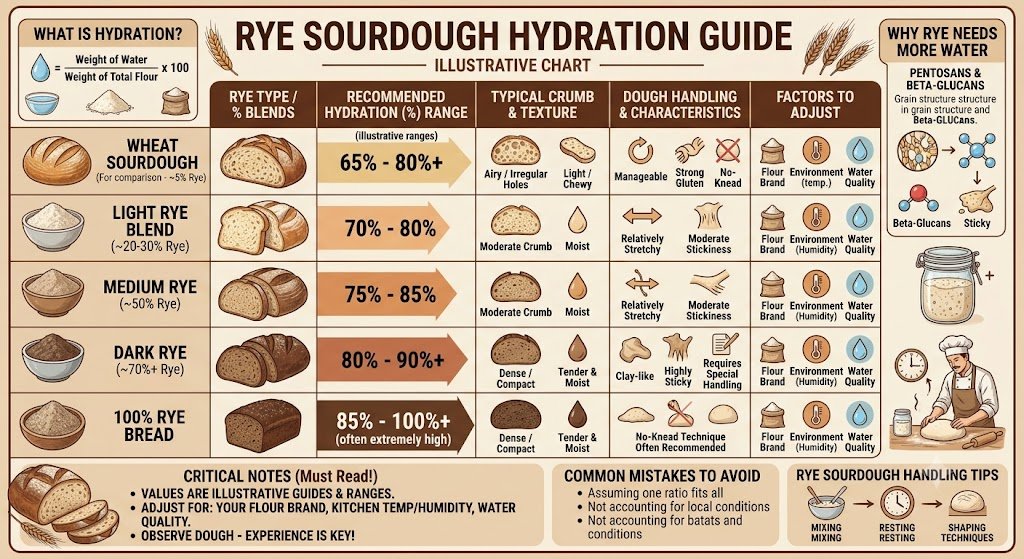
For the full rye percentage and hydration framework by loaf style, see our main rye sourdough bread recipe guide. This post goes deeper into the calculation side specifically.
Why Rye Needs So Much More Water Than Wheat
Rye’s water-holding capacity comes from pentosans — a soluble fiber that can absorb up to roughly eight times its own dry weight in water, forming a thick gel as it hydrates. Wheat’s gluten proteins don’t have anywhere close to that absorption capacity, which is the entire reason rye recipes run so much wetter than wheat recipes at what looks, on paper, like a similar dough consistency. This isn’t a stylistic choice — it’s what the flour physically requires to hydrate properly and develop workable structure. It’s also worth noting that this absorption capacity isn’t uniform across all rye products: coarser cracked rye or rye meal absorbs water more slowly and less completely than finely milled rye flour, since a smaller surface area of the grain is directly exposed to water at any given moment — one more reason two “rye” recipes calling for the same percentage hydration can behave differently depending on exactly what form of rye each one used.
Quick Reference: Dough Hydration by Rye Percentage
| Rye % in Blend | Typical Dough Hydration |
|---|---|
| 10–20% rye | Bread flour baseline + 2–3% |
| 30–40% rye | 75–78% |
| 50–70% rye | 80–85% |
| 90–100% rye | 85–100%+ |
This table is the starting point most rye hydration content stops at. The rest of this guide covers what happens once you add a starter and a scald into that number — because “80% hydration” printed at the top of a recipe often isn’t actually telling you the full story.
Starter Hydration Is a Different Number Than Dough Hydration — Don’t Confuse Them
This is the single most common point of confusion in rye hydration discussions. Your starter has its own hydration percentage, based on the ratio of water to flour you feed it, completely independent of your final dough’s hydration target:
- 100% hydration starter — equal weights of flour and water (e.g., 50g flour, 50g water). This is the most common standard, easiest to convert between recipes, and what most published rye recipes assume unless stated otherwise.
- 125–133% hydration starter — noticeably wetter, closer to a thick batter. Some rye bakers prefer this because superfine rye flour absorbs water so aggressively that a 100% ratio can feel almost too stiff to feed comfortably.
- 166% hydration starter — fed with equal volumes rather than equal weights (since flour is lighter than water by volume), producing a notably looser, more liquid starter.
- 200%+ hydration starter — very loose, pancake-batter consistency. Some bakers keep a starter this wet specifically because it’s more forgiving for long fridge storage between feedings.
Lower-hydration starters (closer to 50-75%) tend to develop more acidity and a more pronounced sour flavor, since the denser environment favors bacterial activity over yeast activity. Higher-hydration starters ferment faster and milder. Neither is “correct” — but whichever hydration your starter is kept at directly changes your dough math, which is the part most recipes skip explaining.
How to Actually Calculate Total Dough Hydration (With Your Starter Included)
A recipe that lists “80% hydration” at the top is describing the dough’s overall hydration — meaning the water contributed by your starter counts toward that total, not just the water you add separately. Skipping this step is why some bakers end up with a noticeably wetter or drier dough than a recipe intended, even when they followed the ingredient list exactly.
Here’s the math, worked through with a real example:
- Add up total flour: flour added directly to the dough + the flour portion of your starter. A 100g starter at 100% hydration contains 50g flour and 50g water.
- Add up total water: water added directly to the dough + the water portion of your starter (the other 50g, in the example above).
- Divide total water by total flour, multiply by 100, for your true hydration percentage.
Worked example: A recipe calls for 450g rye flour, 350g water, and 100g starter at 100% hydration. Total flour = 450g + 50g (from starter) = 500g. Total water = 350g + 50g (from starter) = 400g. True hydration = 400 ÷ 500 × 100 = 80%.
If that same recipe used a 166%-hydration starter instead (100g starter = ~37.5g flour, ~62.5g water), your total flour drops to 487.5g and total water rises to 412.5g — pushing true hydration to about 84.6% even though you weighed out the exact same recipe amounts. This is why swapping starter hydration between recipes without adjusting anything else is a common, invisible source of “why did my dough turn out wetter than the recipe described.”
Scald Hydration: The Number Almost No Recipe Explains
If your recipe includes a rye scald (boiling water poured over a portion of rye flour to gelatinize the starches), that scald has its own separate hydration ratio, and it’s typically run much higher than the rest of the dough — commonly 150-300% hydration for the scald portion itself, meaning up to 2-3 times more water than flour by weight. A weak scald (closer to 100% hydration) sets up too thick and doesn’t fully gelatinize; a properly loose scald at 200%+ hydration gelatinizes more completely and contributes more usable moisture to the final dough.
Critically, the water in a scald counts toward your dough’s total hydration the same way starter water does — a recipe with a large, wet scald plus a separately-stated “80% hydration” figure may not be accounting for the scald’s water in that percentage, depending on how the recipe author calculated it. If you’re building your own rye recipe rather than following one exactly, treat the scald’s flour and water the same way you treat the starter’s: add them into your total flour and total water before calculating a true hydration percentage.
Adjusting Hydration for Your Specific Flour and Kitchen
Published hydration percentages are a starting point, not a guarantee, because rye flour’s absorption varies more than wheat flour’s does between brands, mill dates, and storage conditions. A few practical adjustment factors:
- Flour freshness: Older whole grain rye flour can absorb less water than fresh flour as its oils and starches degrade slightly over time, which can show up as a dough that seems looser than expected even at the recipe’s stated hydration.
- Flour type mismatch: Light, medium, dark, and pumpernickel rye all absorb water differently — dark and pumpernickel absorb the most. If a recipe doesn’t specify which it used and you’re getting inconsistent results, this is often the reason.
- Humidity: In a humid kitchen or climate, flour itself holds more ambient moisture before you even start mixing, which can mean your dough runs wetter than a recipe developed in a drier climate — some rye bakers in humid regions reduce recipe water by a few percent as a standing adjustment.
- Altitude: Lower atmospheric pressure at higher elevations affects fermentation speed more than hydration directly, but faster fermentation at altitude can make an already-wet rye dough feel looser by the time you’re shaping it, simply because it’s had more time to break down.
When adjusting, change hydration in small 2-3% increments and give the dough a full rest period (rye absorbs water slowly, so judge hydration after 20-30 minutes, not immediately after mixing) before deciding whether it needs further adjustment.
How Hydration and Fermentation Speed Interact in Rye
Higher hydration doughs generally ferment somewhat faster because more available water means enzyme activity and microbial access to food both increase — this effect compounds with rye’s already-fast fermentation pace, so a very wet, high-rye dough can move through bulk fermentation noticeably quicker than a lower-hydration blend at the same temperature. Practically, this means that when you increase hydration on a rye recipe, you should also expect to shorten your fermentation time estimate rather than assuming the original recipe’s timing still applies. Watch the dough’s rise and cracking pattern rather than the clock when you’ve adjusted hydration up from a recipe’s original numbers.
A Worked Scald Example
To make the scald math concrete: say a recipe calls for scalding 100g of rye flour with 250g of boiling water — that’s a 250% hydration scald (250g water ÷ 100g flour × 100). If the rest of the recipe (outside the scald) calls for 300g additional rye flour and 180g additional water, plus a 100g starter at 100% hydration (50g flour, 50g water), your true total hydration works out as follows: total flour = 100g (scald) + 300g (additional) + 50g (starter) = 450g. Total water = 250g (scald) + 180g (additional) + 50g (starter) = 480g. True hydration = 480 ÷ 450 × 100 ≈ 107%. That’s meaningfully higher than it might look from skimming the ingredient list, and it’s exactly the kind of gap between “stated hydration” and “actual hydration” that trips up bakers trying to scale or adjust a scalded rye recipe.
Common Hydration Mistakes in Rye Baking
- Treating the recipe’s headline hydration percentage as the whole story without checking whether it already accounts for starter and scald water — as shown above, it sometimes doesn’t, and the only way to know is to do the calculation yourself.
- Adjusting water without adjusting rye percentage in mind. If you’re deliberately increasing hydration to make a dough easier to handle, remember that’s treating the symptom, not necessarily fixing anything — at high rye percentages, high hydration is correct and expected, not a problem to solve by adding flour back.
- Copying hydration percentages between brands of rye flour without adjustment, when dark rye, medium rye, and pumpernickel flour absorb meaningfully different amounts of water even at the same nominal “rye flour” label.
- Judging hydration immediately after mixing rather than after the 20-30 minute rest rye flour needs to finish absorbing water — a dough that looks too wet in the first few minutes often isn’t once pentosans finish hydrating.
- Ignoring the starter’s own hydration entirely when converting a recipe from someone else’s starter maintenance routine to your own, which is the single most common invisible source of hydration mismatches described throughout this guide.
Tools That Make This Easier
If you bake rye often enough that manually recalculating hydration for every recipe adjustment gets tedious, a baker’s percentage spreadsheet or calculator that lets you input starter hydration, scald hydration, and total flour/water separately will save real time over doing the math by hand each time. The formula itself never changes — total water divided by total flour, everything counted, nothing left out — but automating it removes the most common source of small arithmetic mistakes when a recipe has several hydration-contributing components at once.
Signs Your Hydration Is Off (In Either Direction)
- Too low for your rye percentage: Dough feels stiff and dry rather than sticky, doesn’t spread or settle at all in the pan, and the baked crumb can turn out unexpectedly dense or crumbly rather than moist.
- Too high for your rye percentage: Dough won’t hold any shape at all even by rye’s standards, spreads flat in a pan rather than holding a domed top, and the baked loaf can have a slightly gummy texture even after a full cooling rest.
- Right on target: Dough matches the stickiness and handling expectations described in our why is my rye sourdough dough so sticky guide for your specific rye percentage — sticky and paste-like is often correct, not a sign to add more flour.
Frequently Asked Questions
Does starter hydration matter if I’m only using a small amount of starter in the recipe?
Yes, though the effect shrinks with smaller starter quantities — a 20g starter contributes far less water/flour skew to your total than a 150g starter would. For large preferments or high-starter-percentage recipes (common in high-rye baking), the starter’s hydration meaningfully affects your true dough hydration and is worth calculating properly.
Should I keep my rye starter at a different hydration than my wheat starter?
Many bakers keep a rye starter at 100% hydration (the same as a typical wheat starter) for simplicity and easy recipe conversion, though rye’s rapid water absorption means some bakers prefer a slightly wetter rye starter (125-133%) purely for easier stirring and feeding, not because it’s structurally necessary.
Why does my dough feel drier than the recipe’s stated hydration percentage suggests it should?
The most common cause is a starter hydration mismatch — if the recipe assumed a 100% hydration starter and yours is kept at a lower ratio, your true dough hydration will be lower than the stated percentage even though you followed the recipe’s weights exactly. Recalculate using the worked method above to check.
How much does a rye scald add to total dough hydration?
It depends on the scald’s own hydration ratio, but because scalds typically run 150-300% hydration (much wetter than the rest of the dough), even a modest scald portion can meaningfully raise your total dough hydration. Always factor the scald’s flour and water into your total hydration calculation rather than treating it as separate from the recipe’s stated percentage.
Can I use the hydration percentages from a wheat sourdough recipe as a reference for rye?
Not directly — rye’s pentosan-based water absorption is high enough that even a rough conversion needs real adjustment, not just a small tweak. Use the rye percentage table above as your starting reference instead of extrapolating from wheat hydration numbers.
Rye Sourdough — More Guides