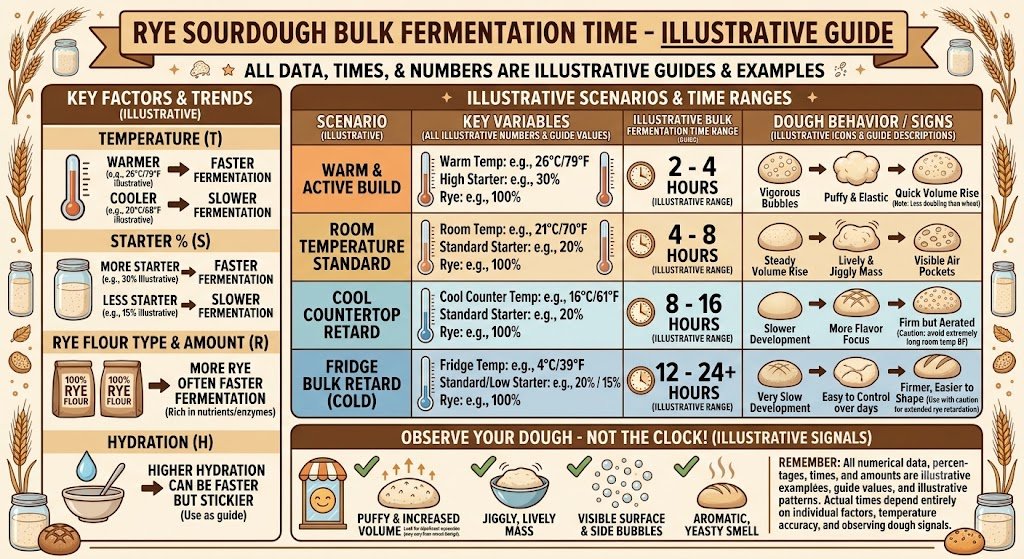
Search around for rye sourdough bulk fermentation times and you’ll find wildly inconsistent numbers — 2 hours in one recipe, 9 hours in another, 8-24 hours for a rye sour specifically. Most of that inconsistency isn’t contradictory advice, it’s different rye percentages, temperatures, and starter strengths all getting lumped into one question with one expected answer. There’s also a genuinely counterintuitive point that most rye content misses entirely: bulk fermentation time often gets shorter, not longer, as rye percentage increases — the opposite of what “rye ferments faster” alone would suggest.
This is one guide in our full rye sourdough bread recipe collection.
Bulk Fermentation Time by Rye Percentage
| Rye % | Typical Bulk Time (76-78°F) | Why |
|---|---|---|
| 10-20% rye | 4-6 hours | Close to wheat sourdough timing, slightly accelerated by rye’s enzyme activity |
| 30-40% rye | 3-4 hours | Rye’s fast enzyme activity and reduced gluten structure both shorten the useful bulk window |
| 50-70% rye | 2-4 hours | Little gluten left to develop through extended time; longer bulk offers no structural benefit and raises overproofing risk |
| 90-100% rye | 2-4 hours (some traditional recipes run 8+ hours at cooler temps specifically for flavor) | Minimal gluten means bulk time isn’t building structure at all — it’s mostly about developing enough gas for a modest rise before baking |
Notice the range doesn’t keep climbing with rye percentage — high-rye doughs often finish bulk fermentation in a similar or shorter window than mid-range blends, once you account for what bulk fermentation is actually accomplishing at each level.
Why Higher Rye Percentage Often Means Shorter Bulk Time, Not Longer
This is the detail almost every general rye guide skips. In wheat sourdough, extended bulk fermentation serves a real structural purpose — it develops and strengthens the gluten network, improving the dough’s ability to trap gas and produce an open crumb. Rye doesn’t have meaningful gluten to develop that way. Andrew Hamelman’s widely referenced professional baking text notes explicitly that bulk fermentation time tends to decrease as rye percentage increases, for two connected reasons: there’s little gas-trapping gluten structure for a long ferment to improve, and rye sourdough’s flavor comes primarily from the already-ripened starter or preferment folded into the dough, not from extending the final bulk fermentation itself.
Practically, this means chasing a long bulk fermentation on a high-rye dough — treating it the way you might intentionally extend a wheat dough’s bulk for more flavor and structure — doesn’t get you a better loaf. It mostly just increases your risk of overproofing, since rye’s enzyme activity keeps working against a dough that has little structural reserve to fall back on if you overshoot.
How to Judge When Rye Bulk Fermentation Is Actually Done
Because rye doesn’t rise as dramatically as wheat even when perfectly fermented, judging doneness by “has it doubled” is unreliable and will often lead you to over-ferment while waiting for a rise that isn’t coming. Use these signs instead:
- A 40-50% rise, not doubling. This is the realistic target across most rye percentages — waiting for a wheat-style doubling means you’ll significantly overshoot.
- A domed, slightly puffy surface rather than flat — at higher rye percentages this can be subtle, so look closely rather than expecting a dramatic visual change.
- Small surface cracks beginning to form, especially at 70%+ rye — a useful visual cue since volume alone is hard to judge on a dense, pan-baked dough.
- A slight give when gently pressed, similar to a poke test, without the dough deflating or feeling completely lifeless.
- Time as a loose guide, not a rule — use the table above as a starting expectation, then confirm with the visual signs rather than pulling the dough purely because the clock says so.
Starter Strength and Maturity’s Role
A young or weak starter, or one that’s several days past its ideal maintenance schedule, will noticeably slow bulk fermentation regardless of rye percentage or temperature — this is one of the most common reasons two bakers following the identical recipe report very different bulk times. A vigorous, recently-fed rye starter at or near peak activity when mixed into the dough will consistently produce faster, more predictable bulk fermentation than a starter that’s flat, over-ripe, or under-fed. If your bulk fermentation is consistently running much longer than the ranges in the table above despite matching the stated temperature, starter strength is one of the first things worth checking — see our rye sourdough starter feeding ratio guide if you suspect your maintenance schedule isn’t producing a sufficiently active starter by baking time.
A Worked Example Schedule
To make the abstract ranges concrete, here’s a realistic same-day schedule for a 40% rye dough at 77°F kitchen temperature:
- 8:00 AM: Feed starter.
- 12:00-2:00 PM: Starter reaches peak (rye starters typically peak faster than wheat, so check earlier than you might expect).
- 2:00 PM: Mix dough, begin bulk fermentation.
- 2:30 PM, 3:00 PM, 3:30 PM: Stretch and folds (only meaningfully useful below 50% rye — skip this step at higher percentages).
- 5:30-6:30 PM: Bulk fermentation complete (40-50% rise, domed surface) — roughly 3.5-4.5 hours after mixing.
- 6:30 PM: Shape and begin final proof.
- 7:15-7:45 PM: Bake.
A cooler kitchen (70-72°F) would push this schedule roughly 1-2 hours later at each fermentation stage; a warmer kitchen (80°F+) would compress it, sometimes meaningfully enough that checking the dough only once in the early afternoon risks missing the window before dinner.
Troubleshooting Overproofed vs. Underproofed Rye
Because the visual cues are subtler than wheat’s dramatic doubling, it’s worth knowing what each failure mode actually looks like in rye specifically:
- Underproofed: Dough looks and feels essentially unchanged from when it was mixed — flat, no visible rise, no surface cracking at higher percentages. The baked loaf will be notably flatter and denser than the recipe’s expected result, sometimes with a slightly gummy texture from insufficient gas development.
- Overproofed: Dough looks wetter and slacker than it did earlier in bulk, may have started to spread rather than hold its shape, and can develop a slightly sour, almost yeasty smell beyond the normal tang. The baked loaf often has a gummy, dense crumb similar to underproofing’s result, which is part of why the two are easy to confuse after the fact — the difference shows up during bulk fermentation itself, not just in the final bake.
- Correctly proofed: A modest 40-50% rise, a slightly domed and often subtly cracked surface, a dough that feels alive and slightly springy rather than flat or slack.
Because overproofed and underproofed rye can produce a similarly disappointing gummy result in the finished bake, tracking your bulk fermentation with the visual and tactile signs above — rather than only judging after the loaf comes out of the oven — is the more reliable way to diagnose which one actually happened and adjust your next attempt accordingly.
Using the Aliquot Jar Method for Rye
The aliquot jar method — pinching off a small piece of dough into a separate small, straight-sided container and marking its starting level — works for rye the same way it does for wheat, and it’s arguably more useful for rye specifically, since judging rise percentage by eye on a large bowl of dense, dark dough is harder than judging it in a small clear jar. Mark the level right after mixing, then watch for that small sample to rise to your target percentage (40-50%, not double) as your cue that the main dough is ready. If you haven’t used this method before, our aliquot method for sourdough guide covers the full technique in more depth — the core method transfers directly to rye, just with a smaller target rise percentage than you’d use for wheat.
Temperature’s Outsized Effect on Rye Bulk Time
Rye’s fermentation speed is more temperature-sensitive than wheat’s, because both the yeast/bacterial activity and rye’s own amylase enzyme activity accelerate with warmth. A few practical implications:
- A 5-degree swing matters more for rye than for wheat. The same dough that bulks in 3 hours at 78°F might take 5-6 hours at 70°F — a bigger proportional difference than you’d typically see with a wheat dough over the same temperature range.
- Warm kitchens compress your working window. In a hot kitchen or during summer, rye bulk fermentation can move fast enough that checking only once every couple of hours risks missing the target window entirely.
- Cool kitchens are more forgiving but slower. If your kitchen runs cool, expect the longer end of the ranges in the table above, and don’t rush the dough to compensate — a still-underfermented rye dough baked early produces a notably flatter, denser-than-intended loaf.
The Small-Percentage Rye Anomaly
A genuinely puzzling pattern reported by some experienced bakers: adding a small amount of rye (in the 4-8% range) to an otherwise wheat-dominant dough has, in some documented cases, actually extended bulk fermentation time rather than shortening it — the opposite of what rye’s reputation for speed would predict. The most likely explanation isn’t that rye slows fermentation at low percentages, but that rye’s bran competes for water in ways that can leave a dough functionally understretched or slightly stiffer than intended if hydration wasn’t adjusted to compensate for the added whole grain, effectively looking like slower fermentation when it’s really a hydration or dough-strength effect. If you’ve added a small amount of rye to a wheat recipe and noticed slower-than-expected fermentation, checking whether you increased hydration to account for the added whole grain flour is worth doing before concluding something else is wrong.
Retarding (Cold Bulk Fermentation) for Rye
Cold-retarding bulk fermentation — moving the dough to the fridge partway through or right after mixing, rather than fully proofing at room temperature — works for rye and is used by many bakers for scheduling flexibility, though the effect is somewhat different than it is for wheat. Since rye bulk fermentation isn’t primarily about developing gluten structure, retarding doesn’t carry the same “structure development” benefit some wheat bakers rely on cold fermentation for — it’s mainly a scheduling tool and a way to develop a bit more sourness over the extended cold time, similar to a cold final proof. If you retard in bulk, expect the dough to need less additional room-temperature time to finish than an equivalent wheat dough would, given rye’s already-fast fermentation pace once it warms back up.
Common Mistakes With Rye Bulk Fermentation Timing
- Applying wheat-dough bulk fermentation habits directly to rye — checking once every few hours the way you might with a slower wheat dough, and missing rye’s faster, narrower window as a result.
- Waiting for a doubling that rye was never going to give you, and badly overfermenting the dough in the process.
- Assuming higher rye percentage always means faster bulk fermentation without accounting for Hamelman’s point above — time can plateau or even shorten further at very high percentages because there’s no structural reason to extend it, not because fermentation itself somehow slows down.
- Extending bulk fermentation on a high-rye dough hoping for more flavor, when that flavor is already primarily coming from your ripened starter — the extra bulk time mostly just adds overproofing risk without a meaningful flavor payoff.
Frequently Asked Questions
How much does starter strength affect bulk fermentation time compared to temperature?
Both matter significantly, but a weak or under-ripe starter can slow fermentation even at an otherwise ideal temperature, while a strong, active starter at a slightly cooler temperature can still ferment reasonably on schedule. If your bulk times are inconsistent despite controlling for temperature, starter condition is usually the next variable to check.
How long should rye sourdough bulk ferment at room temperature?
Typically 2-6 hours at 76-78°F depending on rye percentage, with lower-rye blends generally on the longer end and higher-rye doughs often finishing sooner since there’s less structural benefit to extending the process. Always confirm with visual and tactile signs rather than relying on time alone.
Does higher rye percentage always mean faster bulk fermentation?
Not linearly — while rye’s enzyme activity does accelerate fermentation compared to wheat, bulk time tends to plateau or shorten further at high rye percentages for a structural reason (no gluten to develop through extended time), not because fermentation itself keeps speeding up indefinitely.
Can I use the same doubling target for rye that I use for wheat sourdough?
No — rye typically only rises 40-50% during bulk fermentation even when perfectly fermented, unlike wheat’s more dramatic doubling. Waiting for rye to double will significantly overferment the dough.
Should I retard rye dough in bulk or during final proof?
Both are used successfully by different bakers, and the choice comes down to scheduling convenience more than a strict technical requirement, since rye’s bulk fermentation isn’t primarily building structure the way it is for wheat. Retarding in bulk is common if you want to shape cold dough the next morning; retarding the final proof is common if you’d rather shape while the dough is still at room temperature.
Why did my dough with a small amount of added rye take longer to ferment, not shorter?
This is a documented but not fully explained pattern at low rye percentages (roughly 4-8%), most likely related to rye’s bran affecting hydration and dough strength rather than rye actually slowing fermentation. Check whether you adjusted hydration upward to account for the added whole grain before assuming something else caused the slowdown.
Rye Sourdough — More Guides
- 📖 Rye Sourdough Bread Recipe
- 🌾 How to Make a Rye Sourdough Starter
- 🍞 Why Is My Rye Sourdough Dough So Sticky?
- ⚖️ Is Rye Sourdough Supposed to Be Dense?
- 🌑 100% Rye Sourdough Bread
- 🍫 Dark Rye Sourdough Bread (Pumpernickel-Style)
- ⚖️ Rye Sourdough vs Wheat Sourdough
- 💧 Rye Sourdough Hydration Ratio
- 💧 Converting a Wheat Starter to Rye
- ⚖️ Rye Sourdough Gut Health Benefits
- 🌾 Rye Sourdough Starter Feeding Ratio
- 🍫 Best Flour for Rye Sourdough Bread
- 🍞 Rye Sourdough Bulk Fermentation Time