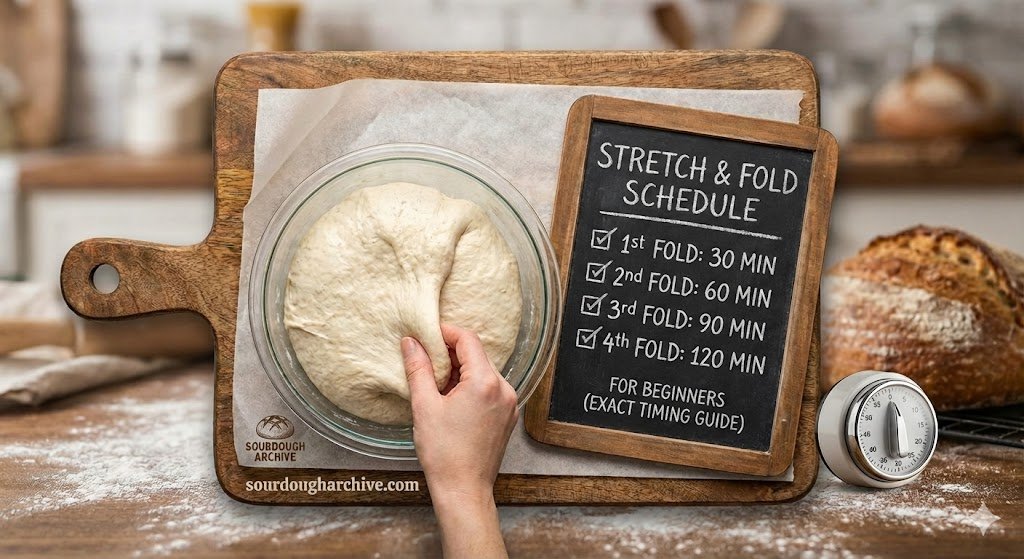
Stretching and folding is one of the easiest and most effective ways to build gluten strength without kneading. This technique improves dough structure, fermentation activity, and final loaf quality. Use the schedule below with temperature adjustments and visual cues to guide your dough development.
What Stretch & Fold Does
- Builds a strong gluten network
- Improves dough elasticity and extensibility
- Supports gas retention during bulk fermentation
- Creates better oven spring and an open crumb
- Makes shaping easier
The Ideal Beginner Stretch & Fold Schedule
Stretch & Fold Timing Chart
| Fold # | When to Do It | What Dough Should Feel Like |
|---|---|---|
| Fold 1 | 30 minutes after mixing or autolyse | Shaggy, beginning to smooth |
| Fold 2 | +30 minutes | More elasticity and tension |
| Fold 3 | +30 minutes | Stronger and more cohesive |
| Fold 4 | +30 minutes | Smoother surface with early bubbles |
For best results, follow with the shaping steps in: How to Shape Sourdough (Boule & Batard)
Temperature Adjustments
Cool Kitchen (65°F / 18°C)
- Stretch and fold every 40–45 minutes
- Slower gluten development
- Longer bulk fermentation
Warm Kitchen (78–82°F / 25–28°C)
- Stretch and fold every 20–25 minutes
- Dough strengthens faster
- Stop folding once dough shows strong tension
Hot Kitchen (82°F+ / 28°C+)
- Reduce to 2–3 folds
- Dough can over-strengthen quickly
- Shorten bulk fermentation
Learn more about fermentation timing here: Bulk Fermentation for Beginners
How to Perform a Stretch & Fold
- Wet your hand
- Lift dough from one side
- Stretch upward
- Fold over itself
- Rotate the bowl
- Repeat 3–4 times
If the dough feels weak or sluggish, see: Dough Not Fermenting? Quick Fixes
Visual Signs the Dough Is Developing
- Smoother surface
- Dough rises taller
- Elastic and springy feel
- Early fermentation bubbles
- Less spreading between folds
The Windowpane Test
After your final fold, stretch a small piece of dough. If it forms a thin, translucent sheet without tearing, the gluten network is well-developed. This test helps you understand dough strength even if perfection isn’t necessary.
Learn how this affects crumb quality: How to Get an Open Crumb
Common Beginner Mistakes
- Pulling too aggressively
- Over-folding
- Not resting long enough between folds
- Folding cold dough
- Expecting identical results each bake
Beginner FAQ
Can I skip a fold?
Yes, one missed fold won’t hurt your dough.
What if I remember a fold late?
Do the next fold and continue.
Can I fold after autolyse?
Yes, this supports early gluten development.
Is coil folding better?
Optional for beginners, helpful for high hydration doughs.