
Bread Poke Test: The Finger Method That Tells You When to Bake
Quick Answer: The bread poke test tells you if your sourdough is ready to bake. Press a floured finger half an inch into the dough and watch the indent: springs back slowly (2–3 seconds) = perfectly proofed, bake now. Springs back

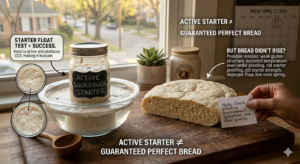




 · [Why is my sourdough so dense?](https://sourdougharchive.com/why-is-my-sourdough-so-dense/) --- ## Cause #1: Overproofed dough (the most common culprit) If your dough looks beautiful in the banneton and then pancakes the second it hits the counter, you almost certainly overproofed. When fermentation goes too long, the acids produced by the bacteria literally eat through the gluten network you worked so hard to build. By the time you bake, there's no structure left to hold anything up. **How to fix it:** - Aim for a **50–75% rise during bulk fermentation**, not a full double - Your dough should feel airy and jiggly (like Jell-O), domed on top, with visible bubbles along the sides - In a warm kitchen (78°F+), check dough 1–2 hours earlier than the recipe suggests - Use an aliquot jar or bulk proofing container with clear walls so you can actually measure rise If you're already in the spreading mess, bake anyway — it won't be pretty, but it'll taste fine as toast or croutons. 👉 Related: [Bulk fermentation 101](https://sourdougharchive.com/bulk-fermentation-101-stop-overproofing/) · [Overproofed vs underproofed sourdough](https://sourdougharchive.com/overproofed-vs-underproofed-sourdough/) · [How to save overproofed sourdough](https://sourdougharchive.com/how-to-save-overproofed-sourdough/) --- ## Cause #2: Weak gluten development Gluten is what gives dough the strength to trap gas and rise upward. If your gluten network is underdeveloped, gas just escapes out the sides and your loaf collapses outward. Most beginners underdo this step. You do two lazy stretch-and-folds, the dough looks "kind of" smooth, and you move on. It's not enough. **How to fix it:** - Do **4 sets of stretch-and-folds** in the first 2 hours of bulk fermentation, 30 minutes apart - Each set: grab one side, stretch it firmly upward, fold over. Rotate bowl 90°. Repeat 4 times. - By the 4th set, dough should feel tight, springy, and pass the windowpane test - If using low-protein flour (9–11%), switch to **bread flour (12%+)** for more gluten You should feel the dough get noticeably stronger with each fold. If it still feels slack after 4 sets, add a 5th. 👉 Related: [Sourdough folding techniques guide](https://sourdougharchive.com/sourdough-folding-techniques-guide/) · [Sourdough autolyse guide](https://sourdougharchive.com/sourdough-autolyse-guide/) --- ## Cause #3: Hydration too high for your flour If you're baking at 80% hydration with grocery-store all-purpose flour, your dough cannot physically hold its shape. Higher hydration needs higher-protein flour to compensate. Period. **How to fix it:** - Start at **70–72% hydration** while you're learning - Only push higher once you're using 12%+ protein bread flour - If your dough feels like pudding after mixing, drop water by 30–40g next time - Whole wheat and rye absorb more water than white — adjust accordingly Higher hydration makes more open crumb, yes. It also makes spreading loaves if your technique isn't there yet. Keep it simple while you learn. 👉 Related: [Sourdough hydration explained](https://sourdougharchive.com/sourdough-hydration-explained/) · [Sourdough dough too wet](https://sourdougharchive.com/sourdough-dough-too-wet/) --- ## Cause #4: Weak shaping (no surface tension) Shaping is where you build the "skin" that holds your loaf together in the oven. If your skin is loose, your loaf spreads. Simple. **How to fix it:** - **Pre-shape** first: gently form a loose ball, let it rest 20–30 minutes - **Final shape** on an unfloured surface (friction = tension) - Drag the dough toward you with a bench scraper to build tension - The surface should feel tight and smooth, like a drum - Flip seam-side up into a banneton and pinch the seam closed The dough should look like a taut, round ball after shaping — not a sad sack. 👉 Related: [How to shape sourdough boule & batard](https://sourdougharchive.com/how-to-shape-sourdough-boule-batard/) · [Shaping and scoring guide](https://sourdougharchive.com/shaping-scoring-guide/) --- ## Cause #5: Starter wasn't ready A weak starter gives you weak dough. If your starter hadn't peaked (or was already past peak and falling) when you mixed, fermentation will be slow and uneven — which often means by the time the dough "looks ready," the gluten is already breaking down. **How to fix it:** - Use starter within 1–2 hours of peak - Starter should double reliably in 4–8 hours at 75°F - Do the float test: a spoonful in water should float - If starter is sluggish, strengthen it before baking 👉 Related: [How to strengthen weak sourdough starter](https://sourdougharchive.com/how-to-strengthen-weak-sourdough-starter/) · [Sourdough starter feeding ratio chart](https://sourdougharchive.com/sourdough-starter-feeding-ratio-chart/) --- ## Cause #6: No cold retard (and shallow scoring) Shaping a dough and baking it right away, at room temp, is a recipe for spreading. The dough is warm, soft, and relaxed — exactly what you don't want going into a hot oven. **How to fix it:** - Cold retard in the fridge for **8–16 hours** after shaping - Cold dough holds its shape far better when it hits the Dutch oven - Score at a **30–45° angle**, firm and confident — shallow scores force the dough to expand sideways - One deep score beats three shy ones 👉 Related: [Cold ferment sourdough](https://sourdougharchive.com/cold-ferment-sourdough/) · [How to score sourdough](https://sourdougharchive.com/how-to-score-sourdough/) --- ## Your pre-bake checklist Before you put the loaf in the oven, verify: - ✅ Starter doubled within 4–8 hours of feeding - ✅ Dough rose 50–75% in bulk (not a full double) - ✅ At least 4 sets of stretch-and-folds completed - ✅ Dough passes the poke test (springs back slowly, about halfway) - ✅ Shaped with visible surface tension - ✅ Cold retarded in the fridge at least 8 hours - ✅ Scored deeply at an angle If you can check all seven, you should get a loaf that rises up, not out. --- ## FAQs **Can I save sourdough that's already spread?** Kind of. You can't un-spread it, but you can bake it anyway — the crumb will be denser and flatter, but still edible. Great for toast, grilled cheese, or croutons. Next time, shorten bulk fermentation. **Why does my dough spread only after cold retard?** Usually means it was already overproofed before you put it in the fridge. Cold retard slows fermentation but can't reverse it. Shorten your bulk time. **Is spreading a starter problem or a dough problem?** Both are possible. A weak starter makes weak dough. But assuming your starter is strong, spreading is almost always over-fermentation or under-developed gluten. **Should my dough rise after shaping on the counter?** A little — maybe 20–30%. If it's ballooning, you're heading for overproof territory. Get it in the fridge. --- ## Still having issues? - Dense crumb after fixing spread? → [Why is my sourdough bread dense](https://sourdougharchive.com/why-is-my-sourdough-bread-dense/) - Not sure if it's over or underproofed? → [Sourdough underproofed vs overproofed](https://sourdougharchive.com/sourdough-underproofed-vs-overproofed-guide/) - Full bulk fermentation walkthrough: [Bulk fermentation for beginners](https://sourdougharchive.com/bulk-fermentation-for-beginners/) Spreading dough is almost always fixable. Tighten up your gluten, pull back on the fermentation clock, and shape like you mean it — your next loaf will stand tall.](https://sourdougharchive.com/wp-content/uploads/2026/04/Sourdough-Dough-Spreading-Instead-of-Rising54555-300x164.jpg)