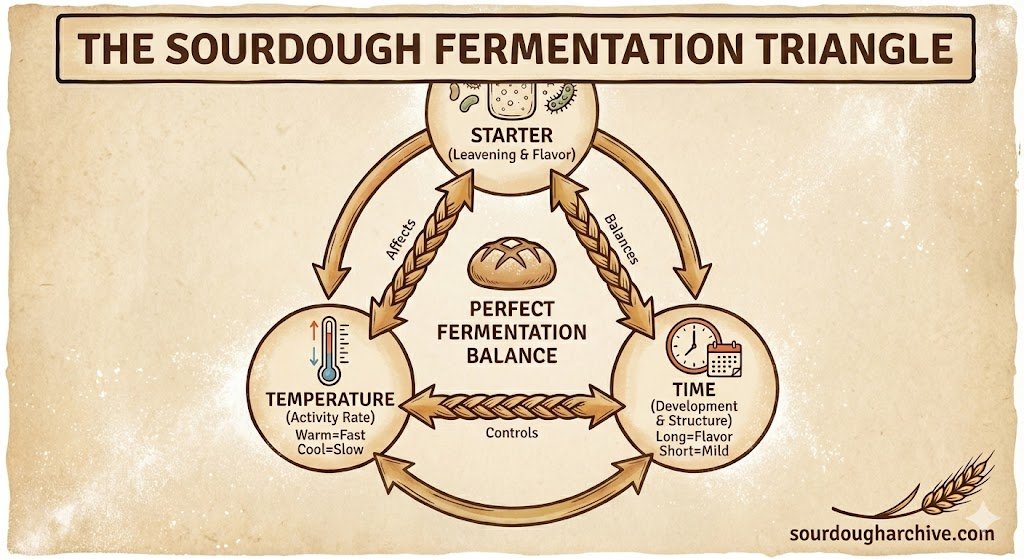
If your sourdough feels unpredictable — sometimes flat, sometimes gummy, sometimes perfect — you’re likely missing one key concept: the Fermentation Triangle.
Sourdough fermentation is controlled by three interconnected variables:
- Starter Strength
- Dough Temperature
- Time
Change one, and the others must adjust. Ignore this balance, and your dough becomes inconsistent.
This guide connects directly with the Sourdough Mastery Beginner Guide, where each fermentation skill builds progressively.
1. Starter Strength
Your starter is the engine of fermentation. A weak starter produces slow, inconsistent rise. A strong starter produces predictable expansion and structure.
- Active, bubbly texture
- Doubles within 4–6 hours
- Smells mildly sweet and tangy
If your dough struggles to rise, review How to Know When Dough Is Ready and check fermentation timing in Bulk Fermentation for Beginners.
Weak starter often leads to underproofed bread and gummy crumb. See Why Your Sourdough Is Gummy for deeper troubleshooting.
2. Dough Temperature
Temperature controls fermentation speed. Warmer dough ferments faster. Cooler dough slows down activity.
- 75–80°F → balanced fermentation
- Below 70°F → slow rise
- Above 82°F → rapid fermentation, risk of overproofing
Learn precise temperature targeting in our Dough Temperature (DDT) Guide.
If dough feels overly sticky or slack, temperature may be accelerating gluten relaxation. Review How to Fix Sticky Dough.
3. Time
Fermentation is not about the clock — it’s about dough maturity. Time must adjust based on starter strength and temperature.
A warmer, active starter doesn’t just rise faster — it drives bulk fermentation forward more aggressively. If you’re adjusting starter temperature, also check the bulk fermentation chart to adjust your rise percentage target accordingly.
Bulk fermentation ends when dough shows:
- Noticeable volume increase
- Surface bubbles
- Elastic, airy feel
- Improved extensibility
If unsure, read How to Know When Your Dough Is Ready and compare results in Underproofed vs Overproofed Sourdough.
How the Triangle Works Together
If your starter is very strong and your kitchen is warm, fermentation time must shorten.
If your kitchen is cool and starter is mild, fermentation time must extend.
Ignoring this relationship causes:
- Dense crumb
- Gummy texture
- Flat oven spring
- Overly sour flavor
Hydration interacts with this triangle as well. Higher hydration accelerates enzymatic activity. Review Sourdough Hydration Explained to see how water percentage affects fermentation speed.
Beginner Application Strategy
- Keep hydration moderate (68–72%)
- Target 75–80°F dough temperature
- Use consistent feeding schedule
- Watch dough — not the clock
When you understand the Fermentation Triangle, sourdough stops feeling random. Every result becomes explainable and correctable.
For a complete structured beginner roadmap that ties all of this together, explore the Sourdough Mastery Beginner Guide.