Picture the scene: It’s Tuesday night. You’re rummaging through the fridge for a snack, and you push aside a jar of pickles to reveal a forgotten Tupperware container. Inside is a ball of sourdough discard pizza dough you made… when? Last Thursday? The Sunday before that?
It looks a little gray. There might be a puddle of dark liquid on top. It smells assertive.
Now you have a decision to make. Do you toss it and waste all that flour? Or do you risk it?
If you check standard food safety guidelines, they’ll tell you to bin it. But as sourdough bakers, we know that fermented dough plays by its own rules. That gray, angry-looking dough might actually be perfectly safe—and could even make the most flavorful pizza you’ve ever tasted. Whether you are meal prepping for the week or freezing sourdough discard pizza dough for later , understanding the lifespan of your dough is the difference between a delicious dinner and a sticky disaster.
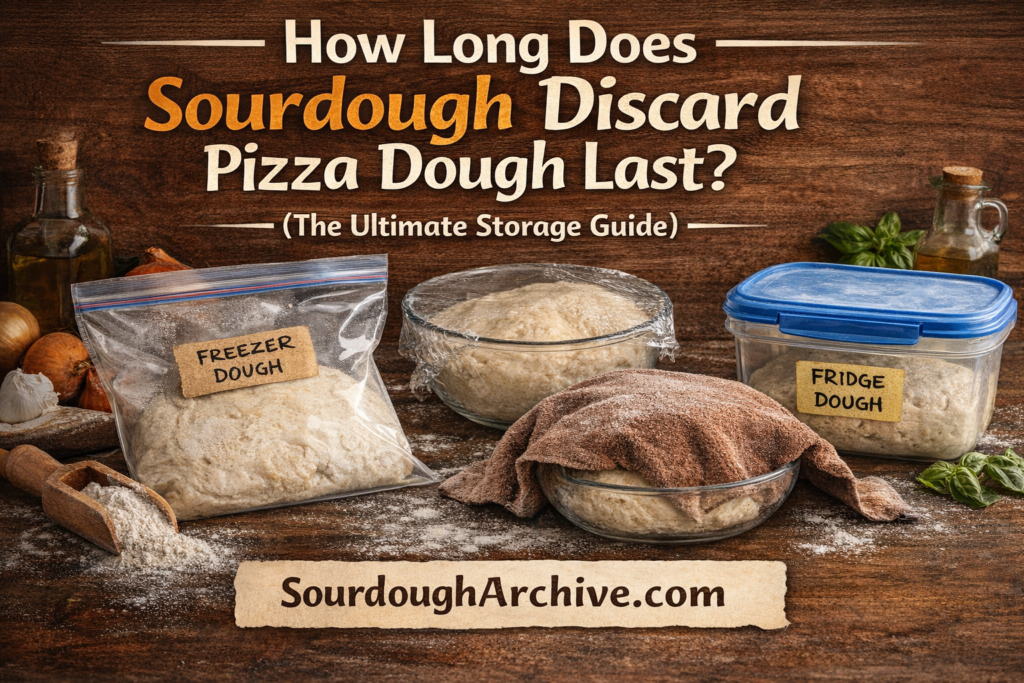
Here is the science of what is happening inside that container, and exactly how long you have before your dough turns into a science project.
The Science: Why Sourdough Outlasts Everything Else
Sourdough discard dough lasts longer than commercial yeast dough because its high acidity (pH < 4.0) acts as a natural preservative against harmful bacteria, though enzymes will eventually degrade the gluten structure.
To understand if your dough is safe, you have to understand the microscopic war happening inside the bowl. Sourdough discard is different from commercial yeast dough because of one superpower: Acidity.
1. The “Acid Armor” (Why it doesn’t rot)
Your sourdough starter is a colony of wild yeast and lactic acid bacteria. These bacteria produce acetic and lactic acid as they consume the flour.
- The Preservation: This acid drops the pH level of your dough significantly.
- The Result: Most harmful pathogens—like mold or the bacteria that cause food poisoning—cannot survive in such an acidic environment.This is why a ball of sourdough discard dough can sit in the fridge for 10 days without growing fuzzy mold, while a standard yeast dough might start looking sketchy by day 4.
2. The “Protease Clock” (Why it turns to soup)
Here is the catch: While the acid protects the dough from spoiling, it is also slowly destroying the texture. Acidity triggers protease enzymes, which act like microscopic scissors. Their job is to snip protein chains.
When you mix flour and water, you build a gluten structure—the elastic “net” that holds gas. Over time, those protease enzymes cut the net.
- Day 3 Dough: The net is strong. You get a great rise and oven spring.
- Day 8 Dough: The net is shredded. The dough feels “slack” (like a puddle) and tears if you look at it wrong. It is still safe to eat, but it will be incredibly difficult to shape.
3. The “Gray Shield” (Don’t Panic)
If your dough has turned a dull gray color, don’t freak out. This isn’t mold; it’s oxidation. Just like a sliced apple turns brown when exposed to air, your dough oxidizes over time. You might also see a dark liquid pooling on top. This is “hooch”—alcohol produced by the yeast as it runs out of food. It’s not harmful.
The Timeline: A Day-by-Day “Smell Dictionary”
Sourdough discard pizza dough is best used within 3 to 5 days for peak flavor and structure, though it remains safe to eat for up to 10 days if stored correctly.
Use this lifecycle guide to diagnose your specific dough ball:
- Day 1-2 (The “Young” Phase):
- Smell: Milky, yeasty, fresh.
- Feel: Tight and elastic. Hard to stretch (springs back).
- Day 3-5 (The “Peak” Phase):
- Smell: Yogurt-like, mild vinegar, pleasant funk.
- Feel: Relaxed, extensible, bubbles easily. Best for Pizza.
- Day 6-7 (The “Danger” Zone):
- Smell: Sharp (acetone/nail polish remover).
- Feel: Sticky and slack. It will tear if stretched thin. Pivot to Focaccia.
- Day 10+ (The “Compost” Zone):
- Smell: Strong alcohol, rancid cheese, or vomit.
- Visual: Pink or orange streaks (mold). Trash it.
Remember, the longer your dough sits, the stickier it becomes due to enzymatic breakdown. If you’ve reached Day 6 or 7 and your dough feels like a glue trap, don’t toss it! Use my triage protocol for fixing sticky discard pizza dough to save the batch.
What Most Recipes Get Wrong
Generic advice often applies USDA meat safety rules to fermented dough or encourages techniques that accelerate spoilage.
If you Google “how long does pizza dough last,” you will find a lot of advice that doesn’t apply to us.
1. The “3-Day Rule” Myth
Most food safety sites apply USDA rules for leftover meat to dough, telling you to toss it after 72 hours. For sourdough, this is actually when the flavor is hitting its peak! Because of the acid armor we discussed, you have a much wider window of safety.
2. The Autolyse Mistake
Many artisan recipes call for a long autolyse (mixing flour and water to rest before adding salt) to build extensibility. While this is great for fresh bread, it is dangerous for long-term storage.
- Why: If you add acidic discard during the autolyse and then store it, you are giving the protease enzymes a head start.
- The Fix: For storage dough, skip the autolyse or keep it under 30 minutes. Salt inhibits enzyme activity, so get the salt in the mix early to slow down the “soupification” process.
3. The “Freezer Pause Button”
Many guides suggest you can freeze dough indefinitely. While the dough won’t spoil, the yeast will eventually die off. If you freeze a dough ball for 6 months, don’t expect a fluffy crust. The gluten might be intact, but the lift will be gone.
Step-by-Step Guide: The Ultimate Storage Protocol
To prevent a hard crust from forming, coat the dough ball in oil and store it in an airtight round container in the coldest part of the fridge.
If you want your dough to last for next Friday’s pizza night, you can’t just shove the bowl in the fridge and hope for the best.
1. Fridge Storage (The “Airtight” Method)
Air is the enemy. It causes the surface of the dough to dry out and form a hard, crusty skin (which we call “elephant skin”). Once that hard skin forms, it won’t stretch, and it will leave hard, unappetizing lumps in your final crust.
- Oil is Key: Before storing, lightly coat the entire dough ball in olive oil. This creates a barrier against the air.
- The Vessel: Use a round glass or plastic container with a tight snap-lid. Round containers help the dough keep its shape.
- Placement: Store it in the back of the fridge where the temperature is consistent. Avoid the door.
2. Freezer Storage (The Long Haul)
If you aren’t going to use the dough within 7 days, freeze it. But do it right.
- The Par-Freeze: Place your oiled dough balls on a baking sheet (not touching) and put them in the freezer for 1 hour until solid. Then transfer them to a freezer bag.
- The Thaw: Never microwave frozen dough. Transfer it to the fridge the night before you want to bake. It needs a slow thaw to preserve the gluten network.
3. The “Wake Up” Routine
This is the most critical step. Cold dough does not stretch; it snaps.
- The Poke Test: Take your dough out of the fridge at least 2 hours before baking. Let it come to room temperature. Gently poke it with your finger.
- Springs back instantly? It’s still too cold and tight. Let it rest.
- Indents and stays? It’s relaxed and ready to shape.
- Finger goes straight through? It’s over-proofed. Don’t try to stretch it—see the “Pivot Strategy” below.
The Flour Factor: Why Bread Flour Outlasts “00”
High-protein Bread Flour withstands acidity significantly longer than delicate “00” flour, making it the superior choice for meal prepping dough.
If you plan on keeping dough in the fridge for a week, the type of flour you use matters just as much as the temperature.
Bread Flour (The Marathon Runner)
If you are a “weekend warrior” who makes dough on Sunday to bake on Friday, Bread Flour is your best friend.
- The Buffer: Bread flour typically has a protein content of 12-14%. This high protein level creates a robust gluten network. Even as the acidity attacks the gluten, there is simply more structure to cut through.
- The Result: You can easily push a bread flour dough to Day 5 or 6 in the fridge.
“00” Flour (The Sprinter)
“00” Flour (doppio zero) is milled incredibly fine and is the gold standard for quick-bake Neapolitan pizza.
- The Risk: The gluten structure is delicate. In a highly acidic sourdough environment, this structure degrades rapidly.
- The Result: By Day 4, “00” dough often turns into soup. If you use “00” flour, plan to bake within 48 to 72 hours max.
The “Pivot” Strategy: Saving the Soup
If dough is over-proofed and slack (Day 7+), do not attempt to shape a pizza; pour it into a pan to make focaccia.
Let’s say you open the fridge, check the date, and realize your dough has been sitting there for 9 days. It smells sharp and pours out of the container like pancake batter.
Do not throw it away.
Just because it can’t be a pizza doesn’t mean it can’t be dinner. The gluten is too weak to hold its shape as a free-standing disc, but it still tastes delicious. You just need a container to hold it up.
The Fix: Sourdough Discard Focaccia.
- Generously oil a cast-iron skillet or a 9×13 cake pan.
- Pour the “over-the-hill” dough straight in.
- Let gravity do the work—it will spread to the edges on its own.
- Dimple the top with oily fingers, add rosemary and sea salt.
- Bake at 425°F (220°C) until golden.
Troubleshooting: The “Is It Safe?” Matrix
Use this table to diagnose exactly what is happening in your Tupperware.
| The Symptom | The Diagnosis | The Solution |
| Gray liquid pooling on top | Hooch: Alcohol byproduct of fermentation. The yeast is starving. | Pour it off for a milder taste, or stir it in for extra sourness. Safe to use. |
| Dough is entirely gray | Oxidation: Air exposure. | If it smells okay, scrape off the gray layer and use the fresh dough underneath. Safe. |
| Pink, Orange, or Green fuzz | Mold: Pathogenic growth. | TRASH IT. Do not scrape. The spores have roots you can’t see. |
| Smells like nail polish (Acetone) | Hungry Yeast: Acidity is very high; yeast is stressed. | Safe to bake, but flavor will be very intense. Pivot to Focaccia. |
| Smells like vomit/rancid cheese | Bacterial Spoilage: “Bad” bacteria have won. | TRASH IT. Sourdough should smell yeasty, beer-like, or vinegary—never rancid. |
| Hard, dry crust on surface | Elephant Skin: Air got into the container. | Remove the hard crust (it won’t bake right). Use the soft dough inside. |
Frequently Asked Questions
1. Can I bake dough that has been in the fridge for 2 weeks?
Technically, yes, it is likely safe to eat due to the pH level. However, it will be extremely sour and likely very dense because the yeast has exhausted its food supply. It won’t rise much. At the 2-week mark, I recommend using it as a starter to mix fresh dough rather than baking it directly.
2. Can I add fresh flour to old dough to save it?
Yes! This is essentially “refreshing” the dough. If you have old, slack dough, you can knead in a small amount of fresh flour and water (a “remix”). Let it rest for 30 minutes. This introduces new protein for structure and new sugar for the yeast.
3. Why is my thawed dough sticky?
Freezing causes water to expand into ice crystals, which can puncture the gluten network on a microscopic level. When it thaws, water leaks out, making the dough feel wet and sticky. Use a little extra flour when shaping thawed dough to compensate.
4. My dough didn’t rise in the fridge at all. Is it dead?
Not necessarily. Fridge temperatures (37°F/3°C) effectively put yeast in a coma. Sourdough discard is already sluggish. If you put it straight into the fridge after mixing, it might not have moved. Next time, give it 2-4 hours on the counter to “kickstart” fermentation before chilling.
5. Does the type of container matter for longevity?
Absolutely. Sourdough is acidic and can react with certain metals (like aluminum), turning the dough a weird color and giving it a metallic taste. Always use glass, food-grade plastic, or stainless steel for storage.
Final Thoughts: Trust Your Nose
The beauty of sourdough is that it communicates with you. You don’t need a lab coat to know if your pizza dough is ready; you just need your senses.
If it smells like fresh beer or yogurt, you are in the “Goldilocks Zone” for the perfect pizza. If it smells sharply like vinegar, you are in the “Pivot Zone” for focaccia. And if your instincts tell you something is wrong—trust them.
Don’t be afraid to push the limits of your fridge storage. That 5-day-old ball of dough hiding behind the milk might just make the best, most complex-tasting crust you’ve ever had.