Temperature is the single biggest factor controlling sourdough fermentation. More than starter strength, flour brand, or hydration, fermentation temperature determines whether your dough rises predictably, develops flavor, and holds structure.
Many sourdough problems — dense crumb, weak oven spring, long rise times, or overproofing — are actually temperature problems in disguise. Once you understand how temperature changes yeast activity and bacterial balance, sourdough becomes dramatically easier and more consistent.
Quick Answer: Best Proofing Temperatures for Sourdough
For most sourdough doughs, the best dough temperature range is 74–78°F during bulk fermentation for a reliable rise and balanced flavor. Cooler dough (65–70°F) ferments slowly and can lead to underproofing unless you extend time, while warmer dough (80–85°F) ferments fast and increases the risk of overproofing. Final proof can be done at room temperature (typically 72–78°F) or cold-proofed in the fridge (38–42°F) to improve scheduling and flavor development.
Why Temperature Matters More Than Almost Anything
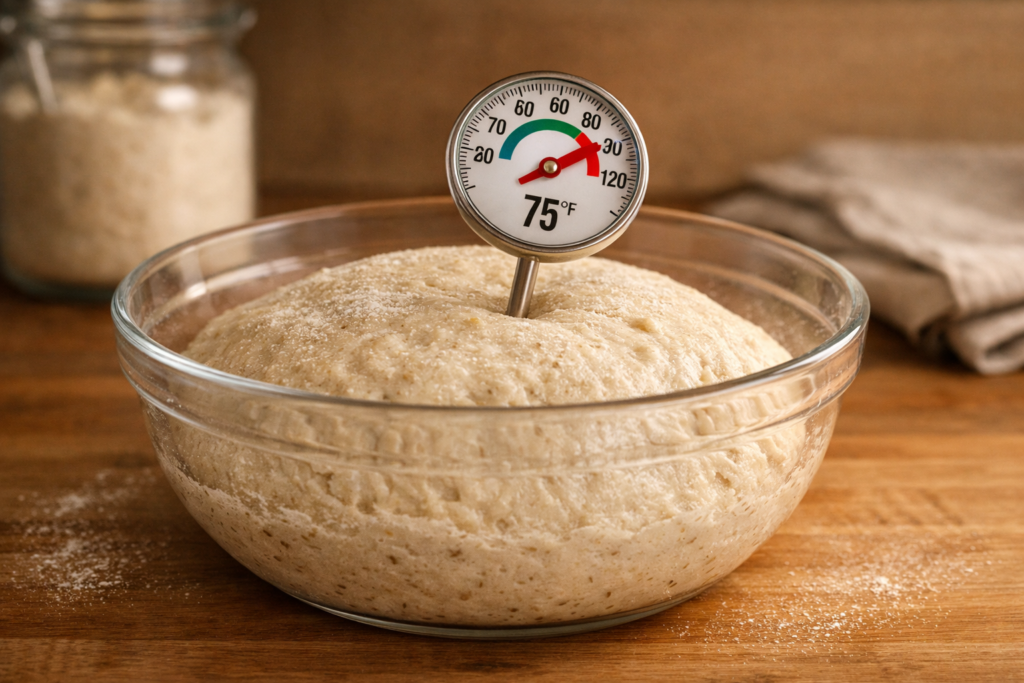
Sourdough fermentation is a living biological process. Inside your dough are wild yeast and lactic acid bacteria competing and cooperating at the same time. Temperature controls the speed of both.
Yeast produces carbon dioxide, which creates rise and open crumb. Bacteria produce acids, which create flavor and strengthen gluten. Enzymes break down starches into sugars the microbes can eat.
Change the temperature, and you change the balance:
- Too cold → yeast slow → dense bread
- Ideal range → balanced rise and flavor
- Too warm → bacteria dominate → sticky, overproofed dough
Because of this, the same recipe can take 4 hours or 14 hours depending only on dough temperature — not your starter.
Sourdough Temperature Zones (60°F–85°F)
Sourdough does not ferment at one speed. It behaves differently across predictable temperature bands. Understanding these zones lets you control timing instead of guessing.
| Dough Temperature | Fermentation Speed | What You’ll See | Result |
|---|---|---|---|
| 60–65°F | Very slow | Little rise for hours | Dense crumb risk |
| 66–70°F | Slow | Gradual expansion | Mild flavor, longer schedule |
| 71–75°F | Moderate | Steady growth | Balanced structure |
| 76–78°F | Ideal | Predictable rise | Best overall results |
| 79–82°F | Fast | Rapid expansion | Risk of overproofing |
| 83–85°F | Very fast | Sticky weak dough | Collapse likely |
Most successful sourdough baking happens when dough temperature stays near 75°F. Below this range fermentation becomes unreliable and slow. Above this range fermentation accelerates faster than gluten can strengthen, which causes flat loaves and sticky dough.
This is why professional bakeries control fermentation temperature instead of relying on room conditions — consistency depends on it.
Bulk Fermentation vs Final Proof (Different Temperature Goals)
Bulk fermentation and final proof should not be treated the same. They serve different structural purposes in bread development.
Bulk fermentation builds strength and gas production. Final proof prepares the loaf for oven spring. Because of this, each stage benefits from a different temperature approach.
For a detailed breakdown, see the best bulk fermentation temperature for sourdough
Best Temperature for Bulk Fermentation
During bulk fermentation, dough performs best between 74–78°F. In this range yeast produces gas steadily while bacteria develop flavor without weakening gluten. Cooler dough slows dramatically and may require doubling fermentation time, while warmer dough rises quickly but becomes fragile and sticky.
Best Temperature for Final Proof
Final proof can happen either at room temperature (72–78°F) for same-day baking or inside the refrigerator (38–42°F) for a slow overnight fermentation. Cold proofing improves scoring and flavor because fermentation continues slowly without overexpanding the dough.
Why Bakers Control Temperature
Home kitchens rarely stay in the ideal fermentation range year-round. Winter kitchens are often too cold and summer kitchens too warm, which causes unpredictable rise times and inconsistent bread.
Many bakers eventually switch to a temperature-controlled proofing box so the dough stays in the same fermentation range every bake regardless of season.
Dough Temperature vs Room Temperature
Many bakers assume room temperature determines fermentation speed, but dough temperature is what actually matters. Flour temperature, water temperature, mixing friction, and ambient air all combine to create the final dough temperature.
Two kitchens at 70°F can produce completely different fermentation results if one dough finishes mixing at 68°F and the other at 78°F.
How to Measure Dough Temperature
The simplest method is an instant-read thermometer inserted into the center of the dough right after mixing. This gives the true starting point of fermentation and predicts how long bulk fermentation will take.
If your dough begins at 72°F, fermentation will move slowly. If it begins at 78°F, it may finish in half the time.
The Desired Dough Temperature Concept
Professional bakers calculate a desired dough temperature (DDT) before mixing. For sourdough, this target is usually 75–78°F. Water temperature is then adjusted so the mixed dough lands inside that range.
Controlling dough temperature is more reliable than extending fermentation time because yeast activity follows temperature more than the clock.
Sourdough Fermentation Time by Temperature
Fermentation time changes dramatically with temperature. Instead of following fixed hours, experienced bakers estimate completion based on dough temperature range.
| Dough Temp | Approx Bulk Time | Dough Behavior | Action |
|---|---|---|---|
| 65°F | 10–14 hrs | Very slow expansion | Extend fermentation |
| 68°F | 8–11 hrs | Gradual rise | Wait patiently |
| 70°F | 7–9 hrs | Mild activity | Normal long schedule |
| 72°F | 5–7 hrs | Balanced growth | Watch closely |
| 75°F | 4–5 hrs | Ideal | Standard fermentation |
| 78°F | 3–4 hrs | Fast | Monitor frequently |
| 82°F | 2–3 hrs | Rapid | Risk of overproofing |
Final Proof Timing
| Proof Temp | Approx Time | Result |
|---|---|---|
| 72°F | 2–4 hrs | Standard same-day bake |
| 75°F | 1.5–3 hrs | Faster expansion |
| 78°F | 1–2 hrs | Watch closely |
| 38–42°F | 8–16 hrs | Cold proof, better scoring |
| 45°F | 6–10 hrs | Mild overnight proof |
If your dough consistently finishes earlier or later than expected, the cause is almost always temperature variation rather than starter strength.
Common Sourdough Problems Caused by Temperature
Many frustrating sourdough issues are actually temperature mismatches rather than recipe mistakes. When fermentation speed and gluten strength fall out of sync, the dough behaves unpredictably.
Dough Not Rising in Winter
Cold kitchens slow yeast activity dramatically. Dough may appear inactive for hours even with a healthy starter. The solution is not adding more starter, but increasing fermentation temperature into the mid-70s°F range.
For a full troubleshooting guide, see why sourdough won’t rise in winter.
Overproofing in Summer
Warm kitchens accelerate fermentation faster than gluten can strengthen. Dough becomes sticky, spreads after shaping, and collapses when scored. Shortening time alone rarely fixes this — temperature must be lowered.
Dense Crumb
Dense bread usually results from underfermentation caused by cool dough. The interior lacks sufficient gas development before baking, even though the exterior may look ready.
A gummy crumb is one of the clearest signs of underfermented dough. Before your next bake, cross-reference the bulk fermentation chart to make sure you’re reaching the right rise target for your kitchen temperature.
Sticky Weak Dough
When dough ferments too warm, acids and enzymes break down gluten excessively. The dough loses structure and feels wet even at normal hydration levels.
How to Control Sourdough Proofing Temperature at Home
Because most kitchens fluctuate throughout the day, bakers often create small controlled environments for fermentation. The goal is not warmth alone, but stability.
If your kitchen runs cold, here are practical methods showing how to keep sourdough dough warm without overheating it.
Oven Light Method
Placing dough inside a turned-off oven with the light on can raise temperature 5–10°F above room temperature. This works in winter but varies widely depending on oven design.
Cooler or DIY Fermentation Box
Some bakers use a small cooler with a jar of warm water. This improves insulation but still requires monitoring and adjustment during long fermentation periods.
Stable Temperature Control
The most consistent approach is maintaining a stable fermentation environment so dough remains within the ideal 74–78°F range for the entire process. Many bakers eventually move to a temperature-controlled proofing box because it removes seasonal variability and produces repeatable results.
For cold vs warm proofing differences, see the best final proof temperature for sourdough.
Frequently Asked Questions About Sourdough Temperature
Can sourdough ferment at 80°F?
Yes, but fermentation becomes fast and requires close monitoring. Dough can overproof quickly, especially during final proof.
Is 85°F too hot for sourdough?
Generally yes. At this temperature gluten weakens rapidly and dough often collapses before baking unless fermentation time is drastically shortened.
What if my kitchen is 65°F?
Extend fermentation time significantly or create a warmer fermentation environment. Most sourdough performs best around 75°F dough temperature.
Does warmer fermentation reduce sour flavor?
Warmer fermentation encourages lactic acid production and milder flavor, while cooler fermentation increases acetic acid and tanginess.
Key Takeaways
Sourdough success depends more on temperature than timing. The ideal dough temperature range is 74–78°F for balanced fermentation. Cooler dough requires longer fermentation, while warmer dough risks structural breakdown. Controlling fermentation temperature turns sourdough from unpredictable to repeatable and consistent.