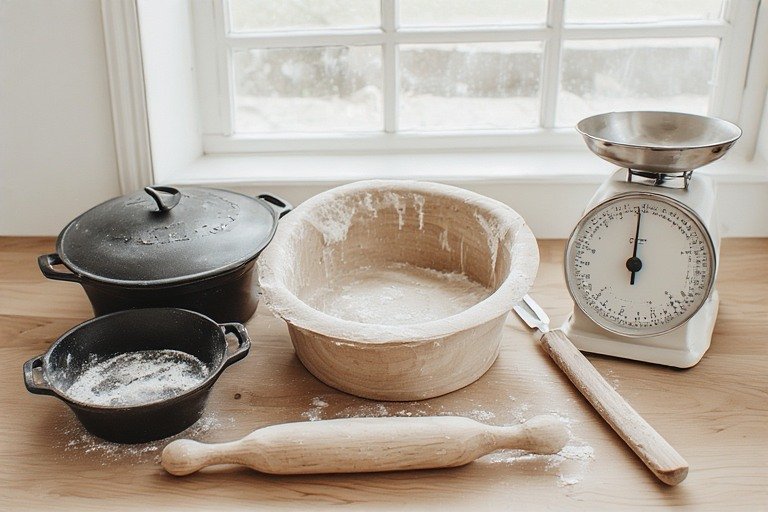
The right equipment makes sourdough easier. The wrong equipment — or the right equipment used incorrectly — causes problems that look like technique failures but are actually equipment failures. This guide covers every common sourdough equipment problem with a practical fix.
Dutch Oven Problems
Is my Dutch oven too small for sourdough?
Most home loaves (800g-1kg dough) need a 5-6 quart Dutch oven. If your dough touches the sides before it finishes proofing, or the lid won't close after the dough rises, size up. A too-small pot restricts oven spring and causes the loaf to push sideways instead of up, giving you a flatter, wider loaf than expected. See the full Dutch oven size guide.
Why is my Dutch oven cracking or chipping?
Thermal shock is the usual cause — a cold Dutch oven going into a fully preheated 450-500°F oven, or an enameled pot hitting a cold surface right out of the oven. Preheat enameled Dutch ovens gradually with the oven itself rather than dropping them in hot, and always set a hot pot on a heatproof trivet, never a cold counter or wet surface.
How do I stop bread sticking to my Dutch oven?
Line with parchment paper for guaranteed release, or dust the pot generously with rice flour (it doesn't burn as easily as wheat flour at high heat) before placing your dough. If your loaf is consistently sticking despite this, it's usually underproofed dough leaking excess moisture onto the pot surface — check your proofing guide.
Glass lid vs. cast iron lid — which is better for sourdough?
Cast iron/enameled lids hold and radiate heat more evenly, giving better oven spring and crust color. Glass lids let you watch the bake without losing heat by opening the oven, but tend to produce a slightly paler crust. If crust color is an issue, pull the lid 5-10 minutes before your bake ends regardless of lid type.
Baking stone vs. Dutch oven — which is better?
A Dutch oven traps steam automatically, which is what gives sourdough its oven spring and crackly crust — this is the easier, more forgiving option for most home bakers. A baking stone gives good bottom heat but requires you to manually create steam (a pan of water, ice cubes, or a steam injection method), which is harder to get consistent. If you don't have a Dutch oven, see baking sourdough without a Dutch oven.
Banneton Problems
Mold growing in my banneton — how do I clean and prevent it?
Mold means the banneton isn't drying fully between uses. Never wash it with water — brush out dried flour/dough with a stiff banneton brush or dry pastry brush, then leave it fully uncovered to air dry for 24+ hours before storing. If mold has already grown, a bleach-free banneton generally can't be fully cleaned — replace it. Store bannetons in a dry spot, not sealed in a bag or drawer.
Dough sticking to my banneton — how do I stop it?
Under-flouring is the top cause. Dust generously with rice flour or a 50/50 rice flour + AP flour blend — rice flour has less gluten and resists absorption, so it won't get "glued" to wet dough the way all-purpose flour can. New bannetons especially need heavier flouring for the first several uses until they build up a natural release patina.
Scoring and Tools
My bread lame isn't cutting sourdough cleanly — why?
A dull or wet blade is almost always the cause. Use a fresh razor blade (they dull after 5-10 loaves) and score with one confident, fast motion at a 30-45° angle rather than sawing back and forth. If the dough is sticking to the blade mid-cut, dip the blade in water or flour right before scoring.
Do I actually need a thermometer for sourdough?
Not strictly, but it removes most of the guesswork. An instant-read thermometer confirms your loaf is fully baked (205-210°F internal temp), and a dough thermometer helps you hit consistent dough temperature for predictable fermentation timing. If you're troubleshooting inconsistent results, a thermometer is the fastest way to rule variables in or out.
Can an inaccurate kitchen scale ruin my sourdough?
Yes — sourdough hydration percentages are precise ratios, and a scale that's off by even 10-15g on a small batch can shift your hydration enough to change dough handling significantly. If your results are inconsistent despite following the same recipe, check your scale against a known weight (a bag of flour with a printed weight) before troubleshooting anything else.
Oven Problems
My oven runs hot or cold — how does that affect sourdough?
Most home ovens are off by 15-25°F from their display, which is enough to change your bake time and crust color meaningfully. Use an independent oven thermometer to check actual temperature, and adjust your set temp accordingly (if your oven reads 25°F cool, set it to 475°F to actually bake at 450°F).
Baking sourdough in a convection oven — what should I adjust?
Drop the temperature by 25°F from the recipe's stated temp, or reduce bake time by about 10-15%. Convection ovens circulate hot air more efficiently, which can over-brown crust or dry out the loaf if you don't adjust. If using a Dutch oven, the effect of convection is minimized during the covered portion of the bake since the pot traps its own environment.
Why is my sourdough burnt on the bottom?
Usually the pot or stone is absorbing too much direct bottom heat. Move your oven rack up one position, or place a second empty baking sheet on the rack below your Dutch oven to diffuse heat. See the full burnt bottom troubleshooting guide.
Still Stuck?
If your equipment checks out and you're still getting inconsistent results, the issue is likely dough-side — check our proofing problems guide or bake fixes guide.
Get Your Free Sourdough Troubleshooting Guide!
Fix dense crumb, weak oven spring, digestive issues, and 7 other common problems with our free PDF checklist + pro baker tips.
Thank you!
Check your email for "Your Free Sourdough Troubleshooting Guide"
and download your PDF.
Happy baking! 🍞