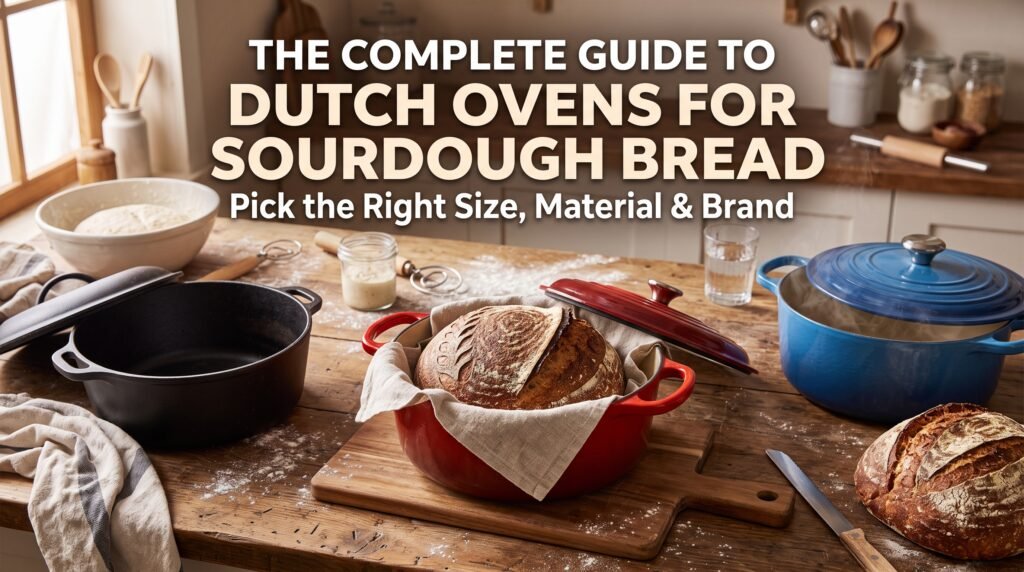
Quick answer: For most home bakers, a 5-6 quart round cast iron or enameled Dutch oven is the best choice for sourdough. The size fits standard dough weights (500-750g), traps steam efficiently for oven spring, and works in most home ovens. Material choice depends on your tolerance for maintenance: raw cast iron is more durable and handles high heat better; enameled is easier to clean but has heat-limit concerns.
But there’s more to choosing a Dutch oven than just “any 5-quart will do.”
In this guide, I’ll walk you through:
- Why a Dutch oven is essential for sourdough (and what it actually does)
- Size selection by loaf type and dough weight
- Cast iron vs. enameled: real tradeoffs and heat limits
- Brand comparison: Lodge vs. Le Creuset vs. Staub vs. budget options
- A step-by-step buying checklist
- Common mistakes that cost money
I’ve tested multiple Dutch ovens and logged thousands of sourdough bakes. Let’s find you the right one.
Why Your Sourdough Needs a Dutch Oven (The Science)
Baking sourdough in a Dutch oven works because of one thing: steam.
Here’s what happens:
- The pot traps heat: Dutch ovens are thick-walled and hold temperature extremely well. This means even heat distribution and consistent crust formation.
- The lid captures steam: As your dough heats, the moisture inside the dough turns to steam. The tight lid traps that steam, keeping it close to the crust. This delays crust formation during the first 20-25 minutes of the bake—the critical rise phase.
- Better oven spring: With the steam barrier in place, your dough has room to expand upward before the crust sets. This is why Dutch-oven loaves have that beautiful, tall ear and open crumb.
- Crust quality: The steam creates that signature crackly, golden crust with blisters. The loaf also develops better color and shine because steam delays crust set.
Without a Dutch oven, your crust sets too early, oven spring is flat, and you get a dense crumb. It’s the single biggest upgrade you can make to your sourdough results.
Can you bake sourdough without one? Yes—by adding steam another way (covered baking stone, steam pan, etc.). But a Dutch oven is still the simplest, most consistent method. If you don’t have a Dutch oven yet, here are your alternatives.
Dutch Oven Size: What Actually Matters
Size is measured in quarts, but what matters is the interior space—specifically, room for your dough to expand without touching the sides of the pot or the lid.
Most home sourdough recipes use 500-750g of dough weight (this is dough weight after mixing, not flour weight). Here’s what size works for each:
| Dough Weight | Loaf Shape | Recommended Size | Interior Diameter (Approx) | Notes |
|---|---|---|---|---|
| 400-550g | Round boule | 4.5-5 quart | 8-8.5″ | Good for small ovens; smallest I’d recommend |
| 550-750g | Round boule | 5-6 quart | 8.5-9.5″ | Most versatile size; fits most recipes |
| 550-750g | Oval batard | 6-7 quart | 9-10″ | Oval shape needs more horizontal room |
| 750-1000g | Multiple loaves or large single | 7-9 quart | 10″+ (or 10″+ x 15″+ for bread pans) | Larger pots; check oven fit first |
The key principle: You want about 2-3 inches of clearance between your shaped dough and the walls of the pot. If the dough touches the sides, it spreads sideways instead of rising up.
Common mistake: Buying a 7-8 quart pot because “bigger = better.” If your dough is 600g and your pot is 9 quarts, the bread spreads flat instead of rising tall. The pot is too big for the dough.
Exception: If you plan to bake 2-3 loaves at once, go bigger. For a single loaf, stick to 5-6 quart.
Round vs. Oval: Which Shape Should You Choose?
Round (boule): The traditional choice. Works with most recipes, fits standard ovens well, and most Dutch ovens come in round. If you’re just starting, choose round.
Oval (batard): Better if you consistently bake oval-shaped loaves. The oval shape matches the elongated proofing basket shape, so you get less reshaping during transfer. But not all recipes call for oval, and round Dutch ovens do work for oval loaves (just with slightly less room).
My recommendation: Unless you specifically want to bake only batards, go round. It’s more versatile.
Material Showdown: Cast Iron vs. Enameled
Both work for sourdough. The choice comes down to heat tolerance, maintenance, and your tolerance for effort.
Raw Cast Iron (Bare, Unsealed)
Heat tolerance: Unlimited. Cast iron handles 500°F, 600°F, even hotter. No damage risk.
Pros:
- Handles high heat without any risk of knob/handle damage
- Less expensive than enameled
- Gets better over time—the seasoning improves with use
- Indestructible; will last 50+ years with basic care
- If seasoning wears, you can re-season it
Cons:
- Requires seasoning (you build up an oil layer over time to prevent rust)
- Can’t put it in the dishwasher
- Can stain or discolor if you let it sit wet
- Higher barrier to entry if you’re not familiar with cast iron care
Best for: Serious bakers who don’t mind maintenance. You get the best heat performance and the pot actually improves with age.
Enameled Cast Iron (Porcelain Enamel Coating)
Heat tolerance: Depends on the brand. Budget enameled Dutch ovens: 450°F max. Mid-range (Lodge): 500°F max. Premium (Le Creuset, Staub): 500°F (sometimes higher). CRITICAL ISSUE: Many enameled Dutch ovens have handles/knobs rated for only 450°F, even if the pot body can handle 500°F.
Pros:
- Easy to clean—wash with soap and water, even dishwasher-safe for many brands
- No seasoning required; ready to use right out of the box
- Won’t rust or stain
- Color options make them kitchen-friendly
- Lower maintenance
Cons:
- Enamel can chip if you bang it around (especially on edges)
- Heat limit on knobs/handles is a real issue (see temperature table below)
- More expensive than raw cast iron for the same capacity
- If enamel cracks, you can’t re-enamel it cheaply
- Dry preheating risk: Preheating an enameled Dutch oven with nothing inside can cause rapid temperature swings that crack the enamel. (The solution: either preheat at a lower temp, or use the “cold Dutch oven method.”)
Best for: Bakers who value convenience over performance. You spend less time on maintenance and the pot looks good on the stovetop.
Heat Limits by Brand (The Handle Issue)
Here’s the real issue most guides skip: Your Dutch oven body can handle high heat, but the knob and handles might not.
| Brand / Type | Max Temperature | Knob/Handle Type | Cost (5Q approx) | Notes |
|---|---|---|---|---|
| Raw Cast Iron (Lodge) | Unlimited | Cast iron | $50-70 | No temperature concern; best for high heat |
| Enameled Cast Iron (Lodge) | 500°F | Brass or metal knob, varies by model | $60-90 | Check knob rating; some older models 450°F |
| Le Creuset (enameled) | 500°F | Metal/stainless knob (usually 500°F safe) | $300-450 | Premium; excellent enamel; high cost-per-use |
| Staub (enameled) | 500°F | Metal knob (usually 500°F safe) | $250-380 | Good enamel quality; mid-range cost |
| Budget enameled (Amazon/Walmart) | 450°F | Plastic knob (often 350°F max!) | $40-80 | Temperature limit can be a problem for sourdough |
What this means: If you buy a budget enameled Dutch oven with a plastic knob rated for 350°F, you cannot safely preheat it to 500°F. The knob will degrade, get brittle, or even melt.
Solution if you have enameled with heat limits: Use the “cold Dutch oven” method. Place your dough in the cold pot, then place the whole thing in a 500°F oven. The dough preheats gradually with the pot, and you avoid the rapid heat shock that damages enamel.
Brand Comparison: Which Should You Buy?
Lodge (Cast Iron & Enameled)
Best for: Budget-conscious bakers who want reliability
5 Quart Cast Iron: $50-70 | Enameled: $60-90
Why it works: Lodge cast iron is pre-seasoned, durable, and handles unlimited heat. The enameled option gives you color without breaking the bank. American-made, good quality control.
Tradeoff: Not as “pretty” as premium brands; enameled enamel quality is decent but not Le Creuset-level. Cast iron is bare and rough compared to polished brands, but that doesn’t affect baking.
Heat/Maintenance: Cast iron unlimited; enameled 500°F (verify knob rating on model). Cast iron needs seasoning; enameled needs care with dry preheating.
👉 VIEW LODGE 5Q DUTCH OVENS ON AMAZON — See current pricing, colors, and customer reviews.
Le Creuset (Enameled)
Best for: Long-term investment; you want the pot to last 30+ years and look premium
5 Quart Enameled: $300-450
Why it works: Le Creuset is the gold standard. Excellent enamel quality, trusted brand, lifetime warranty (though enamel cracks aren’t covered). The knob and handles are typically rated for 500°F. You’re paying for brand reputation and durability.
Tradeoff: Very expensive upfront. For sourdough alone, a Le Creuset is overkill. But if you also braise, make stews, and want a showpiece pot, the cost-per-use over 20 years is reasonable.
Heat/Maintenance: 500°F safe; standard enamel care needed. Avoid dry preheating; the premium enamel can still crack.
Staub (Enameled)
Best for: The middle ground—quality without the Le Creuset price tag
5 Quart Enameled: $250-380
Why it works: Staub is owned by Zwilling and offers excellent enamel quality at a lower price than Le Creuset. Dark interior is practical for sourdough (shows color well). Knob is typically 500°F safe.
Tradeoff: Still expensive, but 20-30% cheaper than Le Creuset. Less brand recognition means resale value is lower.
Heat/Maintenance: 500°F safe; same enamel care as Le Creuset.
Walmart/Amazon Budget Enameled
Best for: Testing the waters; you’re not sure if you’ll stick with sourdough
5 Quart Enameled: $40-80
Why it works: Very cheap. Will bake sourdough just fine. Good for beginners who haven’t committed to the hobby.
Tradeoff: Enamel quality is thin; chips more easily. Heat limits are often 450°F or lower (check before you buy). Will probably need replacement in 3-5 years if heavily used. Resale value is near zero.
Heat/Maintenance: Usually 450°F max (verify knob). Use the cold pot method if possible.
My Recommendation by Budget
- Under $100: Lodge cast iron 5-quart. You get unlimited heat, durability, and no regrets. Spend 30 minutes learning cast iron care and move on.
- $100-250: Lodge enameled or Staub. You get easier cleanup without the Le Creuset markup.
- $250+: Staub or Le Creuset. You’re making an investment piece that does more than just sourdough.
Ready to buy? Check current prices and availability on Amazon — See Lodge 5Q options, enameled colors, customer reviews, and shipping options all in one place.
Buying Checklist: What to Verify Before Purchase
Don’t just look at the quart size. Before you buy, check:
- Interior diameter: 8.5-9.5 inches for round 5-6Q. Verify on the product spec sheet.
- Height under the lid: At least 3-4 inches of clearance from the bottom to the lid. This leaves room for dough expansion.
- Lid fit: The lid should be heavy and fit snugly without rattling. A loose lid = steam escapes.
- Handles: Should be loop handles (not ears), spaced wide enough that you can grab with oven mitts. Avoid handles that stick straight out.
- Knob/handle heat rating (if enameled): At least 500°F. Do not buy if knob is plastic or rated below 450°F.
- Weight: Heavy is good. Cast iron should be 6-8 lbs. Enameled should feel substantial (not thin metal).
- Flat bottom: The pot should sit flat on your stovetop or counter. Rock it gently to check.
Common Mistakes (And How to Avoid Them)
Mistake 1: Buying Too Big
Problem: You buy a 7-8 quart pot thinking bigger is better. Your 600g dough now has too much room and spreads flat instead of rising up.
Fix: Match the pot size to your typical dough weight. 5-6Q for 500-750g. That’s it.
Mistake 2: Enamel Pot Knob Damage
Problem: You buy an enameled Dutch oven, preheat it to 500°F, and the plastic knob starts to warp or melt.
Fix: Check the knob heat rating before you buy. Or use the cold pot method: place dough in an unpreheated pot, then put the pot in the oven.
Mistake 3: Not Checking Interior Space
Problem: You buy a 5-quart pot based on volume alone, but the interior dimensions are tight (8″ diameter). Your boule doesn’t fit well.
Fix: Always verify interior diameter and height, not just the quart rating. Manufacturers measure volume, not baking usability.
Mistake 4: Using a Lid That Doesn’t Seal
Problem: The lid rattles during preheating or baking, steam escapes, and your loaf doesn’t get the full steam benefit.
Fix: Test the lid fit in the store (if possible) or check reviews for tight-fit feedback. The lid should rest snugly without falling through.
Mistake 5: Cast Iron Rust
Problem: You buy cast iron, use it once, then leave it wet on the counter. It rusts.
Fix: Dry cast iron immediately after use. A quick towel wipe is enough. Once a month, rub a tiny bit of oil on the surface. That’s it—people overthink cast iron care.
FAQ: Dutch Oven Questions Bakers Actually Ask
Q: Can I use a Dutch oven on the stovetop while bread bakes in the oven?
A: No. You need the Dutch oven in the oven to bake your bread. Make sure your stovetop isn’t crowded on baking day—place the pot in the oven preheating at least 45 minutes before you need it.
Q: My Dutch oven enamel chipped. Can I fix it?
A: Small chips (under 1/4 inch) are cosmetic and won’t affect baking. The cast iron underneath is fine. Large chips: You can’t re-enamel it affordably. Consider it a reason to upgrade to a new pot or accept the chip as character. Avoid hitting the edges of the pot.
Q: Do I really need to preheat the Dutch oven for a full hour?
A: 45-60 minutes is standard for cast iron to reach full temperature. For enameled pots with heat concerns, the cold Dutch oven method (place cold pot in a hot oven) skips this step entirely and still works well.
Q: Can I use a metal knob instead if plastic comes loose?
A: Yes, but verify the replacement knob is rated for your max baking temperature. Most hardware stores carry universal brass knobs that handle 500°F+. Lodge also sells replacement knobs specifically for their pots.
Q: Is cast iron or enameled better for sourdough?
A: Cast iron wins for heat performance and durability. Enameled wins for ease of use. Both bake excellent sourdough if sized correctly. If you can only afford one, choose based on your maintenance tolerance, not performance.
Q: Do I need to season a new cast iron pot?
A: Lodge cast iron comes pre-seasoned. You can use it right away. After baking, just wipe it clean and dry it. After a few dozen bakes, the seasoning improves and the pot gets better over time.
Q: What if I don’t have a Dutch oven?
A: Check out alternatives like bread pans, baking stones with steam pans, or covered baking vessels. You’ll need to add steam another way, but good sourdough is still possible.
What You Should Do Now
1. Measure your oven’s interior: Make sure a 5-6 quart Dutch oven will fit with headroom. You need room for steam to circulate and the dough to rise.
2. Decide on material: Ask yourself: “Do I prefer heat performance (cast iron) or cleanup ease (enameled)?” Your answer drives the purchase.
3. Verify the specs: Don’t just look at price. Check interior diameter, lid fit, and (if enameled) knob heat rating before you click buy. See our recommended Lodge options on Amazon.
4. Get the recipe right: A Dutch oven helps, but the dough matters more. Start with a tested beginner sourdough recipe and build from there.
5. Learn how to use it: Read our step-by-step guide to baking sourdough in a Dutch oven so you get the steam timing right.
Sourdough Equipment Guides
- Complete sourdough equipment guide — Every tool you actually need (and don’t need)
- How to score sourdough — Scoring technique for Dutch oven baking
- How to get better oven spring — Step-by-step to maximize rise
Last Updated: August 24, 2026