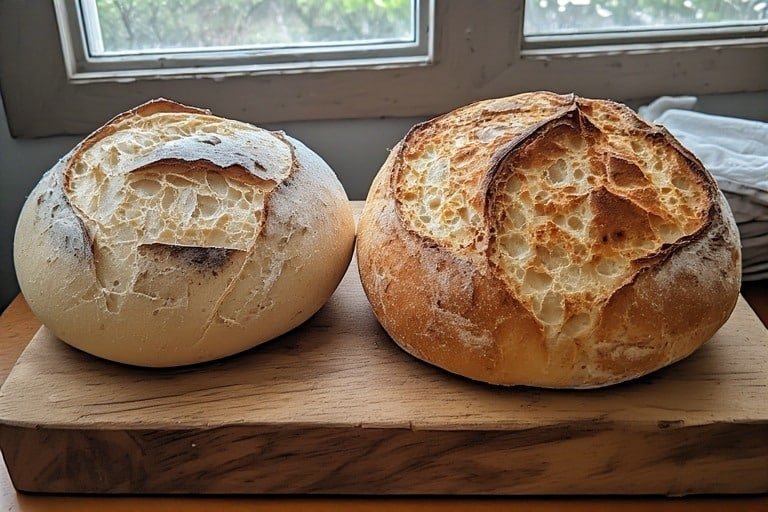
The pale loaf problem: when “done” looks like “raw”
You pull your loaf out after 50 minutes. It should be a deep, caramel, bakery-looking brown. Instead it’s kind of… beige. Dull. Leathery, even. It smells fine. It probably tastes okay. But it looks like the sad sibling of the sourdough loaves you see on Instagram.
A pale sourdough crust is almost always about sugar chemistry. The Maillard reaction and caramelization — the two reactions that brown bread — need sugars, moisture, and heat to happen. If any one of those is off, you get beige. Here are the 6 most common reasons, and exactly how to fix each one.
Cause #1: Overproofing (the #1 reason for pale crusts)
Sounds counterintuitive, but overproofed dough is the biggest cause of pale sourdough. Here’s why: yeast and bacteria eat the sugars in the dough. If they eat them ALL before the loaf hits the oven, there’s nothing left to caramelize. No sugar = no browning = beige crust.
How to spot it:
- Dough is very slack and sticky
- Crust is pale AND shiny/leathery rather than matte and crackled
- Bread is often a little gummy inside too
- Little to no oven spring
How to fix it:
- Pull bulk fermentation at 50–75% rise, not a full double
- Use a shorter cold retard (8–12 hours, not 24+)
- In a warm kitchen, check dough earlier than the recipe says
- Use the poke test — dough should spring back slowly, halfway
👉 Related: How to save overproofed sourdough · Overproofed vs underproofed sourdough
Cause #2: Not enough salt
Salt slows yeast activity, which means sugars don’t get consumed as fast. Less salt = sugars get eaten faster = pale crust (same problem as overproofing, different cause).
Target: 1.8–2% salt by flour weight. For 500g flour, that’s 9–10g of salt.
- Under 1.5%? Your dough will ferment fast and pale
- Over 2.5%? Flavor gets weird, yeast slows too much
- Use fine sea salt or table salt (kosher flakes don’t weigh the same)
Always measure by weight, not volume. A tablespoon of Morton’s weighs way more than a tablespoon of Diamond Crystal.
Cause #3: Not enough steam in the oven
Steam does two big things during the first 15 minutes of baking: it keeps the crust soft so the loaf can fully rise, AND it helps gelatinize the surface starch, which is what creates that glossy, deeply browned crust.
No steam = thick, dull, pale crust. Every time.
How to fix it:
- Always bake the first 20 minutes with the Dutch oven lid on (it traps the dough’s own moisture)
- If baking open, add a pan of boiling water or a few ice cubes in a cast iron skillet at the bottom of the oven
- Spritz the dough with water right before scoring and baking
👉 Related: Bake sourdough in Dutch oven · Bake sourdough without Dutch oven
Cause #4: Oven too cool (or running cold)
Maillard browning really gets going above 300°F on the crust. If your oven is running 25°F cool (and many do), or you dropped the temp too early, you’ll never get deep color.
How to fix it:
- Get an oven thermometer — the dial is often lying
- Preheat to at least 475°F with the Dutch oven inside for 45+ minutes
- For the uncovered portion, stay at 450°F — don’t drop below
- Bake open for the last 15–20 minutes (lid off)
If you take the lid off and the crust is still pale, keep baking. The bread is “done” inside at 205°F internal, but you can keep it in another 5–10 minutes to develop color.
Cause #5: Crust gets wet during baking (or cools too fast)
If you’re brushing the dough with water right before it goes in, or spritzing inside the oven too aggressively, the crust can stay wet long enough to prevent browning. Same problem if you open the oven door too often — steam escapes, temp drops, browning stalls.
How to fix it:
- Spritz dough before it goes in, not during
- Don’t open the oven for the first 20 minutes
- Pull the lid off the Dutch oven at 20 minutes and don’t touch the bread for another 15
A crisp, dry crust surface is what you want for those last 15 minutes. That’s when the deep color develops.
Cause #6: Weak or under-fermented starter
If your starter is sluggish and the dough under-ferments, you’ll have dense bread with an almost raw-looking pale crust. This is the flip side of overproofing — not enough fermentation means the flavor compounds and sugar distribution are off.
Signs you’re here:
- Crust is pale AND dough barely rose
- Crumb is tight and dense
- Bread didn’t get much oven spring
- Loaf feels heavy
How to fix it:
- Strengthen your starter before baking
- Use it within 1–2 hours of peak
- Extend bulk fermentation if the dough isn’t rising enough
👉 Related: How to strengthen weak sourdough starter · Sourdough starter not doubling
Bonus: the “bake longer” fix
Sometimes your dough is fine, your oven is fine, your salt is right — and the crust is still pale. In that case, you just need to bake it longer with the lid off.
- After the lid-off portion of your normal bake, check the color
- If it’s still pale, keep going in 5-minute increments
- Internal temp of 210°F is totally fine
- Want extra browning? Turn on convection for the last 5 minutes
Most beginners pull bread too early because they’re nervous about burning it. Trust the process. Dark crust = more flavor.
Quick pre-bake checklist
- ✅ Bulk ferment ended at 50–75% rise
- ✅ Salt is 1.8–2% of flour weight
- ✅ Dutch oven preheated to 475°F+ for 45 min
- ✅ First 20 minutes covered (steam trapped)
- ✅ Lid off for last 20–25 minutes
- ✅ Oven thermometer confirms actual temp
FAQs
Can I brush the loaf with egg wash for color? For enriched sourdough (sandwich bread, cinnamon loaves), yes. For lean, rustic sourdough, no — it changes the crust texture and isn’t traditional.
Why is my sourdough pale but burnt on the bottom? Your oven is running hot on the bottom and cool on top. Move the loaf up a rack, add a heat shield below (sheet tray), and check if the top element is working properly. Some ovens have weak broil/top elements.
Does flour type affect crust color? Yes. Whole wheat and rye browns faster than white flour because they contain more sugars and enzymes. If you use 100% white bread flour, crust can be slightly paler.
Is a pale crust safe to eat? Yes. It’s just cosmetic and flavor — the bread is still fully baked if internal temp is 205°F+.
Will dropping the oven temperature make a pale crust worse? Yes. Lower temps = less Maillard browning. If your crust is pale, don’t lower the temp — fix the steam and ferment first.
Still troubleshooting?
- Pale crust AND dense crumb? → Why is my sourdough bread dense
- Crust thick and leathery? → Probably a steam issue — try bake sourdough in Dutch oven
- Full baking walkthrough: Bake fixes guide
Pale sourdough is almost always a sugar-and-steam problem. Dial in your fermentation, double-check your salt, keep that lid on for 20 minutes, and you’ll pull out a golden, glossy loaf worth showing off.