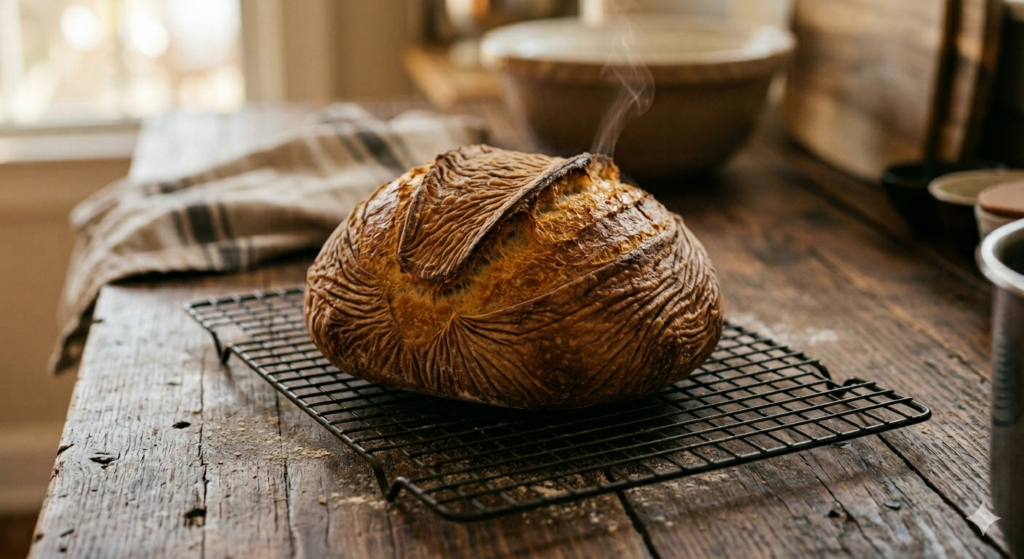
You did everything right. Then your crust wrinkled.
You pull your sourdough out of the oven. Crackling crust. Beautiful color. You set it on the rack, walk away for an hour, and come back to… a raisin. The crust has wrinkled, gone soft, maybe collapsed a little in places, and now looks weirdly pruney. Like your loaf aged 40 years while you weren’t looking.
Wrinkled sourdough crusts almost always come down to one thing: moisture. Specifically, too much moisture trapped inside the loaf that migrates outward as it cools. Here’s exactly what’s going on and how to stop it.
What’s actually happening inside the loaf
When bread comes out of the oven, the inside is still full of water vapor. As the loaf cools, that moisture pushes outward toward the crust. A properly baked crust is strong and dry enough to let the moisture escape without sagging. A weak crust? It absorbs the moisture, gets heavy, and wrinkles as the loaf shrinks underneath.
So wrinkles = weak or wet crust. Which means the fix is almost always about baking longer, baking drier, or letting it cool properly.
Cause #1: Underbaked loaf (the #1 reason)
If the internal temperature didn’t hit 205–210°F, the bread is still carrying too much water. As it cools, that water has nowhere to go but outward — into your beautiful crust, softening and wrinkling it.
How to fix it:
- Always check internal temp with an instant-read thermometer
- 205°F minimum, 210°F is safer for rustic sourdough
- If your crust looks done but the inside isn’t, drop oven temp to 425°F and keep baking
- Don’t pull the loaf just because the timer went off
👉 Related: Why is my sourdough pale after baking
Cause #2: Hydration too high for your flour
High-hydration doughs (80%+) have more water to get rid of. If your flour and technique aren’t up to it, that extra water stays in the crumb and migrates to the crust as it cools.
How to fix it:
- Drop hydration by 5% (from 80% to 75%, for example)
- Use higher-protein bread flour (12%+) if going high-hydration
- Bake 5–10 minutes longer than a lower-hydration loaf
- Leave the lid off for the final portion of the bake
👉 Related: Sourdough hydration explained · Sourdough dough too wet
Cause #3: Cooled in a draft or cold spot
If the outside of your loaf cools much faster than the inside (cold countertop, open window, AC blowing on it), the crust contracts quickly while the crumb is still hot and expanding. Result: wrinkles.
How to fix it:
- Cool bread on a wire rack, not directly on a cold counter
- Keep it out of drafts, AC vents, and open windows
- Let it cool in the turned-off oven with the door cracked for the first 15–20 minutes
- Don’t rush it — sourdough wants 2–4 hours of cool time minimum
Cause #4: Weak crust (not enough Maillard)
A thin, underdeveloped crust will wrinkle even if the loaf is fully baked. You need a properly browned, crackly crust that’s strong enough to hold its shape while moisture escapes.
How to fix it:
- Remove the Dutch oven lid at 20 minutes (not earlier) so the crust can develop
- Bake uncovered 20–25 more minutes for a deeply brown crust
- If the top element is weak, consider finishing with a few minutes of convection
- Don’t drop oven temp too early in the bake
👉 Related: Why is my sourdough pale after baking · Bake sourdough in Dutch oven
Cause #5: You cut it too early
Warm sourdough is still finishing. If you slice into it while it’s hot, steam escapes fast, the crumb gets gummy, and remaining moisture redistributes in weird ways as it cools. This can make the top wrinkle even after you cut.
How to fix it:
- Wait at least 2 hours before slicing (4 hours is better for larger loaves)
- Use a serrated bread knife, not a chef’s knife
- If you absolutely need warm bread, bake rolls or smaller loaves instead
👉 Related: How long does sourdough bread last
Cause #6: Weak gluten or overproofing
If the gluten network is weak (under-developed or broken down by over-fermentation), the loaf can’t hold its shape during cooling. The crumb contracts too aggressively and pulls the crust down with it — creating wrinkles.
Signs this is your issue:
- Dough was slack and spread out before baking
- Poor oven spring
- Dense, gummy crumb inside
- Bread looks slightly deflated even before cooling completes
How to fix it:
- Strengthen gluten with 4+ sets of stretch-and-folds
- Pull bulk fermentation at 50–75% rise, not a full double
- Use bread flour instead of all-purpose
👉 Related: Sourdough folding techniques guide · Overproofed vs underproofed sourdough
The cool-in-the-oven trick
This is the single best fix for wrinkly crusts. When your loaf is done:
- Turn the oven off
- Crack the door open (a wooden spoon does the trick)
- Leave the loaf in the turned-off oven for 15–20 minutes
- Then move to a wire rack to finish cooling
The slow temperature drop lets moisture escape gradually into warm air (where it evaporates) instead of cool air (where it condenses on your crust). Takes an extra 15 minutes. Saves your crust.
FAQs
Is wrinkled sourdough safe to eat? Totally. It’s just cosmetic. The bread is still edible, just not as pretty. Crust often crisps back up when toasted.
Can I revive a wrinkled crust? Yes. Pop the loaf back in a 400°F oven for 5–8 minutes to drive off moisture. The crust will re-crisp, though the wrinkles won’t fully disappear.
Does covering with a towel cause wrinkles? Yes. Covering bread while it cools traps moisture against the crust and guarantees soft, wrinkled results. Let it cool uncovered on a rack.
Why does my sandwich-style sourdough wrinkle more than my boule? Soft, enriched doughs (milk, butter, sugar) have more moisture and softer crusts by design. Some wrinkling is normal. Bake longer and cool uncovered.
Can humidity cause wrinkling? Yes. In humid climates, moisture evaporation is slower, so crusts stay wetter and can wrinkle more. Cool in the oven first and bake a few minutes longer.
Still troubleshooting?
- Crust soft overall? → How to store sourdough bread in humid climates
- Gummy crumb inside? → Why is my sourdough gummy
- Full bake walkthrough: Bake fixes guide
Wrinkled crust is almost always a moisture problem — bake longer, cool slower, and let the loaf rest in the turned-off oven. Your next loaf will hold that beautiful crackly crust all the way to the cutting board.