👈 Back to Complete Malt Guide — All malt types, uses, and baking benefits explained
Explore other malt guides: Diastatic Malt Powder • Malt Syrup • Malted Barley Flour • Malted Flour • Malted Barley • What Is Malting? • DIY Malting • High-Rise Recipe
Non-diastatic malt powder is the safer choice for bakers who want the color, sweetness, and flavor boost of malt—without the risk of accelerating fermentation beyond your control.
Non-diastatic malt powder is sprouted, dried barley (or other grains) that has been kiln-dried at high temperature to deactivate enzymes, leaving pure flavor and sugar behind. Unlike its enzyme-active cousin, non-diastatic malt powder adds no starch-digesting power to your dough—it’s a sweetener and colorant, nothing more.
In this guide, you’ll learn what non-diastatic malt powder is, how it’s made differently from diastatic malt, when to use it, proper dosing, and when non-diastatic is the smarter choice than diastatic.
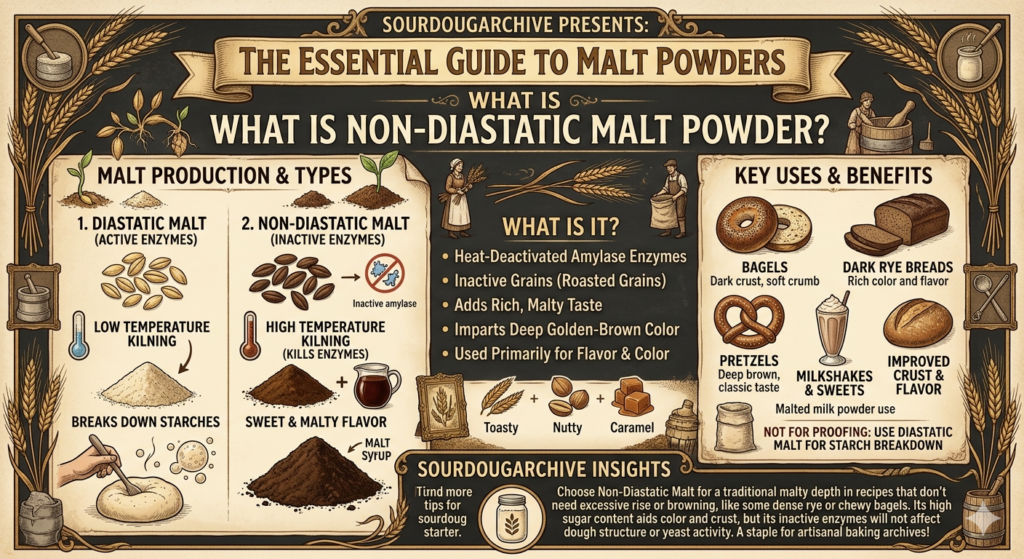
The Bridge: Diastatic vs. Non-Diastatic
If you haven’t already, read what is diastatic malt powder first. That post covers enzyme-active malt—the form that accelerates fermentation. This post is its counterpart: the enzyme-inactive form.
Both start as malted grain. The critical difference? Temperature during kilning. Low heat preserves enzymes (diastatic). High heat deactivates them (non-diastatic). Everything after that flows from that single decision.
What Is Non-Diastatic Malt Powder Made From?
Non-diastatic malt powder follows the same first steps as diastatic malt, then diverges at one critical moment:
Steeping & Germination: Same as Diastatic
Barley is soaked for 24–48 hours, then allowed to sprout for 4–7 days. During germination, enzymes activate and starches are converted to sugar. At this point, diastatic and non-diastatic malt are chemically identical.
Kilning: Where They Diverge Completely
This is the only difference that matters:
For diastatic malt: The sprouted grain is dried at low temperature (60–70°C / 140–158°F). Enzymes survive the heat and remain active.
For non-diastatic malt: The sprouted grain is dried at high temperature (80°C+ / 176°F+). The intense heat denatures the enzymes, permanently deactivating them.
Grinding
Both forms are then ground into fine powder. The roasting at high temperatures also develops the characteristic nutty, caramel-like flavor in non-diastatic malt—a side effect of enzyme deactivation and sugar caramelization.
Why Barley Dominates: Economics of Malt Production
While wheat and rice grains can technically be malted, commercial malt production relies almost entirely on barley. The reason: barley is uniquely adaptive to unfavorable climate and soil conditions, making it an economical source worldwide. Wheat malt production costs more (higher production expenses), and rice malt is rarer still (crop timing conflicts with normal rice-growing cycles). This is why you’ll never see “wheat malt powder” or “rice malt powder” on grocery shelves—barley malt simply wins on cost and availability, even though the malting science works for any grain.
What’s In Non-Diastatic Malt Powder: The Ingredient List
Typical ingredients:
- Malted barley flour (primary)
- Wheat flour (filler, texture)
- Dextrose (processing aid, trace sweetener)
What’s not in it: active enzymes. The amylase and protease that define diastatic malt are either absent or completely non-functional.
What is present: sugars from the fermentation during germination (maltose, glucose, and others), now stable because no enzymes will further break them down.
How Non-Diastatic Malt Powder Works in Sourdough (And What It Doesn’t Do)
What Non-Diastatic Malt Does
1. Adds sweetness (subtle)
The sugars created during germination are present in non-diastatic malt powder. These sugars add a mild sweetness to bread—noticeable but not cloying. It’s less sweet than table sugar and more earthy.
2. Improves crust color dramatically
The Maillard reaction (the browning that happens in the oven) requires amino acids and reducing sugars. Non-diastatic malt powder provides both. The result is a darker, richer, more caramelized crust than you’d get without it—visually similar to bread made with diastatic malt, but through pure sugar availability rather than enzyme action.
3. Adds nutty, toasted flavor
The high-temperature kilning caramelizes sugars and develops complex roasted flavors. This is why non-diastatic malt contributes a warm, molasses-like depth of flavor that appeals to many bakers.
4. Acts as a humectant (moisture retainer)
Non-diastatic malt is hygroscopic—it attracts and holds moisture. This can help keep your bread softer longer, improving shelf life and crumb tenderness. This is especially useful in bagel doughs, which are already wet.
5. Provides yeast food (but passively)
The sugars in non-diastatic malt are available for yeast to consume directly. Unlike diastatic malt (where enzymes create new sugars during fermentation), non-diastatic malt’s sugars are already present and pre-fermentable. The yeast eats what’s there; nothing new is created.
What Non-Diastatic Malt Does Not Do
Does not accelerate fermentation. Without enzymes, your lactic acid bacteria and yeast work at their natural pace, breaking down starches themselves. Fermentation timing doesn’t change.
Does not improve oven spring directly. Oven spring depends on yeast having enough sugar to produce gas right up until 60°C. Non-diastatic malt provides some sugar, but not the continuous supply that enzyme-driven sugar creation offers. The difference is real but modest.
Does not condition dough. Diastatic malt’s proteases relax gluten slightly. Non-diastatic malt has no enzymatic effect on protein or gluten structure. If you need dough extensibility, non-diastatic won’t help.
When To Use Non-Diastatic Malt Powder: The Strategic Choices
Use non-diastatic malt if:
- You want color and flavor, not fermentation changes. You’re happy with your current fermentation timeline and just want a prettier crust and richer taste.
- You’re working with dense or wet doughs (bagels, pretzels, enriched breads). These doughs are already gummy-prone; diastatic malt risks making them unworkable. Non-diastatic adds the benefits without the risk.
- You’re using commercial bread flour (which may already contain malt). Adding more enzyme-active malt risks over-fermentation. Non-diastatic is safer.
- You’re competing or baking high-stakes bread (bread for sale, competition, weddings). Diastatic malt’s fermentation acceleration is unpredictable. Non-diastatic is consistent.
- You need shelf life extension. The humectant properties slow staling.
- You want to control fermentation precisely. Non-diastatic removes a variable from the equation.
Use diastatic malt instead if:
- You want faster fermentation (useful in cold kitchens or with whole grains)
- You’re using flours with no pre-added malt (organic, whole wheat, home-milled)
- You want maximum oven spring
- You understand and trust enzyme-driven fermentation control
Dosing Non-Diastatic Malt Powder: No Risk of Over-Fermentation
Non-diastatic malt powder is forgiving. Because enzymes can’t continue breaking down starches, you can’t accidentally over-ferment your dough through over-dosing.
Standard Dosage: 0.2% to 1.5% of Flour Weight (Home Bakers)
Since there’s no fermentation acceleration risk, you have flexibility in how much non-diastatic malt you use:
- Very light (conservative add to any recipe): 0.2% of flour weight. For 500g flour = 1g (roughly ¼ teaspoon). Use this if you’re adding malt to a recipe that didn’t originally call for it and want minimal impact.
- Light flavor & color: 0.5% of flour weight. For 500g flour = 2.5g (roughly ½ teaspoon)
- Moderate flavor & color: 1% of flour weight. For 500g flour = 5g (roughly 1 teaspoon)
- Deep flavor & color: 1.5% of flour weight. For 500g flour = 7.5g (roughly 1.5 teaspoons)
You can go higher than 1.5% without ruining your bread—the worst you get is very sweet bread, which is subjective.
Commercial Dosage: 1.5% to 2% (Cream Crackers, Artisan Bakeries)
Professional bakers and cracker manufacturers use slightly higher doses depending on the mixing method:
- Sponge and Dough System: 2% of flour weight (more fermentation time, so more flavor extraction)
- Straight Dough System: 1.5% of flour weight (quicker mix, less fermentation)
Cream crackers, for example, commonly use this range to achieve their characteristic color and subtle malt flavor without any equipment or process changes.
Why Dosage Flexibility Matters
With diastatic malt, you stay in the 0.5–1% range because more risks gummy crumb and over-fermentation. With non-diastatic, you can experiment more freely. The 0.2% option is especially valuable for home bakers adding malt to recipes that didn’t originally call for it. Some bakers use 2% and love the result. Others prefer 0.75%. There’s room to dial in your preference without any fermentation risk.
How to Add Non-Diastatic Malt Powder to Your Dough
Mixing Method: Same as Diastatic
Weigh your non-diastatic malt powder and blend it thoroughly with your dry flour before adding water. This ensures even distribution.
You can also add it during the autolyse phase (the 30–60 minute rest after mixing flour and water, before salt and starter). Since it’s just sugar and flavor, timing matters less.
Fermentation Timing: No Changes
Non-diastatic malt doesn’t speed or slow your fermentation. Your bulk fermentation time remains exactly the same as if you hadn’t added malt. This predictability is one reason professional bakers prefer it.
Non-Diastatic Malt Powder in Specific Breads
Bagels: The Classic Use & The Boiling Water Secret
Bagels are the signature bread for non-diastatic malt powder—and it’s used twice in traditional bagel recipes, for two different purposes:
In the dough: Add 0.5–1% of flour weight (same as your loaf sourdough). A small amount in the dough gives bagels their characteristic amber crumb color, earthy sweetness, and tender crumb.
In the boiling water: Add approximately 1 tablespoon of non-diastatic malt powder per 2 liters of water. When you boil bagels in this malt-enriched water, the malt dissolves into the bath and creates the shiny, dark mahogany-brown exterior bagels are known for. The high heat of the boiling water caramelizes the malt sugars on the bagel’s surface, creating both the visual depth and a subtle molasses-like crust flavor. This is why bagels boiled in plain water look pale and steamed, while bagels boiled in malt water develop that distinctive burnished color.
Why bagels use non-diastatic malt: Bagel dough is already very hydrated and tight. Adding diastatic malt (with its enzyme acceleration) would create an unmanageable, gummy mess. Non-diastatic adds all the color and flavor benefits without fermentation risk.
Bagel Boiling Water Substitutions (No Malt on Hand?)
If you don’t have non-diastatic malt powder for the boiling water, you have two solid alternatives:
- Honey in the boiling water: Replace the malt with honey at a 1:1 ratio by weight (so if you’d use 1 tbsp malt powder ≈ 7g, use 7g honey instead). Honey won’t give you the exact malt flavor, but it provides caramelization and darkening. The result is golden-brown bagels with a slightly sweeter crust.
- Brown sugar in the dough, honey in the boiling water: Use brown sugar (same weight as the non-diastatic malt powder) in the bagel dough for color and flavor, and honey in the boiling solution. This combination mimics the malt effect fairly closely without requiring malt powder at all.
Enriched Breads (with eggs, butter, milk)
Brioche, cinnamon rolls, and other enriched doughs benefit from non-diastatic malt. The sweetness complements the richness, and the color is beautiful without the fermentation risk that comes with diastatic malt in already-sweet doughs.
Standard Sourdough: Where It’s Optional
For plain sourdough, non-diastatic malt is purely optional. It will improve crust color and add subtle flavor, but your sourdough will be excellent without it. Use it if you like the result; skip it if you prefer unadulterated grain flavor.
Can You Substitute Diastatic for Non-Diastatic (Or Vice Versa)?
Non-Diastatic → Diastatic: Not Recommended
Substituting non-diastatic malt with diastatic in a recipe calling for non-diastatic will speed up your fermentation unpredictably. You may end up with over-proofed dough before you expect it.
Diastatic → Non-Diastatic: Possible, With Caveat
If you have diastatic malt but need non-diastatic, you can deactivate the enzymes by spreading the diastatic malt powder on a sheet pan and baking it at 350°F (175°C) for 5 minutes. This high-temperature kilning deactivates the enzymes just like commercial production does. The result will be nearly identical to store-bought non-diastatic malt.
Comparing Non-Diastatic Malt Powder to Other Malt Forms
Malt comes in several formats. Here’s how non-diastatic malt powder stacks up:
Non-Diastatic Malt Powder vs. Barley Malt Syrup (The Easier Path for Home Bakers)
What is barley malt syrup? is the liquid, concentrated form of malt. All barley malt syrup is non-diastatic—the boiling process used to create syrup automatically deactivates the enzymes, so there’s no enzyme-acceleration risk to worry about.
For home bakers, barley malt syrup is actually the easier choice than powder:
- No weighing powder: Syrup comes in a jar; you just measure it by volume or weight into your water or dough.
- Dissolves instantly: Since it’s already liquid, it blends into dough uniformly without clumping.
- No enzyme uncertainty: It’s already processed (non-diastatic), so zero risk of unexpected fermentation changes.
- Perfect for boiling water: Syrup dissolves easily in hot water for bagel boiling, whereas powder can clump.
The only tradeoff: Syrup is slightly less convenient to weigh for recipes calling for powder (you need to measure it carefully due to its viscosity), but the ease of use often outweighs this small inconvenience. If you’re new to malt baking, start with syrup.
Non-Diastatic Malt Powder vs. Malted Barley Flour
What is malted barley flour? is similar to non-diastatic malt powder—sprouted grain ground fine. The difference is usually just branding and filler ratios. Most malted barley flours are non-diastatic. Check the label to confirm.
Non-Diastatic Malt Powder vs. Malted Milk Powder
Despite the similar name, malted milk powder is completely different. It’s non-diastatic malt mixed with milk powder and sweeteners—designed as a beverage flavoring, not a baking ingredient. Don’t confuse the two.
Where to Buy Non-Diastatic Malt Powder
- King Arthur Baking Company (online, high quality)
- Bob’s Red Mill (grocery stores, online)
- Specialty baking suppliers
- Online retailers (check reviews)
Check the label: Confirm it says “non-diastatic” or “malt flour” and not “diastatic.” Some sellers are sloppy with labels. If you’re uncertain, barley malt syrup is the foolproof choice (it’s always non-diastatic).
The Bottom Line on Non-Diastatic Malt Powder
Non-diastatic malt powder is the low-risk, high-reward choice for bakers who want better crust color and malt flavor without gambling with fermentation timing. It’s especially valuable for bagels, enriched breads, and any dough where fermentation predictability matters.
Key principles:
- Start with 0.2–0.5% if adding malt to a recipe that didn’t originally call for it
- Use 1–1.5% for pronounced color and flavor in breads designed for malt
- Blend evenly with flour before hydration, or dissolve in water for boiling applications
- Expect zero change to fermentation timing
- Enjoy darker crust and richer flavor with zero fermentation risk
- Perfect for bagels, competition baking, and high-stakes situations
- If unsure, use barley malt syrup instead—it’s always non-diastatic and easier for home bakers
If fermentation control is your primary concern, non-diastatic malt is your answer. Diastatic malt accelerates fermentation; non-diastatic just adds color, flavor, and sweetness. Both are valuable tools—use whichever fits your baking goals.