🌾 Explore Malt in Depth
This guide covers all malt types. For specific malt forms and uses, see:
- Diastatic Malt Powder — Enzyme-rich malt that boosts oven spring and fermentation
- Non-Diastatic Malt Powder — Color and flavor without fermentation risk
- Malt Syrup — Liquid malt form used for bagels and bread
- Malted Barley Flour — Ground malt for seamless blending into dough
- Malted Flour — Pre-blended malt flour for convenience
- Malted Barley — Whole grain malt for sourdough and brewing
- What Is Malting? — The three-stage process that creates malt
- How to Malt Your Own Grain — Complete DIY guide for home bakers
- High-Rise Sourdough Recipe — Using malt for maximum oven spring
Not sure which malt to use? Start here with the complete guide, then jump to the specific malt type that matches your recipe.
Malt is germinated cereal grains that have been dried through a controlled process that transforms their chemical composition and unlocks enzymes crucial for fermentation. If you’re a baker—especially a sourdough baker—malt isn’t just an ingredient: it’s a precision tool that controls oven spring, crust color, fermentation speed, and flavor development.
In this guide, you’ll learn what malt actually is, how it’s produced, why there are two completely different types (and when to use each), and exactly how to apply malt science to bake better bread—whether you’re just starting with sourdough or competing at a serious level.
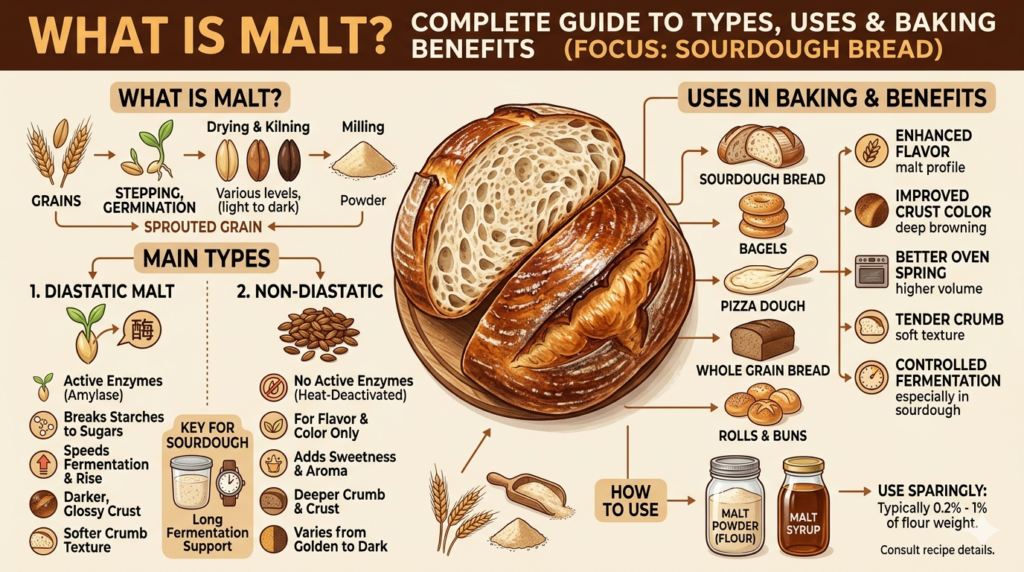
What Is Malt? Simple Definition
Malt is any cereal grain that has been specially prepared through soaking, sprouting, and drying to activate enzymes and convert starches into sugars.
The most common malt is malted barley, though wheat, oats, rye, corn, and rice can all be malted. The result is a product that looks like regular grain but has undergone dramatic internal changes: dormant enzymes are now active, starches have been partially broken down, and natural sugars have developed—making malt a concentrate of fermentable power.
Then explore what is malted flour—the convenience form where the miller has already blended malt (0.5–1%) into bread flour. Learn when pre-blended works, regional availability (common in UK, rare in US), and when buying plain flour + adding your own malt gives you more control.
How Is Malt Made? The Three-Stage Malting Process
Malting is a carefully controlled biotechnological process. It always follows three stages:
1. Steeping
The dry grain is soaked in water for 24–48 hours. This awakens the dormant embryo inside the kernel and raises moisture content to trigger germination. The grain absorbs roughly 45% of its weight in water.
2. Germination
The wet grain is spread on floors or in vessels and allowed to sprout for 4–7 days at controlled temperature (typically 15–18°C). During this stage, tiny rootlets emerge and enzymes activate. The sprouting grain develops amylase and protease enzymes—the same enzymes that make malt so valuable to bakers and brewers.
These enzymes break down the grain’s cell walls, converting stored starch into simple sugars (glucose, maltose, and others) and breaking down proteins into amino acids. This is why malt is such a powerful fermentation ingredient: it pre-digests the grain for you.
3. Kilning (Drying & Roasting)
The sprouted grain (“green malt”) is dried in a kiln using hot air. Temperature and duration determine the final product:
- Low-temperature kilning (60–70°C): Preserves all the enzymes. This creates diastatic malt—the type that actively breaks down starches during fermentation.
- High-temperature kilning (80°C+): Deactivates the enzymes. This creates non-diastatic malt—pure flavor and sugar, with no enzymatic action.
The kilning process also caramelizes some of the sugars and develops the toasted, nutty flavors we associate with malt. Extended roasting at higher temperatures produces darker malts with chocolate, coffee, and smoky notes.
Diastatic vs. Non-Diastatic Malt: The Critical Difference for Bakers
This is where malt gets interesting for bakers. There are two fundamentally different types of malt, and they behave completely differently in your dough.
Diastatic Malt Powder (Enzyme-Active)
Diastatic malt contains active amylase enzymes that continue breaking down starch into fermentable sugars throughout your fermentation and bake. When you add diastatic malt to your dough, you’re introducing a powerful starch-digesting machine.
What it does in sourdough:
- Accelerates fermentation: More simple sugars = faster yeast feeding = quicker rise times
- Improves oven spring: The extra fermentable sugars feed the yeast more aggressively during bake, creating stronger gas production in the oven
- Deepens crust color: The extra sugars caramelize in the oven, creating a darker, richer crust via the Maillard reaction
- Enhances flavor: More fermentation byproducts = more complex, developed sourdough flavor
- Acts as a dough conditioner: The enzymes slightly relax the gluten network, making dough more extensible
Important caveat: Too much diastatic malt makes dough overly fermented and the crumb gummy. Typical dosing: 0.5–1% of flour weight (roughly ½ to 1 teaspoon per 500g flour).
Non-Diastatic Malt (Sugar & Flavor Only)
Non-diastatic malt has had its enzymes deactivated through high-temperature kilning. It’s pure flavor and sugar—it adds sweetness and crust color but does not participate in enzymatic starch breakdown.
What it does in sourdough:
- Adds subtle sweetness: The pre-digested sugars flavor the bread without active enzymatic feeding
- Improves crust color: Works purely through the caramelization of existing sugars
- Tenderizes crumb: The non-fermentable sugars absorb water, softening the crumb
- Doesn’t accelerate fermentation: The lactic acid bacteria in your sourdough still break down starches at their natural pace
Non-diastatic malt is safer for sourdough bakers who want better crust and flavor without gambling with fermentation timing.
What Is Malt Made Of? Nutritional & Biochemical Composition
Malt is biochemically very different from the grain it came from. Here’s what’s actually in it:
Carbohydrates & Sugars
- Maltose (primary fermentable sugar from starch breakdown)
- Glucose (monosaccharide, immediately fermentable by yeast)
- Fructose & sucrose (naturally present in grain, trace amounts)
- Residual starch (not fully converted; partly converted during kilning)
Enzymes (if diastatic)
- Amylase enzymes (break starch into maltose and glucose)
- Protease enzymes (break protein chains into amino acids)
Protein & Amino Acids
Malting increases the availability of amino acids because proteases break down complex proteins into forms that yeast can consume. This is why malt supports yeast nutrition so effectively.
Then explore what is malted barley flour—the ground form that blends invisibly into dough. Learn diastatic vs. non-diastatic types, precise dosing (0.5–5%), effects on fermentation speed and crust color, and why it’s the industry-standard dough conditioner.
Vitamins & Minerals
- B vitamins (B1, B2, niacin, pantothenic acid)
- Calcium, magnesium, phosphorus, iron, zinc
Common Malt Products for Bakers (Forms & Formats)
Malt is sold in several formats, each suited to different baking needs:
Malt Powder (Diastatic & Non-Diastatic)
Fine powder form—the most common choice for home and artisan sourdough bakers. Easy to weigh and blend into flour. Available in both diastatic (enzyme-active) and non-diastatic versions.
Malted Barley (Grain Form)
The whole malted grain. Usually used by brewers, but some bread bakers use it for visual appeal or as a soaker. Must be ground or steeped to access the malt.
Malt Syrup (Liquid Malt Extract)
Concentrated liquid made by steeping malted grain in water, straining, and reducing it. Easier to dissolve in dough than powder but harder to measure precisely. Contains all the sugars and some (if diastatic) or none (if non-diastatic) of the active enzymes.
Malt Extract (Powder Form)
Dried version of malt syrup. Reconstitute with water before use, or blend directly into flour. Less common for bread baking.
Malted Flour (Pre-Blended)
Flour that already contains malt blended in at the mill. Most commercial bread flours in the US include small amounts (typically 0.5–1%) of non-diastatic malt as a standard. If you buy high-protein bread flour, malt may already be in it.
Why Bakers Use Malt: The Science Behind the Ingredient
Malt is not optional in professional bread baking—it’s a precision tool used for four concrete reasons:
1. Fermentation Control (Diastatic Malt)
In sourdough baking, fermentation speed depends on how much sugar is available for yeast to eat. When you use flour alone, the lactic acid bacteria in your starter must break down starches into sugar—this takes time. When you add diastatic malt, you pre-load the dough with enzymes that do this work faster. The result: predictable, faster fermentation that you can actually time reliably.
For bakers in cool climates or working with cold fermentation, diastatic malt can mean the difference between a 12-hour bulk fermentation and a 16-hour one—significant for scheduling.
2. Oven Spring & Gas Production
Oven spring—that dramatic pop in the oven before the crust sets—happens because yeast produces CO₂ gas right up until about 60°C. If you have extra fermentable sugars (from diastatic malt), yeast produces more gas, and you get more spring. The result: an open crumb structure and that audible “ear” many sourdough bakers prize.
3. Crust Color & Browning Reaction
Crust color comes from the Maillard reaction—a chemical reaction between amino acids and reducing sugars that happens at high heat. More sugar in the dough (from malt) = more substrate for the Maillard reaction = darker, more caramelized crust. This is why commercial bakeries add malt to every dough: it’s a crust color guarantee.
4. Dough Conditioning & Extensibility
The proteases in diastatic malt break down gluten proteins slightly, making dough more extensible (stretchier) and easier to handle. This is especially useful when working with high-protein or difficult flours. It also buys you time: dough that’s been conditioned by malt enzymes stays workable longer without over-fermentation.
Historical & Global Context: Malt in Food & Beverage
Malt is not a modern invention. Archaeological evidence suggests malted grains have been used for beer brewing since ancient Egypt and Mesopotamia (over 5,000 years ago). The malting process pre-dates written documentation of baking.
Today, malt is used across multiple industries:
- Brewing: The foundation of beer production. Most beer is 80–100% malted barley.
- Distilling: Malt (especially single malt barley) is essential for whisky, scotch, and other grain spirits.
- Baking: Bread, bagels, rolls, and specialty breads use malt for color and fermentation control.
- Beverages: Malted milkshakes, malted milk powders (Horlicks, Ovaltine, Milo), and malt drinks.
- Confectionery: Malt syrup sweetens candies and chocolate products (Maltesers, Whoppers).
Quick Reference: When to Use Diastatic vs. Non-Diastatic Malt
| Situation | Best Choice | Why |
|---|---|---|
| Standard sourdough (room temp fermentation) | Diastatic (0.5–1% of flour) | Predictable fermentation, better oven spring |
| Cold fermentation (<14°C) | Diastatic (0.75–1%) | Enzymes work even in cool temps; speeds fermentation |
| You want crust color but worry about over-fermentation | Non-diastatic (0.5–1%) | Adds color & sweetness without enzyme activity |
| Using whole grain or rye flour (already whole grain enzyme-poor) | Diastatic (1%) | Compensates for naturally low enzyme activity |
| You want softer crumb & sweetness | Non-diastatic (0.5%) | Absorbs water, tenderizes without fermentation change |
| Competition or high-stakes baking | Non-diastatic (0.5%) | Adds consistency without gambling on enzyme activity |
The Bottom Line
Malt is germinated, dried grain loaded with enzymes and sugars that unlock some of the most powerful levers in bread baking: fermentation speed, oven spring, crust color, and dough extensibility. Understanding the difference between diastatic (enzyme-active) and non-diastatic (sugar-only) malt is essential for controlling your sourdough outcomes.
If you’re serious about sourdough, malt isn’t a “nice to have”—it’s a precision ingredient that professional and advanced home bakers use to achieve predictable, beautiful bread.
Ready to deepen your malt knowledge? Start with what is diastatic malt powder—the enzyme-active form that transforms fermentation speed, oven spring, and crust color. Then explore what is non-diastatic malt powder for competition baking and bagels, what is malt syrup for the liquid form, and what is malt extract for long-term storage.
Then explore what is malting—the complete three-stage process (steeping, germination, kilning) that transforms raw barley into malt, with the science of enzyme activation and why kilning temperature determines whether malt will be diastatic or non-diastatic.
Then explore what is malted barley—the whole grain form of malt that adds visible texture, rustic character, and toasty flavor to sourdough. Learn grinding methods, dosing, hydration adjustments, and how to source it from homebrew suppliers.