👈 Back to Complete Malt Guide — All malt types, uses, and baking benefits explained
Explore other malt guides: Non-Diastatic Malt Powder • Malt Syrup • Malted Barley Flour • Malted Flour • Malted Barley • What Is Malting? • DIY Malting • High-Rise Recipe
If you’ve ever wondered why professional sourdough bakers seem to get deeper crust color, more dramatic oven spring, and better control over their fermentation timing—diastatic malt powder is often the answer.
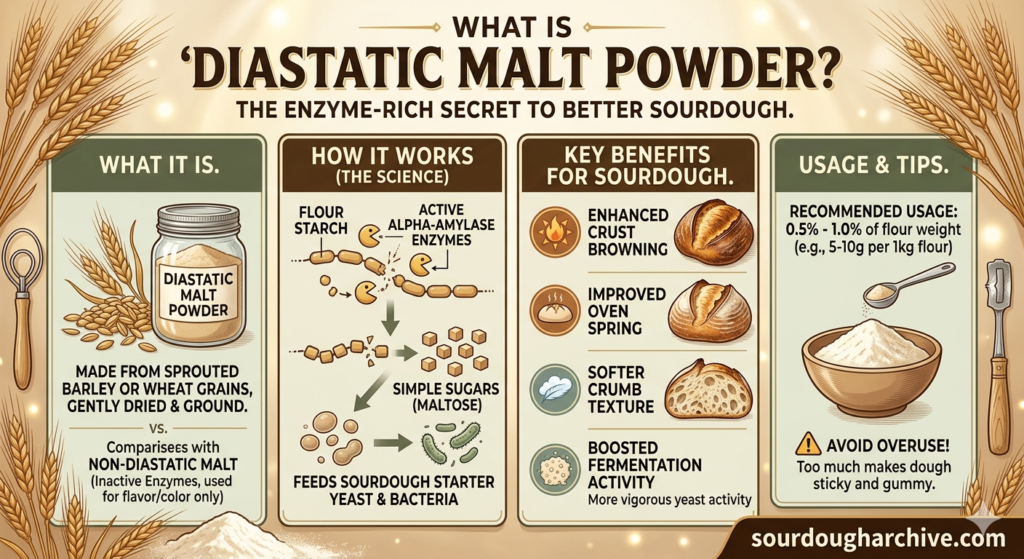
Diastatic malt powder is sprouted, dried grain (typically barley) ground into fine powder that contains active enzymes capable of breaking down starch into fermentable sugars. The term “diastatic” literally means “enzyme-active”—distinguishing it from non-diastatic malt powder, which is purely a sweetener and flavor enhancer. Bakers and brewers have used malted grain for centuries, and it is still a standard ingredient in many commercial bread flours.
In this guide, you’ll learn exactly what diastatic malt powder is, how it works in sourdough fermentation, when to use it, dosing guidelines, and why too much can actually wreck your bake.
The Bridge: Understanding Malt Fundamentals
Before diving into diastatic malt powder specifically, it helps to understand malt itself. What is malt? is a complete guide covering how malt is produced, the three-stage malting process (steeping, germination, kilning), and why bakers use it. That pillar post explains the foundational science—diastatic vs. non-diastatic malt, the enzymes involved, and when each form applies to different baking scenarios.
This post dives deeper specifically into diastatic malt powder: what makes it work, practical dosing for sourdough, what happens when you use too much, and how to integrate it into your fermentation workflow.
What Is Diastatic Power?
“Diastatic power” is the technical term for how effective a given batch of malt actually is at converting starch into fermentable sugar. It’s not a single enzyme — it’s the combined activity of four enzymes: alpha-amylase and beta-amylase (the two most bakers ever hear about), plus limit dextrinase and alpha-glucosidase, which help break down the more resistant branch points in starch molecules that amylase alone can’t touch.
This term originates in the brewing and distilling world, where diastatic power is a formal quality measurement used to grade malt. For home sourdough bakers it’s less important to memorize the individual enzymes than to understand the takeaway: “diastatic” isn’t a marketing word, it’s shorthand for a measurable, real enzymatic capability — and different malt batches, brands, and grain sources can have meaningfully different diastatic power even when both are labeled “diastatic malt.”
What’s Actually In Diastatic Malt Powder?
Reading an ingredient label, you’ll typically see:
- Malted barley flour (the primary ingredient—sprouted, dried barley ground fine)
- Wheat flour (often added for texture and consistency)
- Dextrose (added as a processing aid or minor sweetener)
Barley is the most common base grain, but diastatic malt can also be made from wheat or rice — the enzyme-activation process is the same regardless of grain, though barley remains the industry default because it’s the most cost-effective and produces the most reliable diastatic power.
But the biochemical magic comes from what’s present at a molecular level: active diastase enzymes (alpha-amylase and beta-amylase, plus smaller amounts of limit dextrinase and alpha-glucosidase). These enzymes are the whole point of the ingredient.
When you add diastatic malt powder to your dough, you’re literally introducing a starch-digesting machine that continues working throughout fermentation and into the bake.
How Diastatic Malt Powder Works in Sourdough
Understanding the mechanism is key to using diastatic malt powder effectively. Here’s what happens when you add it to your dough:
Enzyme Action: Breaking Down Starch
The amylase enzymes in diastatic malt powder immediately begin breaking down the long-chain starch molecules in your flour into simpler sugars—specifically maltose (malt sugar) and glucose. This conversion happens in real time as your dough sits.
Flour already contains a small amount of its own amylase enzymes, so some of this happens without any help. Diastatic malt powder adds extra enzyme activity on top, which speeds the process up.
Feeding Yeast & Bacteria
Your sourdough starter contains both wild yeast and lactic acid bacteria. Both organisms need fermentable sugars to thrive. When diastatic malt powder breaks down starch into simple sugars, it’s essentially pre-digesting the flour for your microbes.
The result: more active fermentation, faster rise, better texture development, and more complex flavor from extended metabolic byproducts.
Creating Fermentable Power
As the amylase enzymes work, they produce a steady supply of maltose and glucose—the exact sugars yeast and bacteria consume. This is why bakers refer to diastatic malt powder as a “slow burn” fuel: it keeps feeding your fermentation consistently over hours, even during long cold ferments.
Why Use Diastatic Malt Powder? The Five Benefits for Sourdough
1. Better Oven Spring
Oven spring—that dramatic rise in the oven before the crust sets—happens because yeast produces CO₂ gas as long as the dough is below 60°C (140°F). More fermentable sugars = more gas production = stronger oven spring. The result is higher loaves with more open crumb structure.
2. Darker, More Caramelized Crust
The Maillard reaction (the chemical browning that happens at high heat) requires two things: amino acids and reducing sugars. Diastatic malt powder supplies extra reducing sugars from starch breakdown. More sugars available = darker, richer crust color. This is why commercial bakeries use it religiously.
3. Faster, More Predictable Fermentation
If you struggle with inconsistent fermentation times—sometimes your dough proofs in 4 hours, sometimes 6—diastatic malt powder helps standardize the process. By pre-loading your dough with fermentable sugars, you speed up and stabilize the fermentation timeline, making your baking schedule more reliable.
4. Better Dough Extensibility
The protease enzymes in diastatic malt powder break down gluten proteins slightly, making your dough more extensible (stretchier) and easier to handle. This is especially valuable when working with high-protein flours, whole grain flours, or doughs that resist stretching.
5. Enhanced Flavor Development
Longer, more active fermentation = more complex flavor. The extra fermentation byproducts created by enzyme-accelerated processes develop deeper, more interesting sourdough notes.
How Much Diastatic Malt Powder to Use: The Critical Dosing Guidelines
This is where most bakers go wrong. Too much diastatic malt powder will ruin your bake—not help it.
Standard Dosage: 0.5–1% of Flour Weight
The industry standard is:
- Conservative dosage (safest): 0.5% of flour weight. For 500g flour = 2.5g (roughly ½ teaspoon)
- Moderate dosage: 0.75% of flour weight. For 500g flour = 3.75g (roughly ¾ teaspoon)
- Maximum recommended: 1% of flour weight. For 500g flour = 5g (roughly 1 teaspoon)
If you’re new to diastatic malt powder, start at 0.5% (some bakers start as low as 0.25%) and adjust based on results. For a quick, no-scale reference, King Arthur Baking recommends roughly ½ to 1 teaspoon per 3 cups of flour — a close match to the percentage-based dosing above and a handy volume-based check if you’re not weighing your flour.
What Happens if You Use Too Much: The Gummy Crumb Problem
Using more than 1% of diastatic malt powder creates several problems:
- Over-fermented dough: Excessive enzyme activity means starch is converted to sugar faster than yeast can eat it. The dough becomes overly soft and difficult to shape.
- Gummy crumb: Excess residual sugars that don’t ferment create a sticky, unpleasant crumb texture.
- Loss of oven spring: Paradoxically, over-fermented dough produces less oven spring because the yeast is already exhausted.
- Reddish crust: Some bakers report a reddish tint to the crust when diastatic malt powder is overused—likely from excessive Maillard reaction and heat damage.
Rule of thumb: Start conservative. You can always add more diastatic malt powder to your next bake; you can’t undo adding too much to your current dough.
When to Adjust Your Dosage
Increase diastatic malt powder to 0.75–1% if:
- You’re baking in a cold kitchen (below 18°C / 64°F). Cold temperatures slow enzyme activity; higher dosage compensates.
- You’re using whole grain or rye flour, which naturally contains fewer enzymes than white bread flour.
- You want to speed up fermentation for scheduling reasons.
- You’re using organic or home-milled flour, which may not contain the malt already added by commercial mills.
Decrease or skip diastatic malt powder if:
- You’re already using commercial bread flour (which typically includes 0.5–1% malt as standard).
- Your fermentation is already happening faster than you’d like.
- You want maximum control over your fermentation timeline.
How to Add Diastatic Malt Powder to Your Dough
Mixing Method
There are two approaches:
Method 1: Blend into Flour Before Mixing (Recommended)
Weigh your diastatic malt powder and mix it thoroughly with your dry flour before adding water. This ensures even distribution—you don’t want clumps of powder that ferment faster than surrounding dough.
Method 2: Add to Autolyse
Some bakers add diastatic malt powder during the autolyse phase (the 30–60 minute rest after mixing flour and water, before adding salt and starter). This allows enzymes to begin working on starch before fermentation officially starts.
Do NOT add to your levain or starter. The levain is typically warmer and ferments faster; malt added there will be consumed too quickly and won’t benefit your main dough’s fermentation.
Timing Matters
Diastatic malt powder’s enzyme activity is temperature-dependent:
- 68–72°F (20–22°C): Enzymes work at moderate speed. This is typical room-temperature fermentation.
- Below 68°F: Enzyme activity slows. You may need slightly higher dosage.
- Above 75°F (24°C): Enzyme activity accelerates. Lower dosage or reduce fermentation time.
Diastatic Malt Powder vs. Other Malt Forms
Malt comes in several forms. Here’s how diastatic malt powder compares:
Diastatic Malt Powder vs. Non-Diastatic Malt Powder
What is non-diastatic malt powder? is a companion spoke covering the enzyme-inactive form. Non-diastatic malt powder is kiln-dried at high temperature, deactivating enzymes. It adds sweetness, flavor, and crust color—but does NOT participate in starch breakdown. Use non-diastatic if you want color without accelerating fermentation.
Diastatic Malt Powder vs. Malt Syrup
What is malt syrup? is the liquid equivalent of diastatic malt powder—concentrated extract of malted grain. Malt syrup contains the same enzymes but is harder to weigh precisely and adds significant moisture to dough. Powder is generally easier for home bakers.
Diastatic Malt Powder vs. Malted Barley Flour
What is malted barley flour? is similar to diastatic malt powder but may contain more wheat flour filler and is sometimes ground coarser. Composition varies by brand; read labels carefully.
Can You Make Your Own Diastatic Malt Powder?
Yes, but it’s labor-intensive. You must:
- Soak barley in water for 24–48 hours
- Spread on a cloth and allow to sprout for 4–7 days (keeping at cool temperature, around 15–18°C)
- Dry the sprouted barley in a low-temperature oven (60–70°C) for 6–12 hours
- Grind fine in a food processor or grain mill
The challenge: maintaining the precise low temperature during drying. Too hot and enzymes die (you’ve made non-diastatic malt). Too cool and sprouting may not complete properly.
For most bakers, buying from a specialty baker’s supplier or online is more practical.
Where to Buy Diastatic Malt Powder
Common suppliers:
- King Arthur Baking Company (online)
- Bob’s Red Mill (grocery stores, online)
- Specialty baker’s suppliers
- Online retailers (Amazon, Etsy—check reviews carefully)
Check the label: Confirm it says “diastatic” and lists active enzymes. Some sellers mislabel non-diastatic as diastatic.
Diastatic Malt Powder Substitutes
There is no true substitute for diastatic malt powder, because the enzymes are the whole point. Your best options are malted barley flour (use it at the same percentage) or a bread flour that already lists malted barley flour on the label. Non-diastatic malt powder, honey, or sugar can add sweetness and crust color, but they will not break down starch or speed up fermentation.
How to Store Diastatic Malt Powder
Keep diastatic malt powder in an airtight container in a cool, dry place away from sunlight. Heat and moisture weaken the enzymes, so use it within about 12 months for the best results.
Diastatic Malt Powder FAQ
What does diastatic malt powder do in bread?
It breaks starch into sugars that feed yeast, which improves oven spring, crust color, and dough extensibility.
How much diastatic malt powder should I use?
Use 0.5–1% of your flour weight. That is about 2.5–5g for 500g of flour. Start low, since too much makes the crumb gummy.
Can I use non-diastatic malt powder instead?
No, they are not interchangeable. Non-diastatic malt has no active enzymes, so it only adds flavor and color.
Do I need diastatic malt powder if my flour is already malted?
Usually not. Most commercial bread flour already contains a small amount of malted barley flour, so extra malt can be redundant. It helps most with organic, whole grain, or home-milled flour.
The Bottom Line on Diastatic Malt Powder
Diastatic malt powder is a precision tool for serious sourdough bakers. It controls fermentation speed, improves oven spring, darkens crust, and makes dough more extensible—but only if used correctly.
Key principles:
- Use 0.5–1% of flour weight (start low)
- Mix evenly with flour before hydration
- Never add to your levain
- Adjust for temperature and flour type
- Understand that more is not better—too much creates gummy, over-fermented bread
If you’re working with organic flour, whole grains, or cold-temperature fermentation, diastatic malt powder is a game-changer. If you’re already using commercial bread flour (which includes malt), adding more may be redundant—or even counterproductive.