👈 Back to Complete Malt Guide — All malt types, uses, and baking benefits explained
Explore other malt guides: Diastatic Malt Powder • Non-Diastatic Malt Powder • Malted Barley Flour • Malted Flour • Malted Barley • What Is Malting? • DIY Malting • High-Rise Recipe
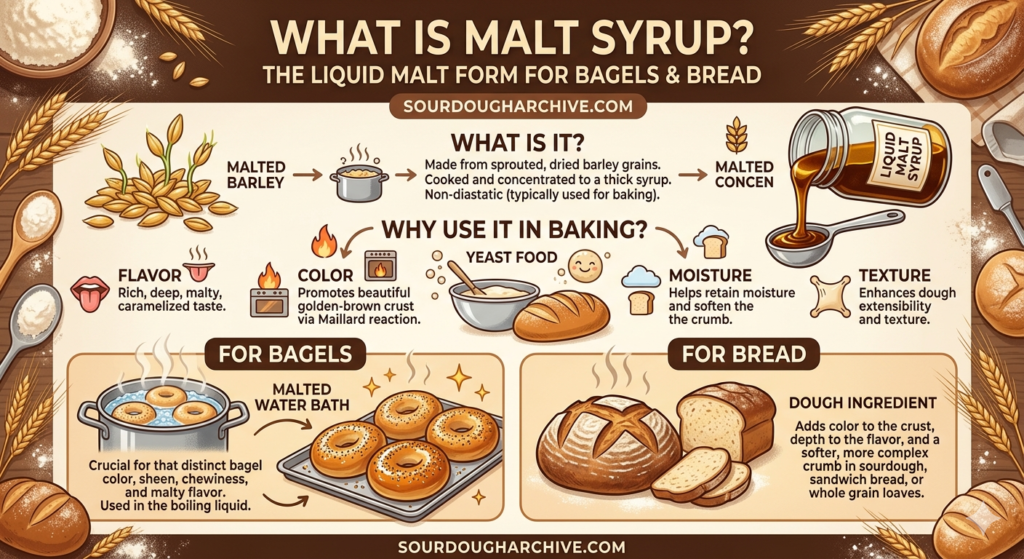
Malt syrup is the liquid, concentrated form of malt—thick like molasses, intensely flavored, and primarily non-diastatic (meaning it won’t accelerate your fermentation).
Malt syrup is sprouted, malted barley that has been steeped in water, filtered, and slowly reduced down into a dark brown, viscous syrup containing about 65–75% maltose. It’s shelf-stable, widely available, and especially prized by bagel bakers who add it both to dough and to the boiling water for that signature amber crust.
In this guide, you’ll learn what malt syrup actually is, how it differs from malt powder, how to use it in sourdough, hydration considerations, and why bagel bakers swear by it.
The Bridge: Malt Syrup vs. Malt Powder
All three malt forms—diastatic malt powder, non-diastatic malt powder, and malt syrup—come from the same source: sprouted, malted barley. The difference is in form and concentration. This post covers the liquid, syrupy version.
If you want powder for easy blending with flour, use powder. If you want to add liquid to your dough (or to bagel boiling water), use syrup. Both accomplish the same flavor and color goals; choice comes down to what works in your recipe.
What Is Malt Syrup Made From? The Production Process
Malt syrup starts with the standard malting process—steeping, germination, and kilning—then diverges into liquid extraction and reduction.
Step 1: Standard Malting
Barley is steeped, sprouted, and kiln-dried (typically to high temperature, making it non-diastatic). At this point, you have dried malt grain.
Step 2: Water Extraction (Mashing)
The dried malt is steeped in hot water. This extracts the sugars, dissolved grain solids, and flavor compounds into the water. The process is similar to making tea or coffee—steep, then filter.
Step 3: Filtration
The liquid is strained to remove solid grain particles. What remains is a pale, sugar-rich liquid (called “wort” in brewing).
Step 4: Concentration & Reduction
The strained liquid is slowly heated and reduced, concentrating the sugars and developing deeper color and flavor through caramelization. This concentration takes 30–45 days using traditional methods, reducing the liquid down to a thick, molasses-like syrup.
The Result
Malt syrup: dark brown, thick, sticky, about half as sweet as refined sugar, with a distinctive toasted, nutty flavor.
What’s Actually In Malt Syrup? Biochemical Breakdown
Sugar composition (approximately):
- 65–75% maltose (malt sugar, the primary fermentable sugar)
- 15–20% glucose (immediately fermentable)
- 3–5% sucrose and fructose (minor sugars)
- 5–10% complex carbohydrates (fiber, minerals, vitamins)
Nutrients:
- B vitamins (thiamine, riboflavin, niacin, pantothenic acid)
- Minerals (iron, magnesium, phosphorus, potassium)
- Amino acids (from sprouted grain protein breakdown)
- Enzymes (if diastatic) or none (if non-diastatic/heat-treated)
Key point: Most malt syrup sold for baking is non-diastatic. The boiling/heating process during concentration deactivates any remaining enzymes. If a product says “malt syrup” without qualification, assume it’s non-diastatic.
Malt Syrup in Sourdough: How It Works
What Malt Syrup Adds to Your Dough
1. Fermentable sugars (but pre-made, not enzyme-generated)
The 65–75% maltose in malt syrup is already present and ready for yeast to consume. Unlike diastatic malt powder (where enzymes create new sugars during fermentation), malt syrup’s sugars exist from day one. Your yeast eats what’s there; nothing is continuously created.
2. Deeper crust color
The Maillard reaction requires amino acids and reducing sugars. Malt syrup supplies both. The result is a darker, more caramelized crust than plain sourdough, without the fermentation risk of diastatic malt.
3. Warm, toasted, molasses-like flavor
The caramelization during concentration develops complex roasted notes—more pronounced than powder forms because the syrup is concentrated.
4. Moisture retention (humectant effect)
Malt syrup absorbs and holds water, keeping bread soft longer. Useful for extending shelf life and achieving tender crumb.
What Malt Syrup Does NOT Do
Does not accelerate fermentation (unless diastatic, which is rare). Your fermentation timeline remains normal.
Does not condition dough (no enzymatic gluten relaxation).
Does not improve oven spring in the way diastatic malt does (through continuous enzymatic sugar creation).
Using Malt Syrup in Sourdough: Dosing & Application
How Much to Use
Malt syrup is more concentrated than powder, so you use less by weight:
- Light use (subtle flavor & color): 0.25–0.5% of flour weight. For 500g flour = 1.25–2.5g (roughly ¼ to ½ teaspoon)
- Moderate use: 0.5–1% of flour weight. For 500g flour = 2.5–5g (roughly ½ to 1 teaspoon)
- Heavy use (pronounced flavor): 1–1.5% of flour weight. For 500g flour = 5–7.5g (roughly 1 to 1.5 teaspoons)
Start at 0.5% and adjust to taste.
How to Add Malt Syrup to Dough
Method 1: Dissolve in Water Before Mixing (Easiest)
Warm a small amount of water (30–40°C), stir in your malt syrup until fully dissolved, then add this to your dough water. This ensures even distribution and prevents clumping.
Method 2: Add During Hydration
Mix malt syrup with your water before adding to flour. Blend thoroughly so the syrup dissolves completely.
Method 3: Add to Autolyse
Mix malt syrup into your water during the 30–60 minute autolyse (rest after flour hydration, before salt and starter). Since it’s just sugar and flavor, timing is flexible.
The Hydration Question: Does Malt Syrup Change Hydration?
Technically yes, but not significantly. Malt syrup is roughly 20% water and 80% dissolved solids (sugar, nutrients). So if you add 5g of malt syrup, you’re adding about 1g of water.
In practice: For the tiny amounts bakers use (0.5–1% of flour), the hydration change is negligible. You don’t need to adjust your water percentage.
For precision: If you want to be exact, reduce your water by about 20% of the malt syrup weight. For 500g flour with 2.5g malt syrup: reduce water by 0.5g.
Why Bagel Bakers Love Malt Syrup
Malt syrup has a special place in bagel tradition. Here’s why:
Bagel Dough Application
Bagel dough is tight, stiff, and already hydrated. Adding liquid malt syrup is easier than powder (which can clump in dense dough). Bakers typically add 0.5–1% of flour weight to the dough.
Bagel Boiling Water
This is the signature bagel technique: malt syrup is added to the boiling water (typically 1–2 tablespoons per 2 liters) before the shaped bagels are dropped in.
What this does: The boiling malt syrup creates a gelatinizing effect on the bagel’s surface, producing that characteristic shiny, amber, slightly reddish crust that professional bagels have. The boiling also caramelizes the syrup, deepening color and developing flavor.
Why it works: The syrup is already dissolved in the boiling water, so it deposits flavor and color directly on the bagel surface during the 30–60 second boil, before the bread’s interior cooks.
Double-Malt Bagels
Professional bagel recipes often use both malt syrup in the dough AND in the boiling water. This creates maximum color and malt flavor.
Diastatic vs. Non-Diastatic Malt Syrup
Most commercial malt syrup is non-diastatic (the heating during concentration deactivates enzymes). However, some specialty producers make diastatic malt syrup (keeping enzymes alive).
Non-Diastatic Malt Syrup (Standard)
- No enzyme activity
- Won’t accelerate fermentation
- Pure flavor, color, sweetness
- Safe for any recipe
- Shelf-stable for years
Diastatic Malt Syrup (Rare)
- Contains active enzymes
- May accelerate fermentation slightly
- Breaks down starch over time during fermentation
- Less common; requires cold storage
- Must be used carefully (enzyme action is unpredictable)
Assumption: Unless the label specifically says “diastatic,” assume your malt syrup is non-diastatic.
Malt Syrup vs. Other Forms: The Comparison
Malt Syrup vs. Diastatic Malt Powder
Diastatic malt powder contains active enzymes that break down starch into new sugars during fermentation. Malt syrup (non-diastatic) has no enzyme activity. Use diastatic powder if you want faster fermentation; use syrup if you want color and flavor without fermentation changes.
Malt Syrup vs. Non-Diastatic Malt Powder
Non-diastatic malt powder is the dry equivalent of malt syrup. Both are non-diastatic (no enzymes). Powder blends with flour easily; syrup adds liquid and works better in recipes where you already have water. Powder is easier to measure precisely; syrup is easier to distribute evenly in dough.
Malt Syrup vs. Malt Extract (Powdered)
Malt extract powder is dried, powdered malt syrup—basically syrup with the water removed. Add water to reconstitute. Less common for home bakers than either powder or syrup.
Where to Buy Malt Syrup
- Health food stores: Usually stock Eden Organic or other brands in the sweetener aisle
- Online retailers: Amazon, specialty baking sites
- Brewing suppliers: Beer and wine homebrew shops often have malt syrup for brewing
- Supermarkets: Increasingly available in natural/organic sections
Recommended brands: Eden Organic (traditional method, simple ingredient list—just barley and water), King Arthur, specialty suppliers.
Cost: More expensive per ounce than powder, but you use less volume and concentrated flavor.
Storage: How Long Does Malt Syrup Last?
Malt syrup is shelf-stable (non-diastatic form). Once opened:
- Room temperature: 1–2 years (the concentrated sugar acts as preservative)
- Refrigerated: Indefinitely (high sugar content prevents spoilage)
- Check for: Crystallization or mold on surface (rare, but discard if found)
Diastatic malt syrup (rare) should be refrigerated for enzyme preservation.
Malt Syrup in Non-Sourdough Breads
Enriched Doughs (Brioche, Cinnamon Rolls)
A small amount of malt syrup adds complexity to sweet breads without overpowering other flavors. Use 0.5% of flour weight.
Malt Syrup vs. Malted Barley Flour
Malted barley flour is ground whole malted grain, slightly different from pure malt powder (often with more whole-grain character). Both syrup and flour work in sourdough, but flour is more convenient for dry blending while syrup is better when you want liquid distribution.
Whole Grain Breads
Malt syrup brings out the natural nuttiness of rye, spelt, and whole wheat. A touch of malt complements these flavors.
Quick Breads & Muffins
Malt syrup can replace some honey or sugar for a deeper, less-sweet result. Use sparingly—its flavor is strong.
The Bottom Line on Malt Syrup
Malt syrup is the concentrated liquid form of non-diastatic malt—a shelf-stable, widely available ingredient that delivers deep color, warm toasted flavor, and subtle sweetness without accelerating fermentation.
Key advantages:
- Easy to distribute evenly in dough (liquid blends better than powder)
- More concentrated flavor than powder
- Ideal for bagel boiling water tradition
- Non-diastatic (fermentation-safe)
- Long shelf life
Key disadvantages:
- Harder to measure precisely than powder (sticky)
- Adds liquid to dough (minor hydration consideration)
- More expensive per ounce than powder
- More expensive than plain sugar
If you’re making bagels, malt syrup is nearly mandatory—both in dough and boiling water. For plain sourdough, it’s optional but rewarding. The syrup form is especially useful if you want liquid ingredients for easier mixing and maximum flavor impact.