
Here’s what almost every marble rye recipe glosses over: in most versions, the dark half of the loaf isn’t actually much higher in rye flour than the light half. The contrast comes from cocoa powder, coffee, or molasses added to darken one dough, not from a real difference in rye content. That’s not a trick or a shortcut — it’s the standard, correct technique, and understanding why makes the whole process easier and far more reliable than trying to swirl two structurally different doughs together.
This is one guide in our full rye sourdough bread recipe collection.
Why Matching the Two Doughs Matters More Than Matching a “Real” Rye Difference
A clean, well-defined marble swirl depends on both doughs rising and handling at roughly the same pace. If one dough has significantly more rye than the other, it will ferment faster, absorb water differently, and handle differently during rolling and shaping — all of which work against a clean swirl, since one dough section will out-rise or out-stretch the other during proofing and baking. Keeping both doughs at a similar rye percentage and hydration, and using color additives to create the visual contrast instead, sidesteps this problem entirely. This is why experienced bakers consistently land on the color-based approach rather than a genuine rye-percentage split, even when the recipe reads as if it’s two very different doughs.
Should You Ever Use a Genuine Rye Percentage Difference Instead?
If you want a real flavor contrast between the two halves, not just a visual one, you can use a genuine rye percentage split — but go in aware of the tradeoff: the higher-rye portion will ferment faster and handle stickier than the lower-rye portion, so you’ll need to either start the higher-rye dough later (to catch up in timing) or watch both closely and combine them once they’re at a matching stage of fermentation, rather than on a fixed shared timeline. This is achievable, just more advanced than the standard color-based approach, and worth attempting only after you’ve made the color-based version successfully at least once.
The Recipe: Marbled Rye Sourdough Bread
This recipe uses two doughs at a matching 30% rye, differentiated by color rather than rye content, following the same principle covered above. It makes one sandwich-style loaf.
Light Dough
| Ingredient | Weight |
|---|---|
| Bread flour | 245g |
| Medium rye flour | 105g |
| Water | 230g |
| Active sourdough starter | 60g |
| Fine sea salt | 7g |
Dark Dough
| Ingredient | Weight |
|---|---|
| Bread flour | 245g |
| Medium rye flour | 105g |
| Strong brewed coffee, cooled | 190g |
| Water | 40g |
| Active sourdough starter | 60g |
| Molasses | 25g |
| Unsweetened cocoa powder | 10g |
| Fine sea salt | 7g |
| Caraway seeds (optional) | 8g |
Notice both doughs use identical flour amounts and rye percentage — only the liquid and flavoring differ. This is the matching principle in practice.
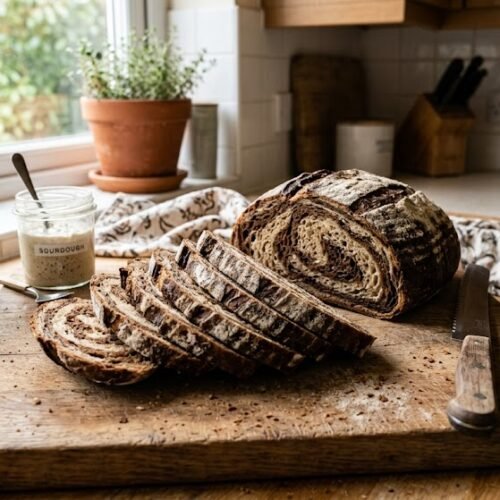
Marbled Rye Sourdough Bread Recipe
Equipment
- 1 Kitchen scale
- 1 Two mixing bowls
- 1 Rolling Pin
- 1 9×5-inch loaf pan
- 1 Serrated bread knife
Ingredients
- 245 grams bread flour light dough
- 105 grams medium rye flour light dough
- 230 grams water light dough
- 60 grams active sourdough starter light dough
- 7 grams fine sea salt light dough
- 245 grams bread flour dark dough
- 105 grams medium rye flour dark dough
- 190 grams strong brewed coffee cooled (dark dough)
- 40 grams water dark dough
- 60 grams active sourdough starter dark dough
- 25 grams molasses dark dough
- 10 grams unsweetened cocoa powder dark dough
- 7 grams fine sea salt dark dough
- 8 grams caraway seeds optional (dark dough)
Instructions
- Feed your starter: Feed your starter 4–8 hours ahead so you have enough active starter for both doughs (120g total).
- Mix both doughs: For the light dough, combine 245 grams bread flour, 105 grams medium rye flour, and 230 grams water, then mix in 60 grams active sourdough starter and 7 grams fine sea salt. For the dark dough, whisk together 190 grams strong brewed coffee (cooled), 40 grams water, 25 grams molasses, and 10 grams unsweetened cocoa powder until smooth. Then mix in 245 grams bread flour, 105 grams medium rye flour, 60 grams active sourdough starter, 7 grams fine sea salt, and 8 grams caraway seeds (optional) if using. Mix both doughs at the same time.
- Bulk ferment: Bulk ferment both doughs side by side at 76–78°F. Check both together—if one is visibly ahead of the other, time the next step around whichever is actually ready.
- Roll into matching rectangles: Once both doughs show a 40–50% rise and a domed surface, turn each out separately and gently pat or roll into rectangles of similar size, roughly 8×10 inches.
- Layer and roll: Layer the two rectangles on top of each other, then roll them up together from one short end into a single log. Handle gently to keep the swirl distinct.
- Seal and pan: Pinch the seam closed and place the log seam-side down into a greased 9×5-inch loaf pan.
- Proof: Proof at room temperature until the dough has visibly puffed and risen slightly above the pan’s edge.
- Preheat oven: Preheat oven to 450°F.
- Bake: Bake at 450°F for 40 minutes, then reduce to 400°F and bake until the internal temperature reaches at least 205°F.
- Cool completely: Cool completely for at least 150 minutes before slicing with a serrated knife for the cleanest swirl.
Notes
Synchronizing Two Doughs on Different Fermentation Speeds
Even with matched rye percentages, coffee’s acidity and molasses’s sugar content can cause the dark dough to ferment at a very slightly different pace than the plain light dough. If you notice a consistent gap in a specific direction (the dark dough always finishing a bit ahead, for example), you can stagger your mixing times slightly on future bakes — mixing the faster dough 15-20 minutes later than the other — so they finish bulk fermentation together rather than adjusting your process on the fly each time.
A Short History of Marble Rye
Marble rye is an American deli invention rather than a traditional European bread — it emerged from Jewish-American bakeries in the early-to-mid 20th century as a visually striking way to offer both light and dark rye in a single loaf, capitalizing on both styles’ popularity in delicatessen culture at the time. It was never intended to represent two dramatically different rye formulas; the swirl itself, driven mostly by color contrast, was always the point, which is part of why the color-based approach covered above isn’t a modern shortcut so much as a return to how the bread was conceived in the first place.
Variations on the Base Recipe
- Extra caraway in both doughs rather than just the dark portion, for a more uniformly deli-style flavor throughout the loaf.
- A third color layer using a different flavoring (a small amount of beet powder for a reddish tint, or turmeric for a warmer, golden light dough) if you want a more elaborate three-tone swirl — this adds complexity to timing three doughs together rather than two, so it’s worth trying only after the standard two-dough version feels comfortable.
- Higher overall rye percentage in both doughs (up to 40-50% in each) for a more pronounced rye flavor throughout, while keeping the same matched-percentage principle between the two colors.
- Onion or everything-bagel seasoning on the crust instead of or alongside caraway, for a different deli-bread flavor direction that still pairs well with the classic swirl presentation.
A Note on Nutrition
At 30% rye in both doughs, this loaf sits toward the lighter end of the rye spectrum nutritionally — meaningfully more fiber than an all-white sandwich bread, but less than a rye-forward loaf like our higher-percentage recipes. The molasses in the dark dough adds a small amount of iron and trace minerals compared to a plain sugar sweetener, though in the quantity used here that’s a minor nutritional detail rather than a significant contribution. If you want more of the fiber and mineral benefits covered in our rye sourdough gut health benefits guide, increasing both doughs’ rye percentage equally (while keeping them matched to each other) is the way to do that without disrupting the swirl technique.
Scoring a Marbled Loaf
Since this recipe sits at 30% rye in both doughs, standard scoring technique applies rather than the docking method needed for higher-rye loaves — a single straight or diagonal score along the top works well and won’t interfere with the swirl pattern underneath, since the score only affects the crust, not the internal spiral. If you increase both doughs’ rye percentage significantly using the variation above, revisit our rye sourdough scoring and shaping tips guide to check whether you’ve crossed into docking territory.
Common Problems and Fixes
- Swirl pattern disappeared into a muddy, blended color: Usually from over-rolling or over-kneading the combined log, which blurs the boundary between the two doughs. Handle the rolling step gently and minimally.
- Loaf came out lopsided with the swirl mostly on one side: The two rectangles likely weren’t rolled to matching size and thickness before layering — measure or eyeball both more carefully next time.
- One color dominates the crumb more than expected: Check whether one dough was significantly further along in fermentation than the other when you combined them — an under-fermented dough layered against a properly risen one can get compressed and underrepresented in the final spiral.
- Bread came out gummy despite matching our other rye recipes’ technique: At only 30% rye, this is almost always a cooling-time issue rather than a rye-specific structural one — give it the full 2-3 hour rest before slicing.
- Doughs stuck together unevenly rather than forming a clean layered log: This usually means one dough was noticeably wetter or stickier than the other at rolling time — double check both formulas were measured accurately, since even a small hydration mismatch between the two doughs is more noticeable in a rolled, layered application than in a single loaf.
Serving Suggestions
Marbled rye is the classic base for a Reuben or Rachel sandwich — corned beef or turkey, Swiss cheese, sauerkraut, and a tangy dressing, grilled until the cheese melts. It also holds up well to simpler preparations: toasted with butter, or as an open-faced base for smoked fish or a hearty spread, similar to other rye-forward breads in this collection.
Frequently Asked Questions
Can I use food coloring instead of cocoa and coffee to darken the dough?
Technically yes, but it’s not the traditional approach and won’t contribute the flavor complexity cocoa, coffee, and molasses add — those ingredients are doing double duty as both colorant and flavor component, which is part of why they’re the standard choice over a plain food dye that would only handle the visual side.
Why do some recipes add vital wheat gluten to marble rye dough?
At a moderate rye percentage like 30%, vital wheat gluten isn’t strictly necessary, but some bakers add a small amount to strengthen the dough further, particularly for the rolling and layering step, where a slightly more elastic dough holds its shape better during shaping than a dough right at the edge of its structural capacity. It’s an optional refinement rather than a requirement for this formula.
Does marble rye bread actually contain two different amounts of rye flour?
Usually not — most marble rye recipes, including this one, use the same rye percentage in both doughs and create the visual contrast with cocoa powder, coffee, and molasses in the dark portion rather than a genuine rye content difference. This produces a more reliable, evenly matched swirl than varying the rye percentage between the two doughs.
Can I make marble rye with a bigger flavor difference between the two halves?
Yes, by using a genuinely different rye percentage in each dough, though this requires more careful timing since the higher-rye dough will ferment faster and handle differently — start it later or watch both doughs closely rather than mixing them on a fixed shared schedule.
Why did my swirl pattern disappear during baking?
This is almost always from over-handling the dough during the rolling and shaping step — repeated re-rolling or aggressive kneading after the two doughs are layered together blurs the boundary between colors. Handle the combined log gently and minimally once it’s rolled.
Can I use instant coffee instead of brewed coffee for the dark dough?
Yes, dissolved in the recipe’s water rather than added as a separate ingredient, though brewed coffee generally gives a milder, less concentrated flavor than instant coffee dissolved at a similar strength — start with less instant coffee than you might expect and adjust to taste.
How long does marbled rye sourdough keep?
At this rye percentage (30%), expect similar shelf life to other moderate-rye loaves — roughly 3-5 days at room temperature wrapped in cloth, and it freezes well pre-sliced for longer storage.
Rye Sourdough — More Guides
- 📖 Rye Sourdough Bread Recipe
- 🌾 How to Make a Rye Sourdough Starter
- 🍞 Why Is My Rye Sourdough Dough So Sticky?
- ⚖️ Is Rye Sourdough Supposed to Be Dense?
- 🌑 100% Rye Sourdough Bread
- 🍫 Dark Rye Sourdough Bread (Pumpernickel-Style)
- ⚖️ Rye Sourdough vs Wheat Sourdough
- 💧 Rye Sourdough Hydration Ratio
- 💧 Converting a Wheat Starter to Rye
- ⚖️ Rye Sourdough Gut Health Benefits
- 🌾 Rye Sourdough Starter Feeding Ratio
- 🍫 Best Flour for Rye Sourdough Bread
- 🍞 Rye Sourdough Bulk Fermentation Time