Rye scoring and shaping isn’t a gentler version of wheat technique — past a certain rye percentage, it’s a different process entirely, including one step most rye content never mentions: docking, which replaces scoring altogether on high-rye loaves. This guide covers shaping and scoring by rye percentage, when to switch from one technique to the other, and why rye is actually one of the most forgiving flours for decorative scoring, not the hardest.
This is one guide in our full rye sourdough bread recipe collection.
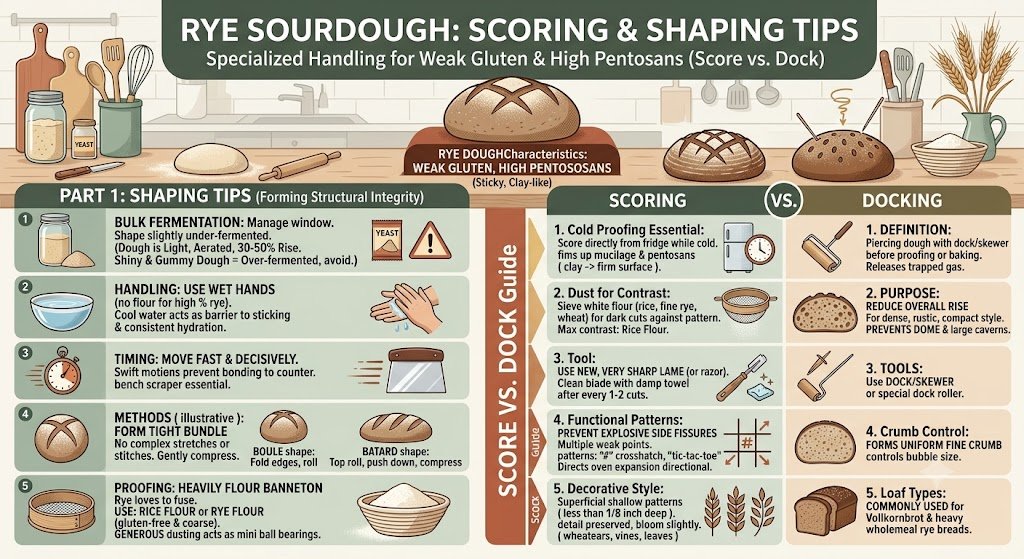
Why Rye Shaping and Scoring Follow Different Rules
Wheat shaping technique is built around building surface tension in an elastic, gluten-strong dough, and scoring is built around controlling where that dough’s dramatic oven spring breaks open. Rye has neither of those things in the same way — minimal gluten means minimal elasticity to build tension with, and minimal oven spring means a scored pattern isn’t fighting against a rapidly expanding loaf trying to blow out somewhere else. Both of these differences work against you if you’re not shaping and scoring for rye specifically, but the second one is actually an advantage: because rye doesn’t spring much in the oven, decorative scoring patterns hold their shape far better on rye than on a wheat loaf that’s about to burst open unpredictably.
Shaping by Rye Percentage
| Rye % | Shaping Approach |
|---|---|
| 10-30% rye | Shape close to standard wheat technique — a boule or batard with normal tension-building, just a lighter touch and slightly less aggressive pulling since the dough tears more easily than pure wheat dough |
| 30-50% rye | Reduced tension, gentler handling. Doing a pre-shape and a separate final shape (rather than shaping directly) helps compensate for the dough’s lower structural strength |
| 50-70% rye | Minimal shaping — the dough is loosely gathered into a rough shape rather than tensioned, often placed directly in a banneton or loaf pan rather than free-shaped on the counter |
| 70-100% rye | No traditional shaping at all — the dough is scraped and smoothed into a greased loaf pan with a wet spatula. Attempting to hand-shape at this percentage isn’t a skill issue, it’s asking the dough to do something it structurally can’t |
For the stickiness you’ll encounter at every level above roughly 30% rye, wet hands rather than dry or floured hands are the standard fix — see our why is my rye sourdough dough so sticky guide for the full handling breakdown by percentage.
The Pre-Shape Step: More Important for Rye Than Wheat
A pre-shape — a loose, gentle initial shaping step before the final shape, with a short bench rest in between — is optional for many wheat doughs but genuinely useful for rye in the 30-50% range specifically. Because rye dough tears rather than stretching under tension, going straight for a tight final shape without a pre-shape step to gently organize the dough first tends to produce tearing and inconsistent tension. The pre-shape gives the dough a chance to relax and hold together loosely before you ask it to hold a tighter final shape.
Scoring vs. Docking: The Decision Rye Guides Usually Skip
This is the single most important technique distinction in this guide, and it’s largely absent from mainstream rye content. Traditional scoring — cutting the surface with a lame to control where the crust opens during oven spring — works fine on rye up to roughly 50-70% rye, following mostly normal technique with lighter pressure and shallower depth to account for reduced gluten strength. Above that threshold, switch to docking instead of scoring.
Docking means poking a series of small, shallow holes (usually less than an inch deep) through the top crust with a skewer, chopstick, or dedicated docking tool, rather than cutting a score line. The purpose is different from scoring’s purpose: at high rye percentages, there’s enough internal gas pressure building during baking but not enough structural elasticity in the crust to release it cleanly through a score line the way wheat dough does. Without an escape route, this can cause a “flying crust” — the top crust separating and lifting away from the loaf in an uncontrolled blowout rather than expanding evenly. Docking gives the gas multiple small, distributed exit points instead of relying on one or two score lines to manage all of it.
If you’ve been trying to score a 70%+ rye loaf and getting inconsistent, sometimes explosive results, switching to docking instead of troubleshooting your scoring technique is usually the actual fix.
Scoring Technique for Rye (Below the Docking Threshold)
- Use a lame, not a knife. A sharp bread lame glides through the dough’s surface with a quick, confident motion; a knife drags, which is worse on already-fragile rye dough than it is on wheat.
- Score cold dough when possible. Chilling the shaped loaf (commonly via an overnight fridge retard) firms it up enough for cleaner, more controlled cuts — this matters even more for rye than wheat, since rye’s stickiness at room temperature makes clean scoring harder to begin with.
- Adjust depth for rye percentage. As gluten content decreases with higher rye percentage, score slightly shallower than you would on a comparable wheat loaf — a deep score on a low-structure rye dough can cause more tearing than controlled opening.
- Reduce the aggressiveness of your angle. A dramatic ear-producing angled score, common on wheat boules, is less useful on rye since there’s minimal oven spring to create that dramatic ear in the first place. A straighter, shallower cut is usually more appropriate.
Why Rye Is Actually Great for Decorative Scoring
This is a genuine advantage rarely mentioned in rye content: because rye doesn’t have wheat’s dramatic, sometimes unpredictable oven spring, a decorative scoring pattern — leaves, wheat stalks, geometric designs — holds its shape through baking far more reliably on rye than on a wheat loaf, where an aggressive spring can distort or blow out an intricate pattern. If you enjoy decorative scoring, rye (up to the docking threshold around 50-70%) is one of the most forgiving canvases for it, precisely because of the same low-gluten structure that makes rye harder to shape.
Docking Technique in Detail
- Use a thin, rigid tool — a wooden skewer, a chopstick, or a purpose-made docking tool with multiple small spikes.
- Space holes evenly across the surface, roughly an inch or so apart, rather than clustering them in one area.
- Keep holes shallow — through the crust and slightly into the crumb, not deep into the loaf’s interior.
- Dock right before baking, at the same point in the process you’d otherwise score, not earlier in proofing.
- Combine with a light decorative flour dusting if you want some visual interest, since docking alone doesn’t create the same striking crust pattern that scoring does — many high-rye bakers dust or stencil a pattern on top in addition to docking underneath it for gas release.
Common Shaping and Scoring Mistakes With Rye
- Trying to build wheat-level tension on a 50%+ rye dough and causing tearing rather than a smooth surface.
- Scoring instead of docking above 70% rye, then being surprised by an uncontrolled crust blowout.
- Scoring too deep, treating rye’s reduced structure the same as wheat’s and tearing the dough rather than achieving a clean cut.
- Skipping the pre-shape step in the 30-50% range and going straight to a tight final shape that the dough can’t hold without tearing.
- Using a dull blade or a knife instead of a fresh lame, which drags on rye’s sticky surface even more noticeably than it does on wheat.
Equipment That Actually Helps
- A sharp bread lame — replace or resharpen blades regularly, since a dull blade drags on rye’s sticky surface more noticeably than on wheat.
- A bench scraper — essential for handling and transferring rye dough at any percentage above about 30%, where hands alone struggle with the stickiness.
- Parchment paper — transferring a shaped, sticky rye loaf directly onto a hot baking surface is one of the most failure-prone moments in the whole process; parchment eliminates the drag and sticking that causes tearing or deflation at transfer.
- A docking tool, skewer, or chopstick — for anything above the 50-70% docking threshold.
- A rice-flour-dusted banneton or bowl — rice flour resists absorption better than wheat flour, which matters more for rye’s already-high-moisture dough than it does for a typical wheat loaf, reducing the chance of sticking during the turn-out.
Transferring a Shaped Rye Loaf Without Deflating It
Because rye dough is stickier and less structurally robust than wheat, the transfer from banneton or bowl to your baking surface is a higher-risk moment than it is with wheat. A few practical steps that help:
- Turn out onto parchment, not directly onto a hot stone or Dutch oven. This gives you a controlled surface to score or dock on before the actual transfer into heat.
- Use the parchment as a sling to lower the loaf into a Dutch oven or onto a baking stone, rather than trying to slide the dough directly, which risks tearing a delicate, sticky surface.
- Move decisively, not slowly. A slow, hesitant transfer gives sticky rye dough more time to catch and drag; a quick, confident motion (once you’re set up and ready) minimizes that risk.
- Have your scoring or docking tool ready before the turn-out, not after, so the loaf spends as little time as possible sitting exposed and losing gas before it goes into the oven.
Decorative Pattern Ideas That Work Well on Rye
Since rye holds decorative scoring patterns unusually well (as covered above), a few pattern styles that particularly suit rye’s character:
- Wheat stalk or grain motifs — thematically fitting for a grain-forward bread, and simple enough to execute with basic straight and diagonal cuts.
- Geometric lattice patterns — rye’s minimal oven spring means a lattice of shallow crossing cuts holds its precise geometry rather than distorting into an irregular shape.
- Simple leaf or feather patterns — a few angled cuts branching from a central line, achievable without advanced freehand scoring skill.
- Flour-dusted stencil designs — since rye’s dark crust color contrasts well with a light flour dusting, stenciled patterns (a paper cutout laid on top before a light flour dusting, then removed) show up clearly, and pair well with docking underneath for gas release on higher-rye loaves where a stencil is your main decorative option.
Troubleshooting Shaping and Scoring Problems
- Dough tears every time I try to shape it: You’re likely using too much tension for your rye percentage — drop to a gentler, looser shaping approach and add a pre-shape step if you’re in the 30-50% range.
- Loaf spreads flat instead of holding its shape after shaping: This can be a hydration issue (too wet for the shaping method you’re using) or simply expected behavior at your rye percentage — check your dough against the shaping table above before assuming something went wrong.
- Score marks fuse back together rather than staying open: Usually means the cut wasn’t deep enough, or the dough had begun to overproof and lost the structure needed to hold a clean opening — check both your score depth and your fermentation timing.
- Crust cracked or blew out somewhere other than the score line: The flying crust problem described above — switch to docking if you’re above roughly 50-70% rye.
- Pattern looked great going into the oven but distorted during baking: More common at lower rye percentages where there’s still enough oven spring to distort a pattern — a shallower cut and less dramatic pattern design tends to hold up better as rye percentage decreases toward the wheat end of the spectrum.
Frequently Asked Questions
Does chilling the dough really make that much difference for scoring rye?
Yes — cold dough holds its shape better during the score itself and resists dragging, which matters more for rye’s stickier surface than it does for a typical wheat dough. If you’re struggling with clean cuts at room temperature, an overnight fridge retard before scoring is worth trying before assuming your technique or blade is the problem.
Should I score or dock a 60% rye loaf?
60% sits right at the edge of the transition zone — scoring with a shallow, gentle cut typically still works at this percentage, though some bakers prefer to switch to docking as early as 50% for extra insurance against crust blowout. If you’re getting inconsistent results scoring at 60%, docking is a reasonable fallback.
Why did my high-rye loaf’s crust tear open in an unplanned spot during baking?
This is the “flying crust” problem — at high rye percentages, internal gas pressure builds without enough structural elasticity to release cleanly through a score line, so it finds its own uncontrolled exit point instead. Switching from scoring to docking gives the gas multiple planned exit points instead of one, which usually resolves this.
Can I do decorative scoring patterns on rye bread?
Yes, and rye is actually a particularly good flour for it up to the docking threshold (roughly 50-70% rye) — because rye doesn’t have wheat’s dramatic oven spring, decorative patterns tend to hold their shape better through baking than they do on a wheat loaf.
Why does my rye dough tear when I try to shape it?
Rye has much less gluten-forming capacity than wheat, so it doesn’t stretch the way wheat dough does — pulling with wheat-level tension causes tearing rather than a smooth, taut surface. Use a lighter touch, less aggressive tension, and consider adding a pre-shape step if you’re working in the 30-50% rye range.
Do I need special tools for docking, or can I use what I already have?
A simple wooden skewer or chopstick works perfectly well — a dedicated multi-spike docking tool is a convenience for doing it faster and more evenly, not a requirement to get a functional result.
Rye Sourdough — More Guides
- 📖 Rye Sourdough Bread Recipe
- 🌾 How to Make a Rye Sourdough Starter
- 🍞 Why Is My Rye Sourdough Dough So Sticky?
- ⚖️ Is Rye Sourdough Supposed to Be Dense?
- 🌑 100% Rye Sourdough Bread
- 🍫 Dark Rye Sourdough Bread (Pumpernickel-Style)
- ⚖️ Rye Sourdough vs Wheat Sourdough
- 💧 Rye Sourdough Hydration Ratio
- 💧 Converting a Wheat Starter to Rye
- ⚖️ Rye Sourdough Gut Health Benefits
- 🌾 Rye Sourdough Starter Feeding Ratio
- 🍫 Best Flour for Rye Sourdough Bread
- 🍞 Rye Sourdough Bulk Fermentation Time