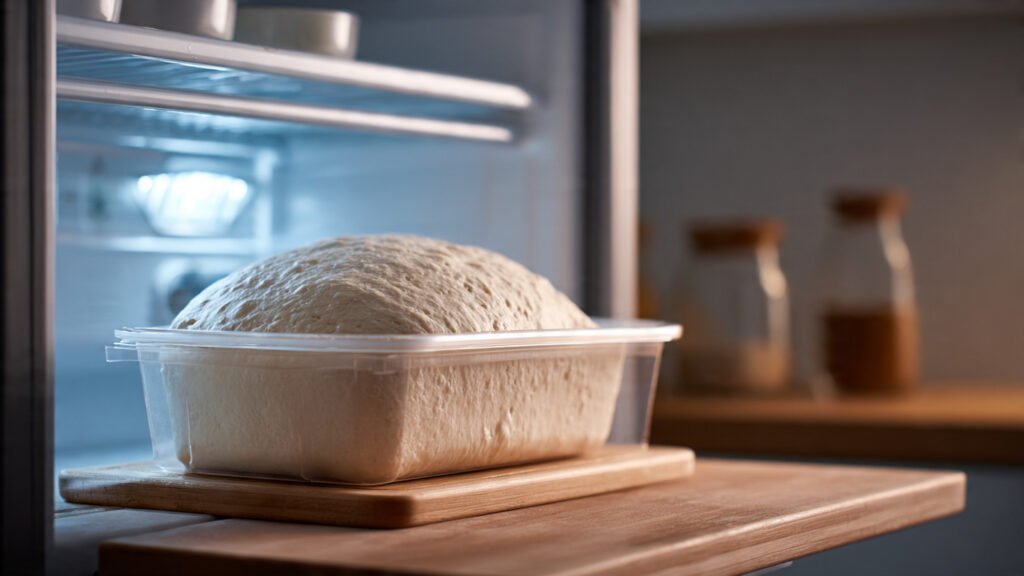
One of the most common points of confusion in sourdough baking: cold bulk fermentation vs. cold proofing. Many bakers think they are the same thing. They are not — and mixing them up leads to either underproofed or overproofed bread.
🧮 Calculate Your Bulk Fermentation Time
Calculate your bulk fermentation time before moving to the fridge:
Accounts for temperature, starter %, hydration, and flour type
Yes, you can bulk ferment sourdough in the fridge. But it works differently than cold proofing, it requires different timing, and it changes how you approach the rest of the bake. This guide covers everything you need to know.
For a full timing reference by temperature, start with the Sourdough Archive Bulk Fermentation Chart.
Cold Bulk vs. Cold Proof: What’s the Difference?
| Cold Bulk Fermentation | Cold Proof (Cold Retard) | |
|---|---|---|
| When | Before shaping | After shaping |
| Dough state | Unshaped, single mass | Shaped, in banneton |
| Fermentation | Continues slowly in fridge | Slows dramatically, near-stop |
| Purpose | Split baking over 2 days, flavor development | Scoring ease, schedule flexibility, flavor |
| Risk | Overproofing if warm-bulk went too long first | Overproofing if cold proof is too long |
| Next step | Remove, shape, proof, then bake | Score and bake directly from fridge |
Why Do Cold Bulk Fermentation at All?
1. Schedule flexibility. You can start your dough in the evening, move it to the fridge overnight, and shape and bake the next morning. No 4-hour block required in a single day.
2. Flavor development. Cold temperatures slow yeast activity more than bacterial activity. The lactic acid bacteria keep working slowly in the fridge, producing more complex acids and deeper flavor over a longer, slower fermentation.
3. Easier handling for high-hydration doughs. Cold dough is firmer and less sticky. If you struggle to shape a wet, slack dough, refrigerating it during bulk makes the shaping step significantly easier.
The Critical Rule: Warm First, Then Cold
This is where most bakers go wrong with cold bulk. You cannot put freshly mixed dough straight into the fridge and expect good results. The yeast needs a warm-temperature head start to activate and begin building gas and gluten structure.
- Mix your dough and perform your stretch and folds at room temperature for 1–2 hours.
- Once the dough has just started to show activity — a slight puff, beginning of surface bubbles — transfer it to the fridge.
- Leave it in the fridge for 8–16 hours (overnight is typical).
- The next day, remove it, shape, then cold proof or proof at room temperature before baking.
How Much Should Dough Rise During Cold Bulk?
Because fermentation continues slowly in the fridge, you need to cut off the warm bulk phase earlier than you normally would.
- At 75°F dough temp: aim for 20–30% rise before refrigerating (not the usual 50%)
- At 70°F dough temp: aim for 30–40% rise before refrigerating
- Let the fridge do the remaining work overnight
By morning, the dough should have risen an additional 20–40% in the fridge. Use your bulk fermentation chart and a straight-sided container to track this accurately.
Can You Put Dough Straight in the Fridge With No Warm Bulk?
Technically yes, but the results are inconsistent and generally not recommended for beginners. Without a warm-temperature head start, yeast activity is too slow to properly develop the gluten network through folds. The dough often comes out underdeveloped — not enough gas, poor structure, weak oven spring.
The exception: some very long cold bulk methods (36–72 hours at very cold fridge temps) are used by advanced bakers for extreme flavor development. These require strong, highly active starters and careful temperature management. It is not a beginner technique.
How to Shape After Cold Bulk
- The dough will be firm and slightly tacky — this is normal and makes shaping easier
- It may feel tighter than room-temperature dough; give it a 15–20 minute bench rest after pre-shaping if it resists
- Do not wait for it to fully warm up before shaping — cold dough is easier to handle
- After shaping, you can cold proof directly or proof at room temperature for 1–3 hours before baking
Cold Bulk vs. Same-Day Baking: Which Is Better?
Same-day warm bulk is faster, more predictable, and easier to monitor in real time. It suits bakers who have a 4–6 hour window and prefer to bake the same day they mix.
Cold bulk is better for flavor complexity, schedule flexibility, and high-hydration doughs that are hard to handle when warm. It suits bakers who prefer to prep the night before and bake in the morning.
Both methods produce excellent bread when the fermentation is managed correctly.
The Bottom Line
Cold bulk fermentation is a legitimate and useful technique — but it is not interchangeable with cold proofing. The dough still needs a warm head start, you still need to shape it after it comes out of the fridge, and you need to cut off your warm bulk earlier than you would for a same-day bake.
Track your rise carefully using a clear straight-sided container, read the 7 signs your bulk is done before shaping, and use the Bulk Fermentation Chart to match your warm-bulk target to your dough temperature.
Get those three things right and cold bulk becomes one of the most useful tools in your sourdough schedule.