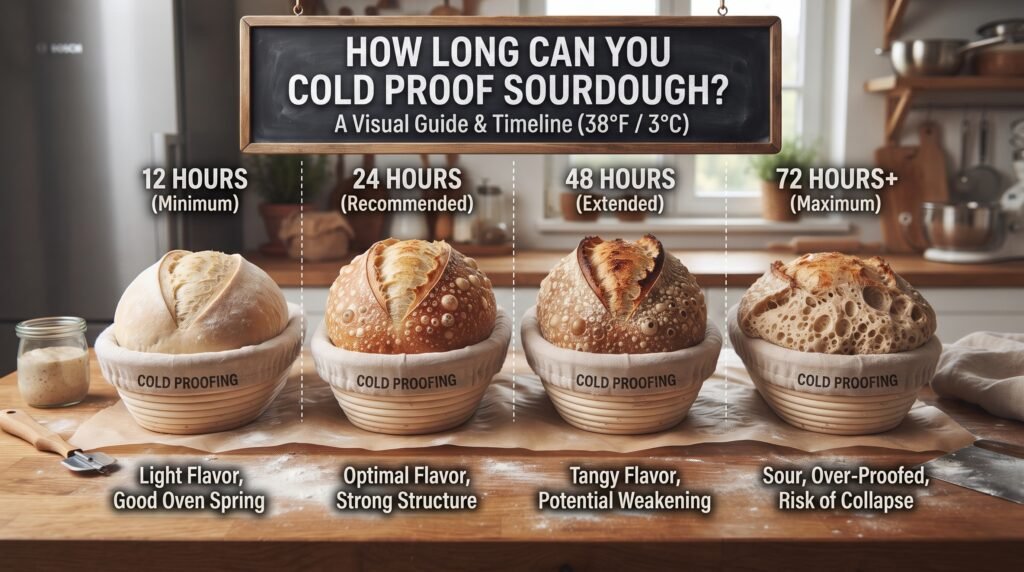
Quick Answer: How Long Can You Cold Proof Sourdough?
You can cold proof sourdough for 12 to 48 hours in the refrigerator at 37–40°F (3–4°C). Most bakers achieve the best balance of oven spring, crumb structure, and flavor between 16–24 hours. Longer proofs increase sourness but eventually weaken gluten structure.
| Duration | Safety Level | Flavor Profile | Dough Texture |
|---|---|---|---|
| 8–12 Hours | Safe | Mild / Creamy | Firm, easy to score. |
| 12–24 Hours | Ideal (Sweet Spot) | Balanced Sour | Perfect tension, best oven spring. |
| 24–48 Hours | Risky | Very Sour / Sharp | Dough relaxes, scoring is trickier. |
| 48–72 Hours | Danger Zone | Intense / Vinegar | Gluten degrades; loaf will be flat. |
Do You Have to Cold Proof Sourdough?
No, you do not have to cold proof sourdough. A room temperature final proof works perfectly well, especially for beginners. However, cold proofing offers significant advantages that most experienced bakers consider worth the extra planning.
Cold proofing is optional, but here is why most bakers choose it:
- Flavor: Cold fermentation allows lactic acid bacteria to keep working while yeast slows down, producing a deeper, more complex sour flavor than a warm proof can develop in the same timeframe.
- Scoring: Cold dough holds its shape firmly when you score it with a lame. Warm dough is softer and more prone to deflating under the blade.
- Schedule: Room temperature proofing requires you to bake within 1–3 hours. Cold proofing lets you bake whenever it suits you.
- Crust: Many bakers find that cold-proofed loaves develop a thicker, blistered crust with a more pronounced ear.
When you might skip cold proofing:
- You are baking same-day and cannot wait overnight.
- You are using a same-day recipe with a high-activity starter.
- Your kitchen is cool (under 68°F) and your dough is developing slowly — adding a long cold proof on top of a slow bulk ferment risks overproofing. If you are unsure, check our guide on sourdough proofing temperature to understand how ambient temperature affects your dough.
The short answer: cold proofing is a tool, not a rule. Skip it when timing demands it, but use it whenever you can.
How Long to Proof Sourdough in the Fridge
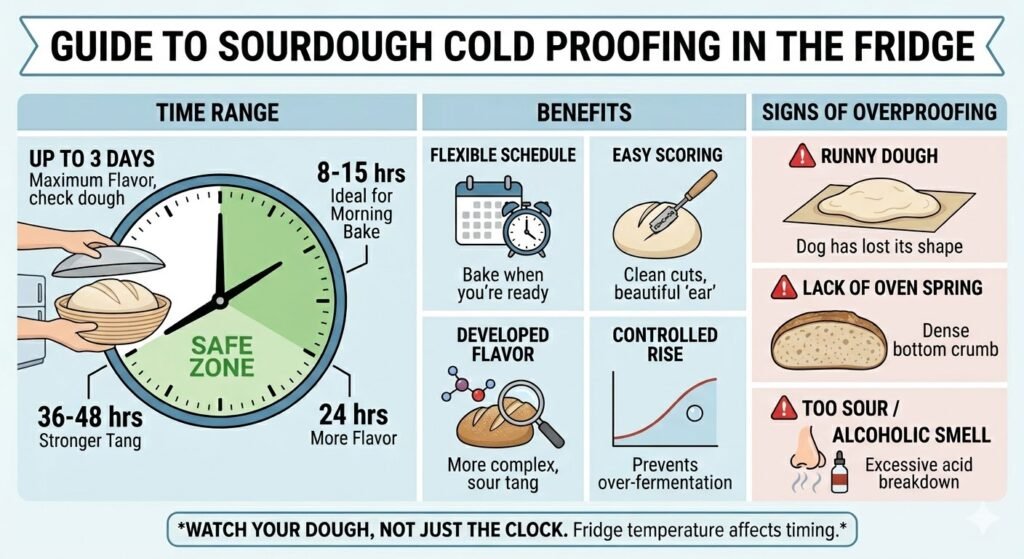
Many bakers ask how long can you cold proof sourdough when trying to improve flavor, structure, and fermentation control. Cold proofing allows dough to ferment slowly in the refrigerator, which strengthens gluten, improves flavor, and makes scoring easier. Depending on your dough strength and refrigerator temperature, sourdough can typically be cold proofed anywhere from 12 to 48 hours.
You can learn more about the science behind fermentation and nutrition in our complete guide to sourdough bread health benefits.
The main advantage of cold proofing timing is that you gain control over your schedule. Mix your dough in the evening, do a short bulk fermentation at room temperature (2–4 hours), shape it, and then pop it directly into the fridge for an overnight proof. When you wake up in the morning, your dough is ready to bake without any time pressure. If you’re not ready to bake in the morning, many bakers can leave shaped dough in the fridge for 24–36 hours without significant quality loss, though flavor will intensify and acidity will increase. This flexibility is one of the biggest reasons experienced bakers use cold proofing — it fits naturally into busy schedules while actually improving the final loaf.
Proper cold proofing works best when bulk fermentation is complete, which is why many bakers follow a bulk fermentation chart to track dough development.
When deciding exactly how long to proof sourdough in fridge, pay attention to how your dough looks and feels rather than obsessing over exact hours. A properly cold-proofed dough should have some visible rise (though much less than room temperature), feel slightly firm but not rock-hard, and show subtle bubbles around the edges when you pull it from the fridge. If you’ve proofed for 12 hours and your dough looks fully expanded and jiggly, it’s ready — don’t wait longer just because recipes suggest 16–18 hours. Conversely, if your dough still looks relatively flat after 24 hours, let it proof a bit longer or give it 30 minutes to an hour at room temperature before scoring and baking. The key is balancing the convenience of cold proofing with careful observation of your specific dough.
If fermentation continues too long, the dough may become overproofed sourdough, making it difficult to bake with good structure.
Many bakers ask how long you can cold proof sourdough because refrigeration dramatically changes fermentation speed. Cold temperatures slow yeast activity while allowing flavor-producing bacteria to continue working. This is why longer cold proofs produce deeper sour flavor but eventually weaken gluten strength.
Ideal Cold Proof Time for Sourdough
Most sourdough loaves are cold proofed between 12 and 24 hours in the refrigerator. Shorter cold proofs produce milder flavor, while longer cold fermentation develops deeper sourdough flavor and can improve dough strength.
However, extremely long cold proofs may eventually lead to over-fermentation if the dough structure weakens. To understand the difference between the two main fermentation stages, see our breakdown of bulk fermentation vs proofing.
Key Takeaways
- Best Overall Time: 12 to 24 hours at 38°F (3°C) is the “sweet spot” for open crumb and complex flavor.
- Minimum Time: 8 hours is needed to cool the dough for easier scoring.
- Maximum Time: Beyond 48 hours, dough can become acidic, lose structure, and bake flat.
- The Golden Rule: The fridge is a “pause button,” not a magic wand. If your dough enters the fridge underproofed, it will come out that way.
What Is the Minimum Cold Proof Time for Sourdough?
The minimum effective cold proof time for sourdough is 4 hours, but 8 hours is the practical minimum for meaningful results.
Here is what each minimum threshold actually achieves:
| Time in Fridge | What It Does | Is It Worth It? |
|---|---|---|
| 1–3 hours | Chills the surface only; center still warm | No — just delays baking |
| 4–6 hours | Dough firms up; easier to score | Minimal — better than nothing |
| 8–12 hours | Some flavor development; good oven spring | Yes — solid result |
| 12–24 hours | Full flavor; open crumb; blistered crust | Ideal |
If you are short on time and cannot do a full overnight cold proof, an 8-hour minimum still delivers noticeably better scoring and crust compared to baking straight from room temperature. The dough will be firm enough to hold a clean score, and some flavor development will have occurred.
Below 4 hours, the dough has not had enough time to cool fully to the core. The center of a dense, shaped loaf can remain above 50°F even after 2–3 hours in a standard refrigerator. At that temperature, fermentation is still proceeding — the dough is not truly resting. The relationship between dough temperature and fermentation speed explains why this matters more than most bakers realise.
The real minimum rule: Cold proof long enough for the dough’s core temperature to drop below 40°F. For most shaped loaves, that means at least 4–6 hours. Everything above 8 hours is a bonus.
Can You Cold Proof Sourdough for 2 Days?
Yes, but with caution. At 36–48 hours, flavor deepens significantly, but gluten strength weakens. High-hydration doughs (75%+ water) are especially vulnerable to collapse during long cold proofs.
If attempting a 48-hour proof, ensure:
- Strong starter activity
- Proper bulk fermentation
- Refrigerator temperature below 40°F (4°C)
Beyond 48 hours, structural failure becomes likely.
Cold proofing gives you better flavor, easier scoring, and scheduling flexibility. But too little time leads to underproofing, and too much time weakens gluten and flattens the loaf.
Understanding the timing window prevents both. If you are not sure whether your dough is proofed correctly, our underproofed vs overproofed sourdough guide walks through exactly what to look for.
What is Cold Proofing? (And What It Isn’t)
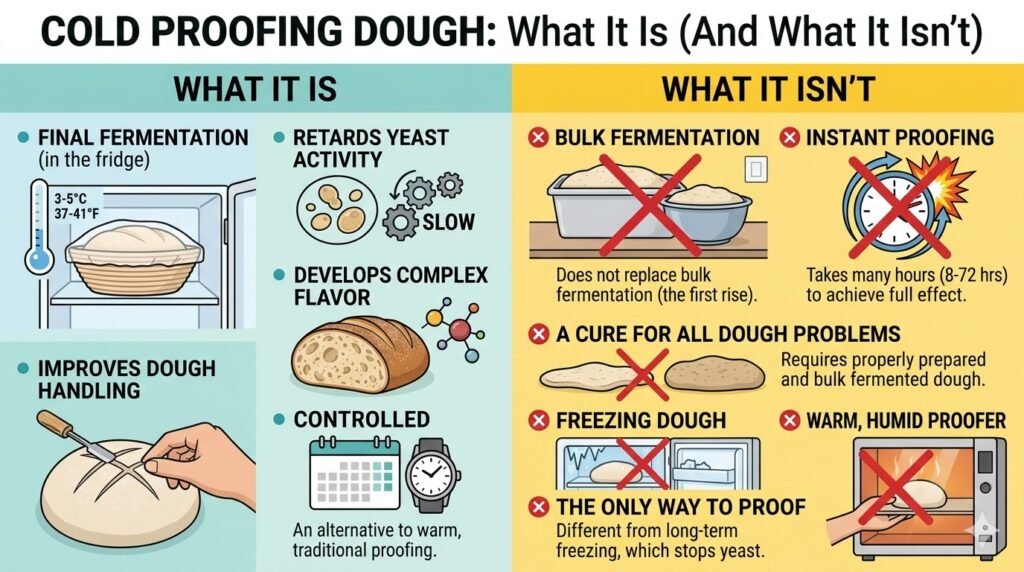
Before talking about timing, we need to clarify the goal. Cold proofing is the “final rise” of your sourdough, but instead of letting it happen on a warm counter, you place the shaped dough into a banneton and put it directly into the refrigerator.
The “Pause Button” Myth
Many beginners think the fridge acts as a “slow motion” button. They assume that if their bulk fermentation was a little short, the fridge will finish the job overnight.
This is a dangerous misconception.
While yeast is still slightly active as the dough cools down, the refrigerator effectively acts as a pause button for volume. If your dough enters the fridge with a dense, tight structure, it will likely come out that way. The cold proof is primarily for flavor development and gluten relaxation, not for rising.
Can You Cold Proof Sourdough for 48 Hours?
Yes, in many cases sourdough can cold proof for up to 48 hours, especially when dough temperature is properly controlled and fermentation before refrigeration is not excessive.
Longer cold proofs tend to create:
- stronger sour flavor
- improved crust color
- easier scoring
However, if bulk fermentation was already advanced, a 48-hour cold proof may cause overproofing. Knowing when bulk fermentation is done before you refrigerate is the single most important factor in avoiding this.
The Timeline: 8 vs. 24 vs. 48 Hours
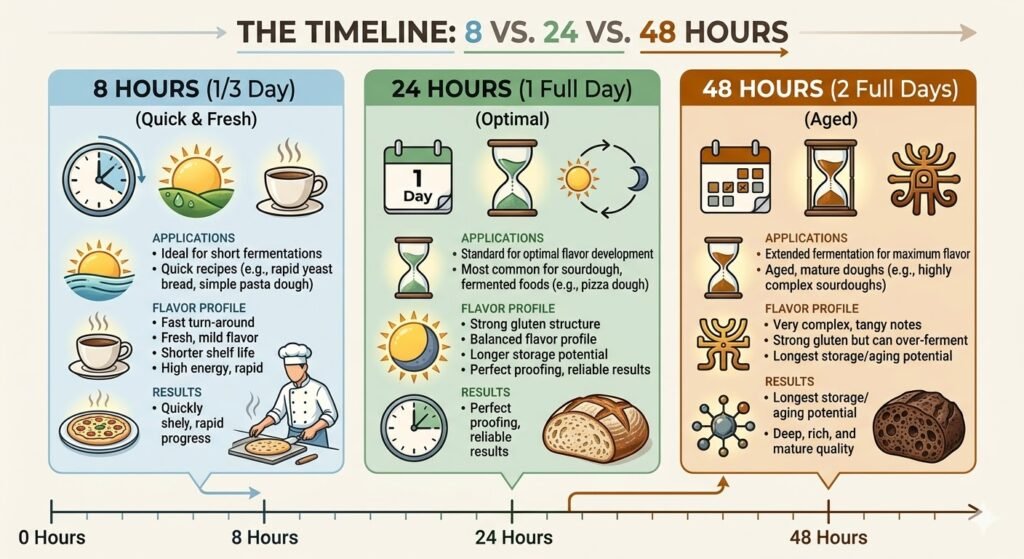
While you can cold proof anywhere from 8 to 72 hours, the results will vary drastically depending on your dough strength and hydration.
1. The Convenience Window (8–12 Hours)
Best For: Beginners or busy schedules.
Result: Mild flavor, good oven spring.
Why do it: If you mix dough in the morning and shape it by the afternoon, you can bake it the next morning. An 8-hour cold proof is sufficient to cool the dough down (making it easier to score) and develop some flavor, though it will be milder than a 24-hour loaf.
Shape after dinner, slide it into the fridge before bed, and pull it out before work — zero timing pressure, fresh bread by morning.
2. The Sweet Spot (12–24 Hours)
Best For: 90% of sourdough recipes.
Result: Complex tangy flavor, open crumb, blistered crust.
Why do it: This window allows bacteria (lactobacillus) to produce lactic and acetic acid, creating that signature sourdough tang. The gluten relaxes fully, which often leads to a more open, lacy crumb structure. See our sourdough crumb guide if you want to understand how proofing time directly affects your crumb.
3. The Danger Zone (36+ Hours)
Best For: Experimentation only.
Result: Very sour, flatter loaf, potential structural collapse.
The Risk: Over time, high acidity begins to break down the gluten network (“proteolysis”). After 48 hours, the dough often loses its structural integrity and may spread into a pancake the moment you turn it out of the basket.
Expert Note on High Hydration: If you are working with high-hydration doughs (80%+ water), stay toward the 12–18 hour mark. Wet doughs have a more fragile gluten structure and tend to degrade faster during a long cold proof than stiff doughs. Our sourdough hydration guide explains exactly how water percentage affects dough strength and fermentation speed.
The “Cooling Lag”: The Secret Variable
Here is the variable most recipes don’t tell you about: Your dough does not get cold instantly.
When you place warm dough into the fridge, it can take several hours for the center to fully cool. During that time, fermentation continues. That’s why dough condition before refrigeration matters more than the clock alone.
This is why “watching the clock” isn’t enough. You have to understand the state of your dough before it goes in.
- If Your Kitchen is Hot (80°F+): Your dough is moving fast. When you put it in the fridge, it will carry that momentum and continue fermenting aggressively for hours. You might only need a 12-hour cold proof.
- If Your Kitchen is Cold (68°F-): Your yeast activity is sluggish. If you put the dough in the fridge too early, the yeast will go dormant before they have finished their work. This is the leading cause of underproofed sourdough — bakers putting sluggish dough into a cold fridge, expecting a miracle. Our guide on sourdough not rising in winter covers this problem in detail.
How Long to Cold Proof Sourdough After Bulk Fermentation
The relationship between bulk fermentation and cold proofing is sequential — and the time you spend in one directly affects how long you should spend in the other. For a deeper understanding of this handoff, our bulk fermentation vs proofing guide breaks down exactly where one stage ends and the other begins.
After bulk fermentation is complete, shape your dough and place it into a banneton. From there, most bakers cold proof for 12 to 24 hours. However, the key variable is how far your bulk fermentation progressed before the dough went into the fridge.
If Bulk Fermentation Was on the Shorter Side (50–75% rise)
Your dough still has active fermentation ahead of it. When you refrigerate, fermentation will continue for several hours as the dough cools. A 16–24 hour cold proof gives the dough time to finish developing without risking overproofing.
If Bulk Fermentation Was Full (75–100% rise)
Your dough is close to fully fermented before it enters the fridge. In this case, a shorter cold proof of 8–16 hours is safer. The dough does not need much more fermentation time — just enough cold rest to firm up for scoring. Not sure if your bulk fermentation is actually complete? Read our guide on how to know when bulk fermentation is done.
The Handoff Rule
Think of bulk fermentation and cold proofing as a handoff. The more work bulk fermentation does, the less the cold proof needs to contribute. Underdoing bulk fermentation and hoping the fridge compensates is the most common mistake bakers make.
| Bulk Fermentation Level | Bulk Rise | Cold Proof Time | Notes |
|---|---|---|---|
| Light bulk | ~50% rise | 18–24 hours | Fridge finishes the work |
| Standard bulk | ~75% rise | 12–18 hours | Sweet spot for most recipes |
| Full bulk | ~100% rise | 8–14 hours | Keep it short to avoid overproofing |
| Over-fermented bulk | Collapsed | Do not cold proof | Bake immediately or discard |
How Long to Cold Proof Sourdough After Shaping
Most bakers cold proof after shaping — this is the standard workflow. Once you have shaped your dough into a boule or batard and placed it seam-side up in a floured banneton, the cold proof begins immediately.
The timing after shaping depends on three things:
- Dough temperature at shaping: If your dough is still warm from bulk fermentation (75–78°F), it will continue fermenting actively for the first 1–2 hours in the fridge before cooling fully. Factor this in.
- How tight the shaping was: A tightly shaped loaf holds its structure longer during cold proofing. A loosely shaped loaf may spread and weaken faster, especially beyond 24 hours. Our guide on how to shape a sourdough boule and batard covers the tension-building techniques that make cold proofing more predictable.
- Hydration: High-hydration doughs (78%+) are more fragile. After shaping, aim for a 12–18 hour cold proof maximum. Stiffer doughs (65–72% hydration) can safely extend to 24–36 hours.
Practical Timeline After Shaping
- Shape dough in the evening (7–9 PM).
- Place banneton in the fridge immediately after shaping.
- Bake the following morning (7–11 AM) — approximately 10–16 hours later.
- If you cannot bake in the morning, most well-shaped loaves hold until the following evening (24–36 hours total).
One important note: do not let shaped dough sit at room temperature for more than 20–30 minutes before refrigerating. Even a short warm rest post-shaping can push fermentation further than intended, shortening your safe cold proof window.
How to Tell if Your Cold Proof Was Successful
1. The Poke Test (Don’t Do It!)
You may have heard of the “poke test” (pressing a finger into the dough to see if it springs back) for room temperature dough.
The Warning: Don’t use the poke test on cold dough. Here’s why it fails: cold temperature physically contracts the gluten network and hardens the entire dough mass — not because it’s strong, but because it’s cold. Even perfectly proofed dough will feel dense and spring back slowly when it’s at 38°F. If you press your finger in and see slow, stiff rebound, you’ll instinctively think “underproofed” and leave it in longer. That extra time is what actually causes the overproofing. The poke test is calibrated for dough at room temperature (75°F+). On cold dough, it’s meaningless. Use the visual check instead.
2. The Visual Check
Look at the dough in the banneton before you bake.
- Good: It should look slightly puffy and may have risen slightly (though not doubled). The surface should look dry and matte.
- Bad: If it looks exactly the same size as when you put it in, and the edges are pulling away from the basket, it might be underproofed.
3. The Score Test
When you score the cold dough with a lame:
- Perfect: The blade glides through, and the dough immediately opens up (“blooms”) along the cut.
- Underproofed: The dough feels rubbery and fights the blade. The cut closes back up.
- Overproofed: The dough collapses or deflates the moment you cut it.
Troubleshooting: Why Your Cold Proof Failed
If you followed the 12–24 hour rule and your bread still came out dense, gummy, or flat, the problem likely wasn’t the time in the fridge. It was the time before the fridge.
Scenario A: The Dense, Gummy Crumb
You cut into your loaf and see tight, dense holes at the bottom and large tunnels at the top. The bread feels heavy.
- The Diagnosis: This is classic underproofed sourdough.
- The Cause: You likely cut the bulk fermentation (the warm rise) too short. You put the dough in the fridge before it had built up enough structure and gas. The cold fridge put the yeast to sleep, and they never woke up. No amount of extra time in the fridge can fix this. See our full guide on why sourdough crumb turns out gummy for more diagnosis tips.
Scenario B: The Spreading Pancake
You turn the dough out, and it immediately spreads into a flat puddle. It doesn’t rise in the oven.
- The Diagnosis: Overproofed.
- The Cause: Either your bulk fermentation was way too long, or your fridge is too warm (above 40°F), allowing the dough to keep fermenting for days. Our guide on how to save overproofed sourdough covers your options if this happens.
3 Best Practices for Cold Proofing
- Check Your Fridge Temp: Place a thermometer on the shelf where you keep your dough. It needs to be between 37°F and 40°F (3°C – 4°C). If it’s 45°F, your dough will overproof.
- Cover It Up: Cold air is dry air. If you leave the dough uncovered, a thick, leathery skin will form. While some bakers like a little skin for easier scoring, too much will restrict the oven spring. Use a reusable shower cap or place the banneton inside a plastic bag (leaving a little air inside).
- The “Top Shelf” Trick: The top shelf is usually the warmest part of the fridge, while the bottom back is the coldest. If you know your dough is slightly under-fermented, put it on the top shelf to buy it a few extra hours of activity.
Not all refrigerators run at the same temperature, and that gap changes your safe proofing window significantly:
| Fridge Temp | Fermentation Speed | Safe Proofing Window |
|---|---|---|
| 35–38°F (1–3°C) | Very slow | Up to 18–24 hours |
| 38–40°F (3–4°C) | Ideal | 12–16 hours |
| 40–45°F (4–7°C) | Faster than expected | Limit to 10–14 hours |
| 45°F+ (7°C+) | Too warm | Do not cold proof |
If you don’t know your fridge temperature, pick up a cheap refrigerator thermometer. A fridge that reads 45°F instead of 38°F can turn a safe 16-hour proof into an overproofed disaster — even if you followed the recipe exactly.
How Long to Cold Proof Sourdough with Inclusions
Sourdough with inclusions — such as olives, cheese, nuts, dried fruit, seeds, or herbs — requires a slightly shorter cold proof than a plain loaf. The general guideline is to reduce your cold proof window by 20–25% compared to what you would normally do.
Here is why inclusions change the timing:
- Moisture migration: Wet inclusions like olives, roasted garlic, or sun-dried tomatoes release moisture into the dough during cold proofing. Over a long cold proof, this extra moisture weakens the gluten network and can make the dough sticky and difficult to score.
- Gluten interruption: Hard inclusions like nuts, seeds, and dried fruit physically cut through gluten strands. This makes the overall structure more fragile, particularly during the extended fermentation of a long cold proof.
- Sugar content: Sweet inclusions like dried cranberries, raisins, or chocolate chips increase the sugar available to yeast and bacteria, which can accelerate fermentation during the cold proof.
Recommended Cold Proof Times by Inclusion Type
| Inclusion Type | Max Cold Proof | Key Risk |
|---|---|---|
| Seeds (sesame, poppy) | 24 hours | Minimal — seeds have little structural effect |
| Nuts (walnuts, pecans) | 18–20 hours | Gluten interruption over long proofs |
| Dried fruit (raisins, cranberries) | 14–18 hours | Sugar accelerates fermentation |
| Cheese (cubed or shredded) | 12–16 hours | Fat weakens gluten; moisture release |
| Olives / roasted garlic | 10–14 hours | High moisture migration |
| Fresh herbs | 12–18 hours | Moisture release; minimal structural impact |
Tips for Cold Proofing Inclusion Loaves
- Pat wet inclusions dry before folding them into the dough. This reduces moisture migration during the cold proof.
- Add inclusions during the final stretch-and-fold of bulk fermentation, not at shaping. This distributes them more evenly and avoids tearing the dough.
- Use a slightly lower hydration (2–3% less water) when baking with high-moisture inclusions to compensate for the moisture they will release.
- Bake from frozen if your inclusion loaf has over-proofed: place the banneton in the freezer for 45–60 minutes before baking. This firms up the dough enough to score cleanly.
The core principle for inclusion loaves is the same as plain sourdough — the fridge preserves rather than creates. Get your bulk fermentation right, keep inclusions reasonably dry, and err on the shorter side of the cold proof window.
Is 24 Hours the Best Cold Proof Time for Sourdough?
For many bakers, a 24-hour cold proof provides the best balance of flavor, fermentation control, and dough strength. However, the ideal timing depends on dough temperature, starter activity, and how far bulk fermentation progressed before refrigeration. For a complete picture of how all these timing variables connect, our sourdough cold proof fridge guide goes deeper on each factor.
Frequently Asked Questions
What is the maximum cold proof time for sourdough?
Most sourdough dough can cold proof safely for up to 48 hours at refrigerator temperatures around 37–40°F (3–4°C).
Can sourdough overproof in the fridge?
Yes. If the refrigerator is warmer than 40°F, fermentation continues and the dough may overproof after long cold proofs. If this happens, see our guide on how to fix overproofed sourdough.
Does longer cold proof make sourdough more sour?
Yes. Extended cold fermentation allows bacteria to produce more organic acids, which increases the sour flavor.
Do you have to cold proof sourdough?
No. Cold proofing is optional — a room temperature final proof works fine. However, cold proofing improves flavor complexity, makes scoring easier, and gives you schedule flexibility. Most experienced bakers cold proof whenever possible for these reasons.
How long to cold proof sourdough with inclusions?
Reduce your normal cold proof window by 20–25% when baking with inclusions. Wet inclusions like olives or cheese should be limited to 10–16 hours. Dry inclusions like seeds can safely go up to 24 hours. The moisture and sugar released by inclusions can accelerate fermentation and weaken gluten over longer cold proofs.
Can you cold proof sourdough for 3 days (72 hours)?
Technically possible but not recommended for most doughs. At 72 hours, even a well-developed gluten network begins to degrade from acidity. High-hydration doughs are especially vulnerable. If you need to extend beyond 48 hours, use a stiffer dough (65–70% hydration), ensure your fridge is at the coldest safe temperature (37–38°F), and expect a significantly more sour, denser loaf.
Related Sourdough Fermentation Guides
Cold proofing works best when the earlier fermentation stages are correct. If you are troubleshooting sourdough timing issues, these guides can help:
- Why isn’t my sourdough starter rising – how to diagnose weak starter activity
- Sourdough starter smells like acetone – what strong alcohol smells mean in fermentation
- Why sourdough bread doesn’t cause bloating – how long fermentation improves digestibility
- Bulk fermentation for beginners – the complete guide to getting your bulk ferment right before cold proofing
- Sourdough proofing time chart – a visual reference for proofing times at different temperatures
When starter strength, bulk fermentation, and cold proofing all align, sourdough develops its characteristic flavor and open crumb.
Final Thoughts
There is no single “magic number” for how long to cold proof sourdough, but the 12–24 hour window is the industry standard for a reason. It offers the perfect balance of flavor, texture, and convenience.
Just remember: The fridge preserves the quality of your dough; it does not create it. If you are consistently struggling with dense loaves, stop blaming the fridge time.
Mastered the cold proof? Now learn how to nail your Bulk Fermentation to ensure your dough is actually ready for the fridge.