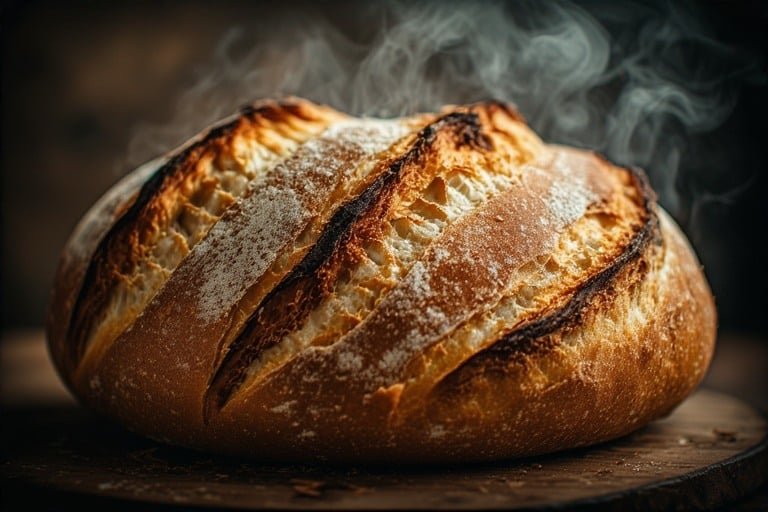
The crime scene: one gorgeous top, one charcoal bottom
You pull the Dutch oven out. The top is golden. The ear is glorious. You flip the loaf over and… it looks like you tried to bake a hockey puck. A thick, dark, chewy bottom crust that’s somewhere between “rustic” and “arson.”
Burnt bottoms are one of the most common sourdough problems, and honestly? Your oven is mostly to blame. Not you. Here are the 10 fixes that actually work, ranked from easiest to most involved, so you can stop sacrificing the bottom half of every loaf.
Why sourdough bottoms burn in the first place
Three things cause it, usually together:
- Direct contact with a scorching hot baking surface. A preheated Dutch oven or baking stone can be 450°F+ when the dough goes in.
- Heat coming from below. Most home ovens heat from the bottom element, so that’s where the intense heat hits first.
- Dark-colored bakeware. Dark cast iron and black enamel absorb way more heat than lighter surfaces.
Fix one or two of these and the problem usually disappears. Here’s how.
Fix #1: Put a sheet tray on the rack below your Dutch oven
This is the #1 tip from experienced bakers and it takes 10 seconds. Slide a half-sheet tray or cookie sheet onto the rack directly below your Dutch oven. It blocks radiant heat from the bottom element and acts as a heat shield.
- The tray doesn’t have to touch the Dutch oven
- Can stay in for the whole bake
- Works even better with a cast iron pan (more thermal mass)
If you do one thing from this list, do this. It fixes maybe 60% of burnt-bottom problems on its own.
Fix #2: Move your rack up
Most home bakers set the Dutch oven on the middle or lower rack. Move it up one notch. The farther you are from the bottom heating element, the less direct heat hits the bottom of your loaf.
- Middle rack → upper-middle rack
- If you have convection, this matters even more (hot air circulates from the bottom in many ovens)
- Your top crust may need the lid off a few extra minutes to compensate
👉 Related: How to get better oven spring in sourdough
Fix #3: Drop your baking temperature
A lot of sourdough recipes call for 500°F preheats. That’s aggressive. If your bottom keeps burning, just… turn it down.
- Try preheating to 475°F, dropping to 450°F when the loaf goes in
- After 20 minutes, drop to 425°F for the uncovered portion
- Get an oven thermometer — many home ovens run 25–50°F hotter than the dial claims
Ovens lie. A $10 thermometer tells you the truth.
👉 Related: Bake sourdough in Dutch oven · Baking bread with sourdough starter
Fix #4: Double up your parchment
A standard sheet of parchment under your loaf provides almost no insulation. Fold it in half, or use two layers. It’s a small thing that gives you a little extra buffer between scorching cast iron and dough.
- Cut two squares of parchment, stack them
- Or use thick baking paper (some brands are sturdier than others)
- Bonus: makes the loaf easier to lift out
Fix #5: Add a layer of semolina or cornmeal
Sprinkle a tablespoon of semolina, cornmeal, or bran on the bottom of your Dutch oven (on top of the parchment). It creates a small air gap between the dough and the pan, deflecting heat.
- Semolina is the pro move — it’s tough and doesn’t scorch fast
- Cornmeal works in a pinch but can burn at high temps
- Don’t overdo it; a thin layer is enough
Fix #6: Don’t preheat the Dutch oven
Yes, this is controversial. Yes, it works. Cold-start Dutch oven baking has become a legit technique, and it basically eliminates burnt bottoms.
- Place shaped, cold-retarded dough in a cold Dutch oven
- Put the lid on, slide into a cold oven
- Set oven to 450°F, bake for 45–50 minutes with lid, 10–15 without
- Oven spring is still great; bottom is noticeably lighter
Especially good if you’re using a cast iron pot with a dark interior.
Fix #7: Switch to a lighter-colored Dutch oven
If you bake a lot and keep burning bottoms, your Dutch oven itself might be the problem. Dark interiors (black enamel, raw cast iron) absorb and radiate more heat than light interiors.
- Cream, white, or light blue enamel interiors = lighter bottoms
- Lodge, Staub (black interior) = darker bottoms
- Le Creuset, cream-colored Tramontina = lighter bottoms
You don’t have to rebuy — Fix #1 through #6 will likely do the trick. But if you’re shopping, this matters.
👉 Related: Lodge combo cooker review
Fix #8: Bake open, not in a Dutch oven
If burnt bottoms are a constant problem and none of the above work, try baking on a sheet tray with a separate steam source. You’ll lose some oven spring but gain complete control over bottom browning.
- Bake loaf on a parchment-lined sheet tray on the middle rack
- Create steam with a pan of hot water on the bottom rack, or ice cubes in a cast iron skillet
- Remove steam source after 20 minutes for a crisp crust
👉 Related: Bake sourdough without Dutch oven
Fix #9: Watch for enriched dough (and reduce sugar)
Sourdough with honey, maple syrup, milk, or sugar browns faster — and burns faster. If your recipe has added sugars and you’re burning the bottom, that’s part of the reason.
- Reduce sugar by 25–50%
- Bake 25°F cooler than a plain lean dough
- Pull it earlier and check internal temp (200–205°F = done)
Chocolate chip, cinnamon raisin, cranberry orange sourdough — all more prone to burning. Adjust accordingly.
Fix #10: Pull the bread early and check doneness
You don’t actually need to bake the full 50 minutes if your loaf is done. Internal temp of 205–210°F means the bread is baked through, regardless of how long it’s been in the oven.
- Use an instant-read thermometer
- Pull when internal temp hits 205°F for a lighter crust, 210°F for a darker one
- Lightly tap the bottom — it should sound hollow
Stop overbaking “just to be safe.” That’s how burnt bottoms happen.
Quick-start: what to do right now
If you only have time for one fix before your next bake: sheet tray on the rack below, oven temp dropped to 450°F, middle rack. That’s it. Three small changes and most burnt-bottom problems disappear.
FAQs
Can I eat sourdough that’s burnt on the bottom? Yes — just slice off the burnt crust. The rest of the loaf is fine.
Why does my sourdough burn on the bottom but the top is pale? Your oven is channeling too much heat from below. Shield the bottom (sheet tray) and add steam to brown the top. You may also need to bake longer with the lid off.
Does aluminum foil in the Dutch oven help? Yes. Crumpled foil at the bottom of the Dutch oven creates an air gap and deflects heat. It’s an old King Arthur Baking tip and it works well. Just don’t use so much that the bread won’t cook through.
Is baking on a stone better than a Dutch oven for avoiding burnt bottoms? Stones hold intense heat and can still burn bottoms. A sheet tray or double-parchment on top of the stone helps.
Should I use cornstarch on the bottom? Use cornmeal, semolina, or rice flour — cornstarch burns too fast.
Still troubleshooting?
- Thick, chewy bottom crust but not burnt? → Probably a hydration issue. Sourdough hydration explained
- Dough collapsing in the oven? → Why does sourdough collapse after baking
- Full bake walkthrough: Bake sourdough in Dutch oven · Bake fixes guide
Burnt bottoms are annoying, but they’re one of the easiest sourdough problems to solve. Shield, lower, and move up — you’ll be flipping over loaves with pride in no time.