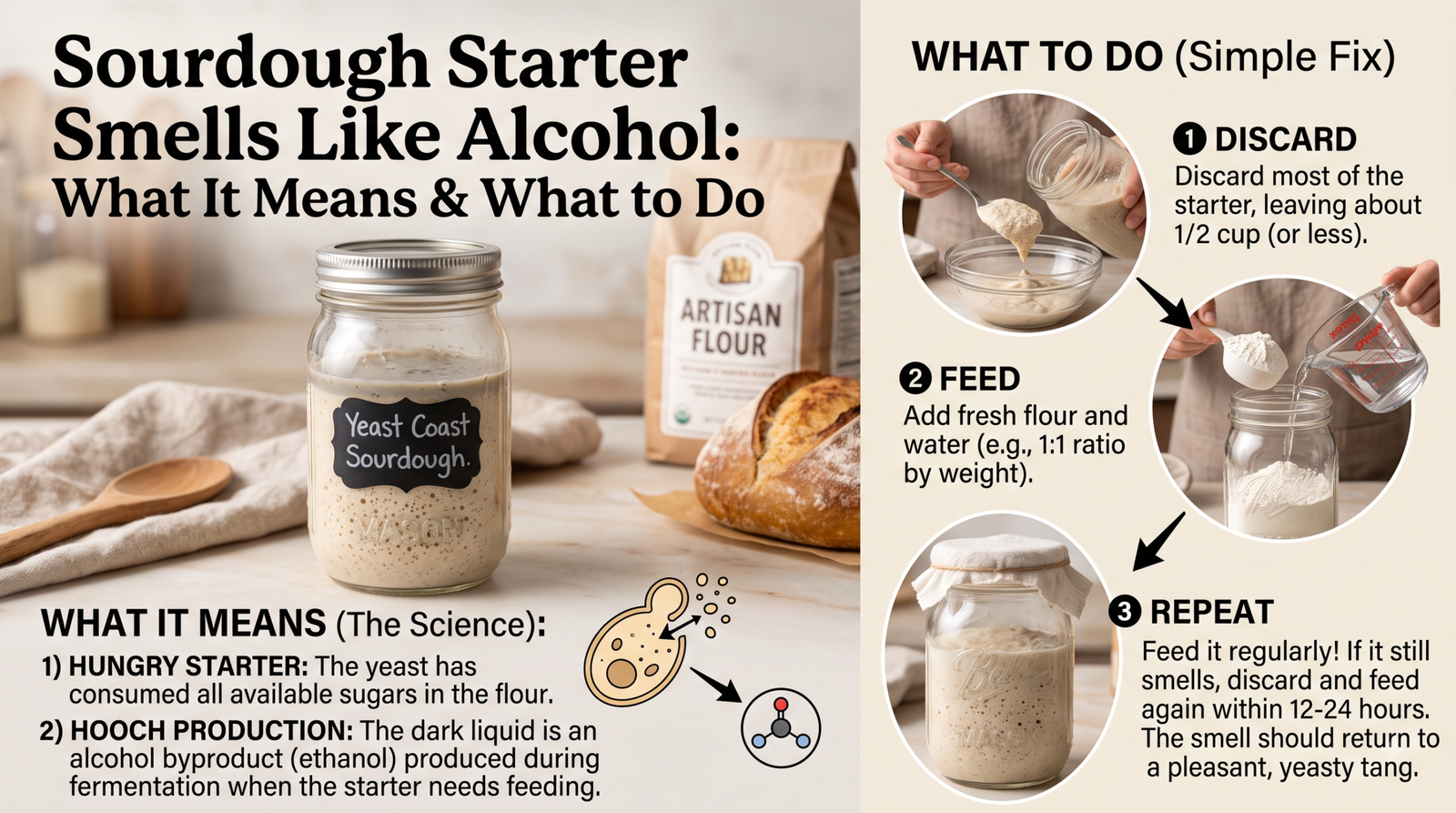
Short answer: your starter is hungry, not dead. An alcohol smell is one of the most normal things a sourdough starter can do — it means the yeast has consumed most of its available food and is producing ethanol as a byproduct. Feed it and the smell will fade within a few hours. There is nothing wrong with your starter.
“Alcohol smell and acetone smell are related but different — alcohol indicates yeast activity, while acetone indicates starvation. If your smell is sharp and solvent-like rather than boozy, see our guide on sourdough starter smells like acetone for the correct diagnosis.”
Quick Answers
- ✓ Is it safe? Yes — alcohol smell is a normal fermentation byproduct, not spoilage.
- ✓ Is the starter dead? Almost certainly not. Dead starters show mould or pink/orange contamination, not alcohol smell.
- ✓ Can I still bake with it? Not yet — feed it first and wait for it to peak.
- ✓ What causes it? The starter has eaten through its flour and is starving.
- ✓ How to fix it? Pour off any gray liquid (hooch), discard to 25g, feed 1:2:2, keep warm.
Why Your Starter Smells Like Alcohol
Wild yeast produces two things when it ferments: carbon dioxide (which makes dough rise) and ethanol (alcohol). Both are always present in an active starter. The alcohol smell becomes noticeable when the yeast has eaten through most of the flour you last fed it and has nothing left to consume — it enters a starvation state and ramps up ethanol production.
Having trouble with your starter beyond the smell? See the Why Your Sourdough Starter Isn’t Rising: Complete Diagnostic Guide for step-by-step troubleshooting across every symptom.
You’ll often see a thin gray or brownish liquid pooling on top at the same time. This is hooch — concentrated ethanol that has separated from the starter. Its presence alongside the alcohol smell is the clearest possible confirmation that your starter needs feeding, not that something has gone wrong.
An alcohol smell in your finished loaf usually means bulk fermentation went too long and the yeast exhausted the available sugars. See the bulk fermentation chart for the correct rise percentage cutoff at your dough temperature.
The Smell Spectrum: What Each Sourdough Starter Smell Means
Starter smells vary significantly depending on where it is in its feeding cycle and how healthy the yeast-to-bacteria balance is. Here’s what each smell indicates:
| Smell | What it means | What to do |
|---|---|---|
| Alcohol / beer / wine | Starter is hungry — has eaten through its flour supply | Feed immediately at 1:2:2. Will resolve in 4–8 hours. |
| Vinegar / sharp acidity | Over-acidic — acetic acid bacteria are dominant | Feed more frequently. Try 1:5:5 ratio to dilute acidity. |
| Acetone / nail polish remover | Yeast under stress — starving or temperature too extreme | Feed at 1:2:2 with warm water. Check temperature (target 75–78°F). |
| Yoghurt / mild tang | Healthy, active starter approaching peak | Nothing — this is ideal. Use within 1–2 hours of peak. |
| Cheese / funky but not rotten | Normal for new starters in first 1–2 weeks | Keep feeding consistently. Will mellow as starter matures. |
| Truly rotten / putrid | Possible contamination | Check for pink, orange, or green colour. If present, discard and start over. |
How to Fix a Starter That Smells Like Alcohol
- Pour off the hooch — that gray liquid on top is concentrated ethanol. You can also stir it in, but pouring it off gives the starter a cleaner reset and produces less sour flavor.
- Discard down to 25g — a smaller amount of starter ferments more predictably and recovers faster.
- Feed at 1:2:2 — add 50g fresh flour and 50g warm water (80°F / 27°C) to the 25g starter. Stir fully to combine.
- Keep it warm — place at 75–78°F / 24–26°C. On top of the refrigerator or in the oven with just the light on works well.
- Watch for activity — within 4–8 hours you should see bubbles and a clear rise. The alcohol smell will fade as fresh fermentation takes over.
If the starter was severely neglected (weeks in the fridge with no feeding), it may need 2–3 consecutive feedings before it fully recovers. See our full sourdough starter not rising guide for a day-by-day fridge revival protocol.
Alcohol vs. Acetone: What’s the Difference?
These two smells are often confused but mean slightly different things:
- Alcohol/beer smell — ethanol produced by yeast when food is exhausted. Starter has fallen flat and is starving. Fix: feed immediately.
- Acetone/nail polish remover smell — a sharper, more chemical odor indicating yeast stress, often from extreme temperature or prolonged starvation. Still fixable — feed at 1:2:2 with warm water and a warm environment. See our dedicated guide: sourdough starter smells like acetone.
Both smells burn off completely during baking. If your starter smells like alcohol or acetone but you use it after a proper feeding at peak activity, your bread will not smell or taste like either.
Is It Safe to Bake With a Starter That Smelled Like Alcohol?
Yes — after feeding it and letting it reach peak activity. Do not bake with a starter that currently smells strongly of alcohol. The smell indicates the starter is past peak and the yeast is depleted, which means it won’t have enough leavening power to raise your dough properly. Feed it, let it double, and use it at peak — then the smell will be gone and the starter will perform correctly.
If your sourdough loaf (not the starter) smells like alcohol after baking, that’s a different problem — scroll down for the full diagnosis.
When your bread smells like a frat house
You pull your loaf out of the oven expecting that warm, bready, tangy sourdough smell. Instead, you get something that smells vaguely like beer. Or vodka. Or a bottle of wine that fell over in the pantry. It’s… a lot.
A sourdough loaf that smells like alcohol isn’t ruined. But it is telling you something went off during fermentation. Ethanol (alcohol) is a normal byproduct of yeast doing its job — but when you smell it strongly in the finished loaf, there’s usually too much of it, and that means fermentation got out of balance. Here’s why, and what to do about it.
Why sourdough produces alcohol in the first place
Quick science break: yeast eats sugars and produces two main byproducts — carbon dioxide (which makes the dough rise) and ethanol (alcohol). Lactic acid bacteria produce lactic and acetic acid for tang. Both happen during every fermentation. That’s just sourdough.
Most of the alcohol evaporates during baking. A little residual smell is totally normal. But if your loaf smells overwhelmingly boozy after baking, you’ve got too much ethanol in the dough — which usually means one of five things.
Cause #1: Over-fermentation (the #1 reason)
If your dough sat too long in bulk or cold retard, yeast and bacteria kept eating sugars and producing ethanol the whole time. By the time you baked it, alcohol concentration was so high that the bake couldn’t evaporate it all.
Signs you’re here:
- Dough was slack, sticky, spread flat when tipped out
- Bread has a dense or gummy crumb
- Strong alcohol smell + strong sour taste
- Little oven spring
How to fix it:
- Pull bulk fermentation at 50–75% rise, not a full double
- Shorten cold retard to 8–16 hours (not 24–48)
- If your kitchen is warm, check dough earlier than the recipe says
👉 Related: Bulk fermentation 101 · How to save overproofed sourdough
Cause #2: Over-fermented starter used in the dough
If you used starter that was well past peak — deflated, sour, maybe with a layer of hooch on top — it had already produced a lot of alcohol before it even went into your dough. Now you’re starting behind.
How to fix it:
- Use starter within 1–2 hours of peak, not hours later
- Starter should look domed and actively bubbling
- Do the float test just before using
- Feed your starter on a schedule that aligns with your baking window
👉 Related: How to strengthen weak sourdough starter · Why sourdough discard has liquid hooch
Cause #3: Weak starter + long fermentation
A weak starter doesn’t have enough yeast to raise the dough quickly, so it takes way longer than expected. During all that extra time, the bacteria keep producing ethanol and acids. Long fermentation with a weak starter = alcoholic bread.
Signs you’re here:
- Dough took way longer than the recipe said to rise
- Bread is dense AND smells boozy
- Crust is pale (sugars depleted)
How to fix it:
- Strengthen your starter before baking (see Fix #1 in our strengthening guide)
- Use bread flour for your starter for a few days
- Make sure starter is doubling reliably in 4–8 hours before you bake with it
👉 Related: How to strengthen weak sourdough starter · Sourdough starter not doubling
Cause #4: Too warm an environment
Warm temperatures speed up yeast activity — which means more alcohol produced in the same amount of time. If you bulk ferment at 85°F and follow a recipe written for 72°F, you’ll overshoot and end up with a boozy loaf.
How to fix it:
- Ideal bulk temp: 74–78°F
- In summer, use AC or move dough to a cooler spot
- Shorten bulk time by 25–40% in a hot kitchen
- Use the aliquot method to measure actual rise instead of watching the clock
👉 Related: Best bulk fermentation temperature for sourdough · How dough temperature affects fermentation
Cause #5: Too much starter in the recipe
Using more starter than the recipe calls for doesn’t just speed things up — it can accelerate alcohol production beyond what normal fermentation timing accounts for. More starter + same bulk time = over-fermented dough.
How to fix it:
- Stick to the ratios in the recipe (usually 15–25% starter to flour)
- If you increase starter, decrease bulk fermentation time proportionally
- For 500g flour, 100–125g starter is a standard range
“My starter smells like alcohol but my bread doesn’t”
That’s fine. A starter smelling like alcohol just means it’s hungry. It’s normal — feed it and the smell will fade. It doesn’t mean your bread will come out boozy, as long as you:
- Feed the starter fresh before baking
- Use it near peak
- Don’t over-ferment the dough
If the starter has a thin layer of grey liquid on top (hooch), that’s concentrated ethanol. Stir it in or pour it off, then feed. No harm done.
👉 Related: Sourdough starter smells like acetone fix · Why sourdough discard has liquid hooch
FAQs
Is alcoholic-smelling sourdough safe to eat?
Yes. The alcohol is a byproduct of natural fermentation, not a sign of spoilage. Most of it bakes out. Even an overly boozy loaf is safe, just not delicious.
Will the smell bake out?
Usually yes — most ethanol evaporates at 173°F, well below baking temperature. If the smell persists after baking, you produced more alcohol than could evaporate in the bake time.
Does the alcohol smell mean my bread will taste like alcohol?
Sometimes. Mildly over-fermented bread tastes slightly sharp or boozy. Severely over-fermented bread tastes sour and unpleasant.
Can I use a boozy-smelling loaf for something?
Absolutely. Make toast, croutons, French toast, breadcrumbs, or bread pudding. Toasting especially drives off residual alcohol.
Is there alcohol left in baked sourdough?
Trace amounts, usually under 2% of what was in the dough. Not enough to affect anyone.
My sourdough starter smells like alcohol — is it dead?
No. An alcohol smell is one of the clearest signs your starter is alive and actively fermenting — just past its peak and hungry. Dead starters show no bubbles at all, and contaminated starters show pink or orange streaks. A starter that smells like alcohol just needs feeding. Discard to 25g, add 50g flour and 50g warm water, and leave at 75–78°F. The smell will be gone within 4–8 hours.
What is the gray liquid on top of my starter?
That’s hooch — ethyl alcohol that has separated and pooled on top of the starter. It forms when yeast has consumed all its food and keeps producing alcohol with nothing left to ferment. It’s harmless and very common, especially in refrigerated or neglected starters. Pour it off or stir it in, then discard and feed.
How do I prevent my starter from smelling like alcohol?
Feed more frequently. A starter at room temperature typically needs feeding every 12–24 hours. If you’re seeing hooch regularly, your starter is consistently running out of food — either feed more often, use a higher flour-to-starter ratio, or store in the fridge between bakes (where it only needs weekly feeding). Adding 10–20% rye or whole wheat flour to feedings also helps by giving the yeast a more nutrient-rich food source.
Still troubleshooting?
- Still Troubleshooting? Start Here:
- Why Your Sourdough Starter Isn’t Rising: Complete Diagnostic Guide
- Sourdough Starter Not Doubling
- How to Strengthen a Weak Sourdough Starter
- Sourdough Starter Smells Like Acetone Fix
- Sourdough Starter Smell Guide
- Revive a Dried Sourdough Starter
- 72-Hour Sourdough Starter
- How to Keep Your Sourdough Starter Warm
- Winter Sourdough Guide
A boozy sourdough loaf is fermentation telling you it went too long or too warm. Dial back the time, dial down the temperature, and your next bake will smell like the bakery — not the bar.
2 Responses
Can I use discard that smells like alcohol or should I toss it? I just started working towards growing my own starter, thinking the smell would go away and it didnt. I’ve fed every 24 hours for the past 3 days but at a 1:1:1.
Great question — no need to toss it! A new starter smelling like alcohol in the first week is actually really common, especially only feeding once a day. Since it’s brand new, try upping to twice-a-day feedings (every 12 hours) at a 1:1:1 ratio instead of once every 24 — a young starter often can’t make it a full 24 hours without running out of food, which is exactly what causes that boozy smell. Keep it warm (75–78°F) and you should see the smell fade and bubbly activity pick up within a few days. Don’t bake with it yet, just keep feeding until it’s reliably doubling