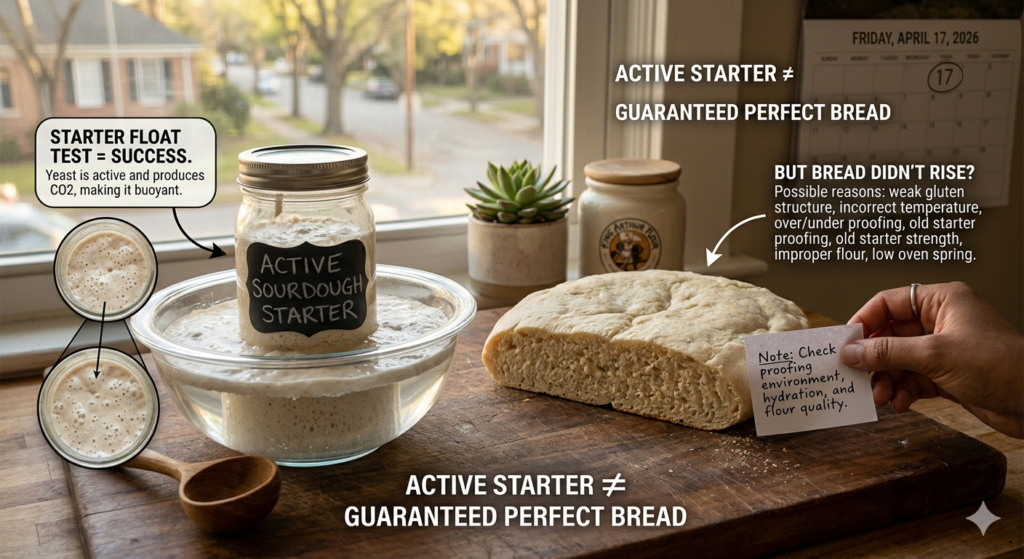
Wait — my starter floated. Why is my bread a brick?
You did the float test. You watched a dollop of starter bob to the top of the water like a tiny bread-flavored astronaut. You felt smug. You baked. You pulled out a loaf that looks like a hockey puck.
Here’s the uncomfortable truth: the float test is not actually that reliable. A starter can float and still not be strong enough to raise bread. And even with a strong starter, a dozen other things can stop your dough from rising. Let’s figure out which one got you.
Why the float test lies
The float test only checks one thing: is your starter producing enough gas right now to be less dense than water? That’s it.
It doesn’t tell you:
- Whether your starter is mature enough to raise a full loaf
- Whether it has enough yeast biomass to handle 500g of flour
- Whether it was at peak when you used it
- Whether your technique, flour, or temperature will support the rise
A starter that’s 7 days old can float. A starter maintained with rye flour might never float — but still bake great bread. The test is a rough indicator, not a guarantee.
👉 Related: Sourdough starter not doubling · Why isn’t my sourdough starter rising
Cause #1: Starter is too young (false positive)
A starter under 2–4 weeks old can technically pass the float test but doesn’t have the yeast population to raise bread reliably. Mature starters have way more wild yeast than young ones.
How to fix it:
- Keep feeding daily for another 2–4 weeks
- Look for consistent doubling in 4–8 hours (not just floating)
- Mature starters rise reliably every time, not sporadically
Cause #2: Used starter too long after peak
You fed your starter, waited for it to look bubbly, tested it — float! — and got excited. But if it was actually past peak and already starting to deflate, its rising power was already declining even though it still floated.
How to fix it:
- Use starter within 1–2 hours of peak, not later
- Peak = highest rise, still domed, starting to plateau
- Past peak = starting to sink, liquid forming on top, surface getting flat
- Mark the jar with a rubber band at feeding time to track exactly when it peaks
👉 Related: Sourdough starter feeding ratio chart · How to feed and maintain sourdough starter
Cause #3: Dough environment is too cold
A strong starter still can’t do its job if the dough is sitting in a 62°F kitchen. Yeast activity slows dramatically below 70°F, and below 65°F it’s barely working. Your dough might need 12+ hours to bulk instead of the 4–6 your recipe called for.
How to fix it:
- Bulk ferment at 74–78°F
- Use your oven with the light on, a proofing box, or a warm spot in the kitchen
- In winter, expect much longer bulk times even with a strong starter
- Watch the dough’s rise, not the clock
👉 Related: Sourdough proofing temperature · Sourdough not rising in winter · Keep sourdough dough warm
Cause #4: Flour is too low in protein
Your starter can be a champion, but if your flour doesn’t have enough gluten to trap the gas it produces, the bread won’t rise. All-purpose flour (9–11% protein) often can’t hold the rise of a high-hydration sourdough.
How to fix it:
- Switch to bread flour (12%+ protein)
- King Arthur Bread Flour is 12.7% — a reliable choice
- If using whole wheat or rye, blend with bread flour (at least 60% bread flour)
👉 Related: Best flour for sourdough beginners · Can you use all-purpose flour for sourdough
Cause #5: Not enough starter in the recipe
Different recipes use different starter ratios. Some call for 10% (lean, slow fermentation). Some for 25%+ (faster rise). If your starter is strong but you only used a tiny bit, the bread might genuinely need 12+ hours to bulk — and you might have pulled it too early.
How to fix it:
- Check your starter ratio against your recipe
- For beginners, 20–25% starter is more forgiving
- If using less starter, plan for longer bulk and proof times
Cause #6: Under-fermented dough (you pulled bulk too early)
Even with a great starter, if you ended bulk fermentation before the dough was ready, it’ll bake into a dense loaf. Under-fermented dough doesn’t look obviously “wrong” — it just feels firm and tight and didn’t rise enough.
Signs you’re here:
- Dough felt dense and tight going into the banneton
- Poke test: dough springs back fully and immediately
- No visible bubbles along the sides of your bulk container
- Bread is dense AND pale
How to fix it:
- Look for 50–75% rise during bulk, not a fixed time
- Do the poke test — dough should spring back slowly and halfway
- If in doubt, give it another 30–60 minutes
👉 Related: Bulk fermentation for beginners · Sourdough underproofed vs overproofed
Cause #7: Weak gluten network
Your starter fermented the dough fine. Your flour was great. But you only did 2 lazy stretch-and-folds and never built any real gluten structure. The gas that was produced escaped instead of getting trapped. Bread comes out dense.
How to fix it:
- Do 4+ sets of stretch-and-folds in the first 2 hours
- Each set: 4 folds, dough should feel noticeably tighter by the last set
- Consider coil folds or lamination for high-hydration doughs
- Let the dough rest 20–30 min between sets
👉 Related: Sourdough folding techniques guide · Stretch and fold schedule for beginners
Better tests than the float test
If you don’t trust the float test (and you shouldn’t, entirely), here are better ways to know your starter is ready:
- Doubles reliably in 4–8 hours after feeding
- Visible bubbles throughout, not just on top
- Domed top at peak (not sunken or flat)
- Smells yeasty and slightly tangy — not strongly sour or alcoholic
- Passes the poke test on the surface (springs back slowly)
Do two consecutive feeds that look textbook-perfect before baking. That’s way more reliable than a single float test.
FAQs
If the float test isn’t reliable, why do people use it? Because it’s easy and gives a quick yes/no. It’s a decent beginner tool, just not a guarantee. Use it with other signs, not alone.
Can rye or whole wheat starters pass the float test? Often no. They don’t trap gas as well as white flour starters. A rye starter might never float but still make incredible bread. Look at rise, bubbles, and smell instead.
My starter floated, sank, then floated again. What’s happening? Probably past peak. The bubbles broke as it deflated. Feed it and use at peak next time.
Should I feed my starter right before baking every time? Yes, if it’s been refrigerated or sitting around. Feed, wait for peak (4–8 hours), then use.
How long should bulk fermentation take with a strong starter? At 75°F with 20% starter, usually 4–6 hours. Colder kitchen = longer. Warmer = shorter. Watch the dough, not the clock.
Still troubleshooting?
- Dense bread despite good fermentation? → Why is my sourdough bread dense
- Starter never doubles? → How to strengthen weak sourdough starter
- Not sure if dough is ready? → Sourdough poke test visual guide
- Full starter rescue plan: Starter SOS Guide
The float test is a check, not a promise. Look at the whole picture — doubling time, bubbles, smell, dough environment, flour, technique — and your bread will start rising like it should.