👈 Back to Complete Malt Guide — All malt types, uses, and baking benefits explained
Explore other malt guides: Diastatic Malt Powder • Non-Diastatic Malt Powder • Malt Syrup • Malted Flour • Malted Barley • What Is Malting? • DIY Malting • High-Rise Recipe
Malted barley flour is malted barley (sprouted and dried grain) that has been ground into a fine powder—the most common and convenient form of malt for home and professional bakers.
Malted barley flour is malted barley grain that has been steam-dried, hulled, and finely ground, then sifted to create a uniform flour that blends invisibly into bread dough. Unlike whole malted barley grains, which add texture, malted barley flour dissolves completely into your dough. It’s the form you add when you want the enzyme activity and flavor of malt without any visible grain pieces.
In this guide, you’ll learn what malted barley flour is, how it differs from other malt forms, how to use it in sourdough, and when to choose it over alternatives.
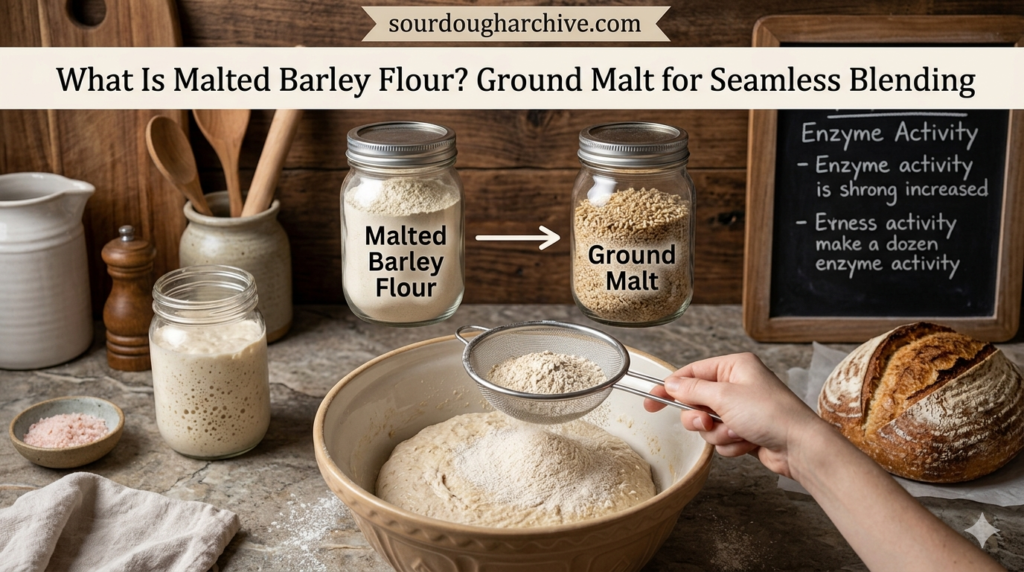
From the Pillar: Understanding Ground Malt
This spoke covers malted barley flour as a ground malt product, part of the complete what is malt guide. If you’re new to malt, start with the malting process to understand how grain becomes malt. This post focuses on the ground flour form and its practical applications in bread.
What You’re Buying: Ground Malted Grain
Malted barley flour is the result of a simple process:
- Malting: Barley is sprouted and dried (see the malting process for full details)
- Steam-drying & hulling: The grain is dried with steam and the outer hull is removed
- Grinding: The malted grain is milled into a fine flour
- Sifting: The flour is sifted to remove coarse particles and create a uniform powder
The result is a light tan to brown powder that looks similar to whole wheat flour but is much finer.
Diastatic vs. Non-Diastatic Malted Barley Flour
Diastatic Malted Barley Flour (Enzyme-Active) — Standard
Low-temperature kilned and ground. Contains active amylase enzymes that break down starch into maltose (sugar) during fermentation. This is the most common form you’ll find.
What it does in dough:
- Accelerates fermentation (yeast has more sugar to feed on)
- Improves oven spring (extra fermentable sugars = more gas)
- Darkens crust (residual sugars caramelize)
- Adds subtle sweet, nutty flavor
- Acts as a dough conditioner (softens dough slightly)
- Extends bread shelf life (moisture retention)
Best for: Most sourdough bakers. It enhances fermentation naturally and improves the final loaf with minimal adjustment.
Non-Diastatic Malted Barley Flour (Enzyme-Inactive) — Specialty
High-temperature kilned and ground. Enzymes have been deactivated. Used purely for flavor and color, with no impact on fermentation speed.
What it does in dough:
- Adds flavor (toasty, nutty, slightly sweet)
- Darkens crust (pure sugar content, no enzyme action)
- Does NOT accelerate fermentation
- Does NOT improve oven spring via enzyme action
Best for: Bakers who want malt flavor without fermentation changes, or those with whole grain flours that already have high natural enzyme activity.
How to tell the difference: The label should specify. If it just says “malted barley flour” with no qualifier, assume it’s diastatic. Non-diastatic will say “non-diastatic” explicitly.
Malted Barley Flour vs. Other Malt Forms
Malted Barley Flour vs. Whole Malted Barley
Whole malted barley is intact grain kernels; malted barley flour is ground to fine powder. Whole grain adds visible texture and crunch; flour blends invisibly. Whole grain requires grinding; flour is ready to use. Both have similar enzyme activity (if diastatic), but flour disperses enzymes more evenly through the dough.
Malted Barley Flour vs. Malt Powder (Extracted)
Malt powder (also called diastatic malt powder or malt extract powder) is a concentrated product where sugars have been extracted and dried. Malted barley flour is the whole ground grain. Malt powder is more potent (concentrated enzymes and sugars); malted barley flour is milder. Malt powder: 0.5–1% dosage; malted barley flour: 1–5% dosage. Malt powder is shelf-stable for years; malted barley flour degrades faster.
Malted Barley Flour vs. Malt Syrup
Malt syrup is liquid extracted malt. Malted barley flour is dry ground grain. Syrup adds pure sugar/flavor; flour adds enzymes + sugars + whole-grain fiber. Syrup is easier to measure and blend; flour requires thorough mixing. Syrup doesn’t require additional liquid adjustment; flour is dry and absorbs water initially.
Malted Barley Flour vs. Pre-Blended Malted Flour
Malted flour (pre-blended by the miller) contains 0.5–1% malted barley flour already mixed into bread flour. Pure malted barley flour is 100% ground malt. Pre-blended is convenient but less flexible; pure malted barley flour lets you adjust dosage.
How to Use Malted Barley Flour in Sourdough
Typical Dosage
Light use (subtle enzyme activity & flavor): 0.5–1% of flour weight. For 500g flour = 2.5–5g (roughly ¾–1 teaspoon)
Moderate use (noticeable effect on fermentation): 1–2% of flour weight. For 500g flour = 5–10g (roughly 1–2 teaspoons)
Heavy use (pronounced effect & strong flavor): 2–5% of flour weight. For 500g flour = 10–25g (roughly 2–5 teaspoons)
Important warning: More than 1–1.5% can create gummy crumb and unpredictable fermentation. Start low and test.
How to Add It
Step 1: Mix with dry flour
Add malted barley flour to your bread flour and mix thoroughly before adding water. This distributes the flour evenly and prevents clumping.
Step 2: Hydrate normally
Mix in water and salt as usual. No special hydration adjustment needed—malted barley flour is negligible in quantity and blends seamlessly.
Step 3: Ferment and watch timing
If using diastatic malted barley flour, fermentation will proceed 15–30 minutes faster than without it. Watch the dough, not the clock. Bulk fermentation should be 20–30% faster than your baseline.
Step 4: Bake normally
No special baking adjustments. The extra sugars will caramelize on the crust for deeper color.
Common Approaches
The “standard additive” approach: Add 0.5–1% to every bread you make. It becomes invisible and improves every loaf. This is how commercial bakeries use it—routine dough conditioning.
The “experimental” approach: Make two loaves side-by-side, one with and one without malted barley flour, at the same time under identical conditions. Compare fermentation speed, color, flavor, and crumb. This teaches you its effect.
The “skip it” approach: Some bakers (especially those using whole grain flours like rye or spelt that already have high enzyme activity) skip malted barley flour altogether. Sourdough ferments fine without it.
Effects of Malted Barley Flour on Sourdough
Fermentation Speed (Diastatic Only)
Diastatic malted barley flour accelerates fermentation by 15–30 minutes in a typical 4–6 hour bulk fermentation. The effect is modest but noticeable. If you normally bulk for 5 hours, expect 4.5 hours with diastatic malted barley flour.
Non-diastatic has zero effect on fermentation speed.
Oven Spring
Extra fermentable sugars (from enzyme action) give yeast more food during final proof and oven spring. You’ll see slightly improved rise and a taller loaf.
Crust Color
The residual sugars caramelize during baking, creating a darker, deeper golden-brown crust. Non-diastatic also darkens the crust (pure sugar), but diastatic is more dramatic.
Flavor
Malted barley flour adds a subtle toasty, nutty, slightly sweet undertone. It’s not overwhelming—most people won’t taste it explicitly, but the bread tastes “rounder” and more complex. At 1–2%, it’s background flavor; at 5%, it becomes more pronounced.
Crumb Texture & Moisture
Malted barley flour acts as a dough conditioner—it softens the dough slightly and helps retain moisture. Crumb is slightly more tender and stays moist longer (improved shelf life).
Gummy Crumb Warning
Overuse (more than 1.5%) can result in gummy crumb. The enzymes break down starch too aggressively, creating a wet, sticky interior. If your crumb is gummy, reduce dosage by half on the next bake.
Where to Buy Malted Barley Flour
Online baking suppliers: King Arthur Baking, Breadtopia, Giusto’s, Ardent Mills. Most have small bags (1–2 lbs) suitable for home bakers.
Homebrew suppliers: Often stock it, sometimes labeled “diastatic malt powder” or “malted barley flour.” Usually competitive pricing.
Specialty/health food stores: Less common, but some carry it.
UK & Europe: Widely available in flour sections of grocery stores and baking suppliers.
US grocery stores: Rarely in-stock. Order online.
Cost: $1.50–$3.50 per pound. A little goes a long way (1–2 teaspoons per loaf), so one bag lasts months.
Storage & Shelf Life
Diastatic malted barley flour: Cool, dry place (pantry or refrigerator). 6–12 months, though quality degrades slightly over time. Enzymes slowly deactivate at room temperature.
Non-diastatic malted barley flour: Room temperature, sealed container. 1–2 years. No enzyme activity to preserve, so shelf life is longer.
Pro tip: Store in the refrigerator or freezer if you live in a warm climate. This preserves enzyme activity (for diastatic) and overall freshness longer.
The Bottom Line on Malted Barley Flour
Malted barley flour is the most practical, commonly-used form of malt for sourdough bakers. It blends invisibly, improves fermentation and crust color (if diastatic), and costs very little. At 1% dosage, it’s the industry-standard dough conditioner.
Best for:
- Bakers who want invisible improvement without texture changes
- Those seeking better oven spring and crust color
- Anyone wanting convenient, pre-measured malt
- Commercial-style baking (standard dough conditioning)
Less ideal for:
- Bakers who want visible grain texture (use whole malted barley instead)
- Those with whole grain flours already high in natural enzymes
- Bakers who prefer minimal ingredients (though 1% is negligible)
Malted barley flour is the workhorse of professional bakeries. Add it to your rotation and watch your sourdough improve with zero extra effort.