Quick Answer: For most home bakers, bulk fermentation takes 4–6 hours at 75–78°F (24–26°C). In a cold kitchen at 68°F it can stretch to 8–12 hours. In a warm kitchen above 80°F it can finish in as little as 3 hours. Temperature — not the clock — is the real answer.

What Is Bulk Fermentation?
Bulk fermentation is the first rise — the period between mixing your dough and shaping it. It’s called “bulk” because the entire dough mass ferments together as one piece before being divided or shaped. During this window, wild yeast produces carbon dioxide (making the dough rise) and lactic acid bacteria produce organic acids (building flavor and improving digestibility).
It is the most misunderstood stage in sourdough baking — and the one most responsible for flat, dense, or gummy loaves when it goes wrong. For a full explanation of how it differs from the final proof, see our guide on bulk fermentation vs proofing.
How Long Does Bulk Fermentation Take? (By Temperature)
There is no single answer — but there is a reliable framework. Dough temperature is the single biggest factor controlling how fast or slow fermentation moves. Use this table as your starting reference:
| Dough Temperature | Expected Bulk Fermentation Time | Notes |
|---|---|---|
| 65°F / 18°C | 10–14 hours | Very slow — cold kitchen; monitor closely for signs not time |
| 68°F / 20°C | 8–12 hours | Slow but manageable; common in winter kitchens |
| 72°F / 22°C | 6–8 hours | Moderate pace; typical for cooler home environments |
| 75°F / 24°C | 5–6 hours | Ideal range for beginners — predictable and forgiving |
| 78°F / 26°C | 4–5 hours | Sweet spot for most recipes; best flavor and structure |
| 80°F / 27°C | 3–4 hours | Fast — monitor closely, overproofing risk increases |
| 82°F / 28°C | 2.5–3.5 hours | Very fast — experienced bakers only; easy to miss the window |
| 85°F / 29°C+ | 2–3 hours | Upper limit — above this, yeast degrades gluten rapidly |
Important: These times assume an active, healthy starter used at 15–20% of flour weight. A weak or immature starter will significantly extend these times regardless of temperature. See our guide on what to do when your starter won’t double if your bulk consistently takes longer than expected.
Why Time Alone Is Not Reliable
The most common bulk fermentation mistake is treating it like a timer. “The recipe said 4 hours” is not a finish line — it is a starting point for observation. These variables all change the actual time:
- Starter strength: A starter that peaks at 4 hours will ferment faster than one that peaks at 8 hours
- Starter percentage: 20% starter ferments significantly faster than 10%
- Flour type: Whole wheat and rye ferment faster than white flour due to higher enzyme activity
- Hydration: Higher hydration doughs ferment faster than stiffer doughs
- Kitchen humidity: Affects surface drying and perceived dough behaviour
- Elevation: Higher altitude means faster fermentation and shorter bulk times
To understand the full science behind why temperature drives all of this, see our guide on how dough temperature affects fermentation.
How to Know When Bulk Fermentation Is Done (Not by Time)
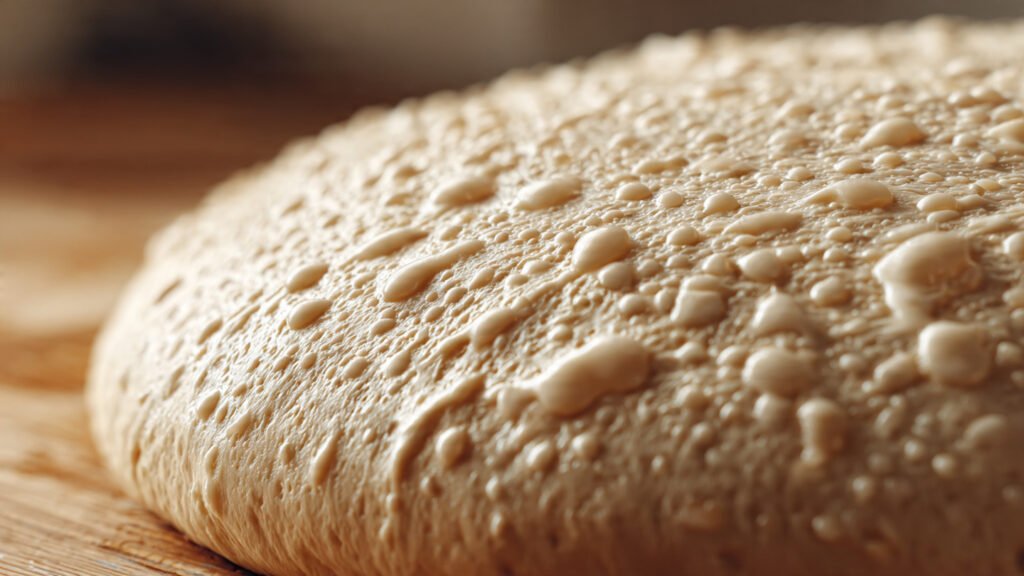
Watch for these signs — all of them together, not just one:
1. Volume Increase of 50–75%
Your dough should increase by roughly 50–75% — not double. Doubling is a common myth that leads to overproofing. A straight-sided, clear container with volume markings makes this easy to track. The aliquot jar method is the most accurate way to measure this — take a small sample of dough at the start and watch it rise in a small jar alongside the main batch.
2. Dough Feels Airy and Domed
Gently shake the bowl — properly fermented dough will jiggle with a slight wobble, like set jelly. The top surface should look domed and slightly rounded, not flat or collapsed. If it looks like it’s starting to fall back on itself, you have likely gone too far.
3. Bubbles on the Surface and Sides
Look for visible bubbles along the sides and surface of the dough. These indicate active CO2 production. Large, irregular bubbles near the top combined with a collapsed centre are a warning sign of over-fermentation.
4. Smooth, Elastic Texture
The dough surface should look smooth and slightly taut — not sticky or shaggy like it was at the start of mixing. When you perform a stretch and fold, the dough should pull back gently rather than tearing. Dough that tears or feels slack has either gone too far or needs more folding.
5. Passes the Windowpane Test
Stretch a small piece of dough between your fingers. If it stretches thin enough to see light through without tearing, gluten development is sufficient and bulk fermentation has done its job. If it tears immediately, give it another 30 minutes. See our guide on what to do if your dough won’t pass the windowpane test.
What Happens If Bulk Fermentation Goes Too Long?
Over-fermented bulk dough loses its gluten structure as protease enzymes break down the protein network. Signs it has gone too far include a very sticky, slack dough that spreads across the counter when turned out, a surface that looks blistered or wet, and a strong smell of alcohol or acetone. At this point, shaping a traditional loaf is very difficult — your best rescue is to pivot to focaccia or flatbread. See our full guide on how to fix overproofed sourdough for rescue methods.
What Happens If Bulk Fermentation Is Too Short?
Under-fermented dough hasn’t produced enough gas or developed enough flavor. The result is typically a dense sourdough loaf with a tight, gummy crumb and a pale crust. The dough will feel stiff and won’t jiggle when shaken. If you catch it early enough during shaping, you can extend the bench rest or let the shaped loaf proof longer at room temperature before refrigerating.
How to Control Bulk Fermentation Time
Speed It Up
- Use warmer water when mixing (raises dough temp)
- Increase kitchen temperature or use a proofing box
- Increase starter percentage slightly (use 20% instead of 15%)
- Use a higher proportion of whole wheat flour
Slow It Down
- Use cooler water when mixing
- Reduce starter percentage (use 10–12% instead of 20%)
- Move the dough to a cooler spot in your kitchen
- Use a cold ferment — move shaped dough to the fridge after a short room-temperature bulk
If your kitchen is cold and you’re struggling to control bulk fermentation timing consistently, see our guide on how to keep sourdough dough warm for practical solutions including proofing boxes, oven light setups, and seedling mat comparisons.
Stretch and Fold: What to Do During Bulk Fermentation
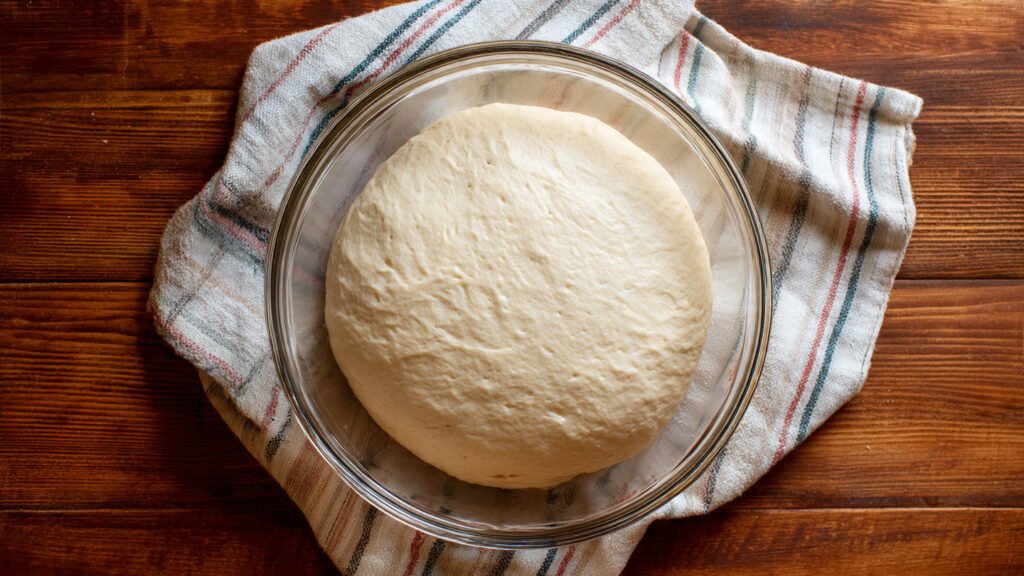
Bulk fermentation is not passive waiting. During the first 2 hours, you should perform 3–4 sets of stretch and folds spaced 30 minutes apart. This builds gluten strength, regulates dough temperature, and degasses large bubbles that would otherwise create irregular crumb structure. Follow our stretch and fold schedule for beginners for exact timing and technique.
After the final fold, leave the dough undisturbed for the remainder of bulk fermentation. Touching or deflating the dough in this window resets gas production and extends your total time.
Bulk Fermentation Timing by Schedule
Here are three practical schedules based on real kitchen scenarios:
| Schedule | Mix Time | Bulk Duration | Shape Time |
|---|---|---|---|
| Morning bake (warm kitchen) | 8:00 AM | 4–5 hrs at 78°F | 12:00–1:00 PM |
| Evening bake (cool kitchen) | 2:00 PM | 6–8 hrs at 72°F | 8:00–10:00 PM |
| Overnight bulk (cold kitchen) | 9:00 PM | 8–12 hrs at 68°F | Morning |
For a complete visual breakdown of timing by temperature, see our sourdough proofing time chart — it covers both bulk fermentation and final proof windows side by side.
Bulk Fermentation Chart by Temperature
Temperature is the single biggest factor controlling how fast your dough ferments. A dough that takes 6 hours at 75°F might take 12+ hours at 65°F. Using a fermentation chart helps you dial in precise timing for your specific kitchen conditions.
| Kitchen Temperature | Bulk Fermentation Time | Notes |
|---|---|---|
| 60–65°F | 12–16 hours | Very slow; ideal for cold kitchens or overnight fermentation |
| 66–70°F | 8–12 hours | Moderate pace; common room temperature |
| 71–75°F | 5–8 hours | Brisk; warm kitchens or summer baking |
| 76–80°F | 3–5 hours | Very fast; watch for over-fermentation |
| 80°F+ | 2–3 hours | Extremely fast; risk of over-fermentation is high |
Pro tip: Temperature matters more than exact timing. A 5-degree shift can change your fermentation speed by 30-50%. Rather than watching the clock, watch your dough—look for signs of readiness (50-80% rise, domed top, visible bubbles).
For the most accurate fermentation predictions specific to your starter and flour, check our complete bulk fermentation chart.
How to Adjust Fermentation Time in Cold/Hot Kitchens
If Your Kitchen is Under 65°F
Cold kitchens are actually a blessing for sourdough. Fermentation slows dramatically, which gives you more time to work and more complex flavor development. Here’s how to work with it:
- Expect 12-16 hour bulk fermentation. Your dough won’t rush. This is normal and actually desirable for flavor.
- Warm your starter beforehand. Take your starter out of the fridge 2-3 hours before mixing to let it come to room temperature. A cold starter in a cold kitchen = very slow fermentation.
- Keep dough near a heat source. Place your bowl near (but not touching) a warm spot: above a water heater, near a sunny window, or next to a lamp (not a light bulb that gets too hot).
- Use warmer water in your dough. Mixing with water around 85-90°F can boost fermentation speed by 1-2 hours without overheating the dough.
If Your Kitchen is 75-80°F
Warm kitchens ferment fast. This is efficient, but watch closely—over-fermentation happens quickly.
- Expect 3-5 hour bulk fermentation. Start checking your dough at the 3-hour mark. Don’t rely on a timer alone.
- Look for 50-60% rise, not 80%. In warm kitchens, stop fermentation earlier than you think. An extra 30 minutes can turn perfect into over-fermented.
- Consider a cool-down. If your kitchen is above 78°F, move the dough to a slightly cooler spot (pantry, basement, garage) during bulk fermentation to slow things down.
- Use cooler water in your dough. Mixing with room-temperature or cool water (65-70°F) helps offset the warm environment.
Proofing Box vs. Room Temperature Fermentation
A proofing box (like the Brod & Taylor proofer) lets you set an exact temperature, giving you complete control. But if you don’t have one, you can still ferment perfectly at room temperature—just adjust your expectations based on your kitchen temp.
Proofing box: Consistent fermentation every time, precise control, predictable timing. Best if you bake multiple times per week.
Room temperature: Free, flexible, no equipment needed. Requires more attention to visual cues instead of timers.
Choose based on your priorities. Either works—consistency comes from understanding your environment.
Bulk Fermentation Signs You Can’t Miss (Visual Checklist)
The best bakers don’t rely on timers—they watch their dough. Here are the visual signs that tell you exactly where you are in fermentation, regardless of temperature or time.
25% Rise (Early Fermentation)
- Dough looks slightly puffier but still looks mostly like it did at mixing
- Few visible bubbles on the surface
- Dough still feels dense and tight
- Action: Keep fermenting. Not ready yet.
50% Rise (Mid Fermentation)
- Dough is noticeably taller; you can see the rise clearly
- Surface shows small, regular bubbles
- Dough jiggles slightly when you move the bowl
- Sides of the bowl show dough climbing upward
- Action: Halfway there. This is a good time for your first set of stretch-and-folds if not already done.
75% Rise (Late Fermentation)
- Dough has risen significantly; clearly 3/4 of the way full
- Bubbles are larger and more visible
- Dough is puffy and airy
- Dough moves slightly even without touching it (from internal gas)
- Action: Getting close. You can shape now, or continue to 100%.
100% Rise (Ready to Shape)
- Dough fills about 3/4 to full of your container
- Large, visible bubbles throughout (not just the surface)
- Top looks slightly domed or puffy
- Dough is very soft and jiggles noticeably
- The Poke Test: Poke your finger 1/4 inch into the dough. Your finger mark should spring back slowly (about 1-2 seconds). If it springs back instantly, it’s under-fermented. If it doesn’t spring back at all, it’s over-fermented.
- Action: Shape immediately. Your dough is perfect.
Over-Fermented (Past Ready)
- Dough looks collapsed or spreads flat in the bowl
- Very large, irregular bubbles (some may have burst)
- Poke test: No spring-back; your finger leaves a permanent dent
- Dough looks liquid or soupy
- Action: Too late. Bake it anyway (it will still taste good, just be denser), or compost it and start over. Next time, shorten fermentation by 1-2 hours.
Bottom line: Fermentation signs matter more than time. Get to know how your dough looks, feels, and jiggles at each stage. This skill translates to perfect bread every time, no matter your kitchen temperature.
Frequently Asked Questions
Bulk fermentation typically takes 4-6 hours at room temperature (68-72°F), but varies by temperature, hydration, and starter strength. Use our bulk fermentation chart to dial in your exact timing.
Yes, dramatically. Warmer kitchens (75-80°F) ferment 30-50% faster. Cold kitchens (60-65°F) take 8-12+ hours. Check the chart for your specific temperature range.
Look for 50-80% volume rise, a domed top, and visible bubbles at the surface. Some bakers use the poke test—your finger should leave a slow-recovery dent.
Yes. Over-fermentation weakens gluten and leads to a flat, gummy loaf. Most sourdough hits peak fermentation between 4-8 hours at room temp.
Bulk fermentation is the first rise (dough develops strength). Proofing is the final rise after shaping (dough reaches oven-ready).
Yes, by warming your kitchen or using a proofing box (75-78°F). Faster fermentation = less time waiting, but watch for over-fermentation.
Under-fermented dough is dense, gummy, and lacks flavor. It also has poor oven spring.
Related Guides
Bulk fermentation vs final proofing — what’s the difference?
How to use the aliquot jar method
Sourdough proofing time chart
How dough temperature affects fermentation
Stretch and fold schedule for beginners
Complete sourdough fermentation guide