Jump to Section
A sourdough starter is a live, fermented mixture of flour and water containing wild yeast and lactic acid bacteria (LAB) that naturally exist in flour, the air, and on your hands. When fed regularly, these microorganisms multiply and produce carbon dioxide gas — the same thing that makes your bread rise, no commercial yeast required.
Think of it as a living ingredient you cultivate and maintain. It’s the heart of every sourdough loaf — and once you have it, you’ll be ready to follow our complete sourdough bread guide.
If you’re brand new to this, start with my sourdough starter guide for beginners before diving in.
Already have a starter and wondering what to do next? Check out our new post: how to use your sourdough starter.
What You Need
Ingredients
- Flour — unbleached all-purpose or bread flour (whole wheat for the first 1–2 days speeds things up)
- Water — room temperature tap water works for most; if heavily chlorinated, leave it out overnight first
Equipment
- A clean glass jar (wide-mouth mason jar is ideal)
- A kitchen scale (strongly recommended for accuracy)
- A rubber band or tape to mark rise levels
- A spatula or fork for mixing
No proofer needed to get started. If your kitchen runs cold, see our guide on how to keep sourdough dough warm.
Best Flour for Your Sourdough Starter
Whole wheat or rye flour has more natural sugars and wild yeast — perfect for kickstarting fermentation. After Day 2, switch to unbleached all-purpose or bread flour for routine feedings. Avoid bleached flour, which can inhibit microbial activity.
Once your starter is active, you’ll want to check out my full guide on how to feed and maintain your sourdough starter — it covers everything from ratios to timing.
Bookmark this sourdough starter feeding ratio chart — you’ll refer back to it constantly.
The Day-by-Day Sourdough Starter Recipe (7 Days)
The full process takes 7–10 days. Each day requires about 5 minutes of active time. Here’s exactly what to do:
Day 1 — Mix It
- 50g whole wheat flour (or all-purpose)
- 50g room-temperature water
Mix until no dry flour remains. Cover loosely — it needs to breathe. Leave at room temperature, ideally 70–78°F (21–26°C). Don’t touch it for 24 hours.
Day 2 — First Signs of Life
You may see a few small bubbles forming — that’s a great sign. Discard half the starter (about 50g), then feed with 50g fresh flour and 50g water. Mix well, cover loosely, and wait 24 hours.
Days 3–4 — The Ugly Phase (Don’t Panic)
Many starters go flat or smell unpleasant around days 3–4. This is completely normal. Leuconostoc bacteria dominate briefly before wild yeast takes over. Keep discarding and feeding daily at the same time each day — consistency matters more than anything right now.
If your starter smells like nail polish remover, read: sourdough starter smells like acetone — how to fix it.
Days 5–6 — Activity Builds
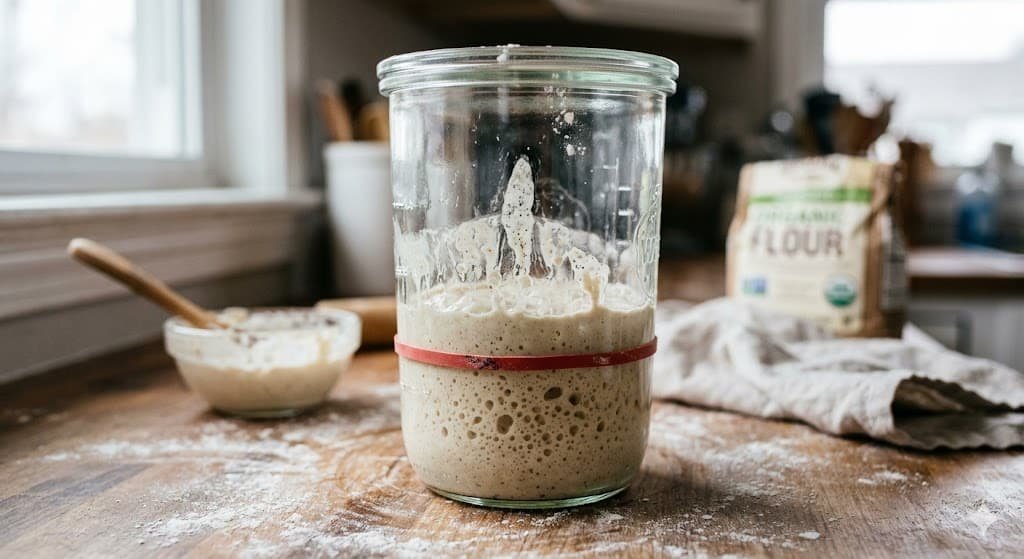
You should start to see consistent bubbles and notice the starter rising after feedings. Mark the level with a rubber band after each feeding — if you see residue above the line the next day, your starter rose and fell. That’s exactly what you want.
If you’re not sure how often to feed, I break it all down in this post on feeding your sourdough starter.
Day 7 — The Float Test
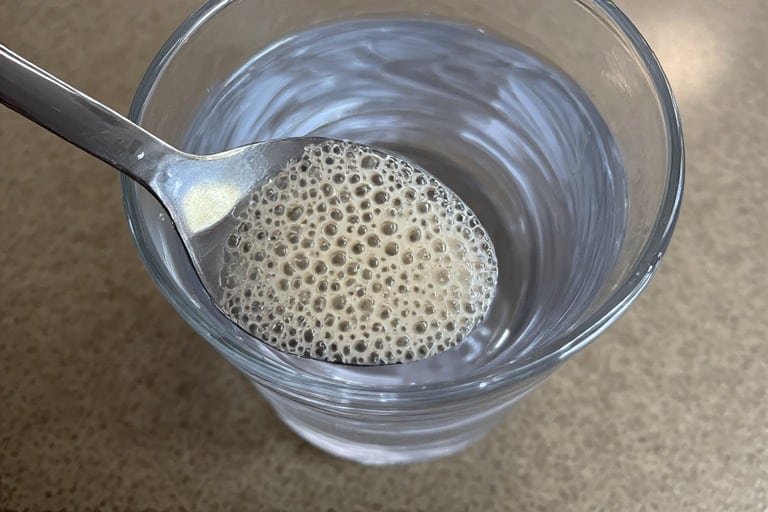
Drop a small spoonful of starter into a glass of water. If it floats, your starter has enough gas production and is likely ready to use. If it sinks, keep feeding for 1–2 more days.
A ready starter will smell pleasantly sour or yeasty (like beer or tangy yogurt), be full of bubbles, and double in size within 4–8 hours of feeding. If it’s not doubling, see: sourdough starter not doubling — troubleshooting guide.
How to Feed Your Sourdough Starter
The basic feeding ratio is 1:1:1 — 1 part starter : 1 part flour : 1 part water by weight. Example: discard down to 50g, then add 50g flour + 50g water. You can also use a 1:2:2 or 1:5:5 ratio for a slower, more controlled rise. See our sourdough starter feeding ratio chart for every option.
Room Temperature vs. Refrigerator
- Baking multiple times a week? Feed daily at room temperature.
- Baking once a week or less? Store in the fridge and feed once a week before baking.
- Always give it 1–2 feedings at room temperature before baking to wake it up.
Full details: how to feed and maintain your sourdough starter.
Troubleshooting: Why Is My Starter Not Working?
Starter Not Rising or Bubbling
The most common culprits: too cold, wrong flour, or inconsistent feeding. See how to keep a sourdough starter warm for easy fixes.
Liquid on Top (Hooch)
A grey or dark liquid on top is called hooch — alcohol produced when your starter is hungry. Stir it in or pour it off, then feed immediately. Learn more: why sourdough discard has liquid hooch.
Starter Not Doubling
Usually fixable with a warmer spot and fresh flour. Full guide: sourdough starter not doubling.
Starter Totally Inactive
Don’t give up — you can usually rescue it. See: sourdough starter not working.
What to Do with Sourdough Discard
Every feeding produces discard — don’t throw it away. Here are some of our most popular recipes:
- Sourdough discard crackers with rosemary and sea salt
- Fluffy sourdough discard pancakes
- Sourdough discard tortillas
- Baker-style sourdough discard muffins
- 1-hour sourdough discard cinnamon rolls
- Sourdough discard pizza dough (no yeast)
- Sourdough discard flatbread (no yeast)
You can also freeze your discard: can you freeze sourdough discard?
Your Starter Is Ready — Now What?
Once your starter passes the float test and doubles consistently, it’s time to bake. Start here:
- How to make sourdough bread — our complete beginner guide
- How to use your sourdough starter
- Sourdough recipe for beginners
You’ll also want to understand bulk fermentation for beginners, how to score sourdough, and how to shape a sourdough boule or batard.
Ready to bake? Here’s exactly how to use your sourdough starter in your first loaf.
Storing and Preserving Your Starter Long-Term
- Taking a short break? Refrigerate and feed once a week.
- Going away longer? Dry your sourdough starter for a shelf-stable backup that lasts years.
- Inherited a dried starter? See how to revive a dried sourdough starter.
Frequently Asked Questions
How long does it take to make a sourdough starter?
Typically 7–10 days for a reliably active starter. Some people see strong activity by Day 5; others need 2 weeks, especially in colder kitchens.
Can I use tap water?
Yes, in most cases. If your water is heavily chlorinated, leave it in an open container overnight before using.
What if I miss a feeding day?
Not a disaster. Discard and feed as soon as you remember, then get back on your schedule. Once mature, starters are very forgiving.
Can I make a sourdough starter without commercial yeast?
Yes — that’s exactly what a sourdough starter is. Wild yeast naturally present in flour and the environment does all the work. Related: sourdough starter without yeast.
My starter is only 72 hours old — can I use it?
Very unlikely to be ready, but we cover the 72-hour sourdough starter approach if you want to explore it.
Final Thoughts
Making a sourdough starter from scratch is one of the most rewarding things you can do in the kitchen. It only takes flour, water, and about 5 minutes a day — the patience is the hardest part.
Stick to the schedule, keep it warm, and trust the process. By Day 7 you’ll have a bubbly, tangy starter ready to leaven real bread.
Ready to bake? Head to our complete sourdough bread guide — and don’t miss our new post on how to use your sourdough starter.